Black phosphorus attracts considerable attention as a potential material for future electronics and photonics, but its instability limits practical applications. Hayden Groeschel, Arjyama Bordoloi, and Sobhit Singh, all from the University of Rochester, investigate how introducing sulfur atoms into black phosphorus alters its fundamental properties, with a focus on a peculiar mechanical behaviour known as auxeticity, the tendency to expand sideways when stretched. Their calculations reveal that sulfur substitution fundamentally changes the material’s structure, suppressing this auxetic behaviour and impacting its mechanical strength and electronic characteristics. This research demonstrates a trade-off between stability and functionality, providing crucial insights for designing nanoscale devices that utilise black phosphorus and offering a pathway to tailor its properties for specific applications.
This research systematically investigates how substituting sulfur atoms into black phosphorus alters its mechanical behaviour, with a particular focus on auxeticity, the unusual property of expanding when stretched. The team demonstrates that increasing the amount of sulfur progressively suppresses this auxetic behaviour, transitioning the material from expanding to contracting under tension, and ultimately achieving uniform mechanical properties. This suppression arises from changes in the way atoms bond and vibrate within the material, directly impacting its response to stress. These findings provide crucial insights for tailoring the mechanical properties of sulfur-doped black phosphorus for specific applications, paving the way for materials with enhanced stability and predictable behaviour.
Sulfur Alters Black Phosphorus Auxeticity and Mechanics
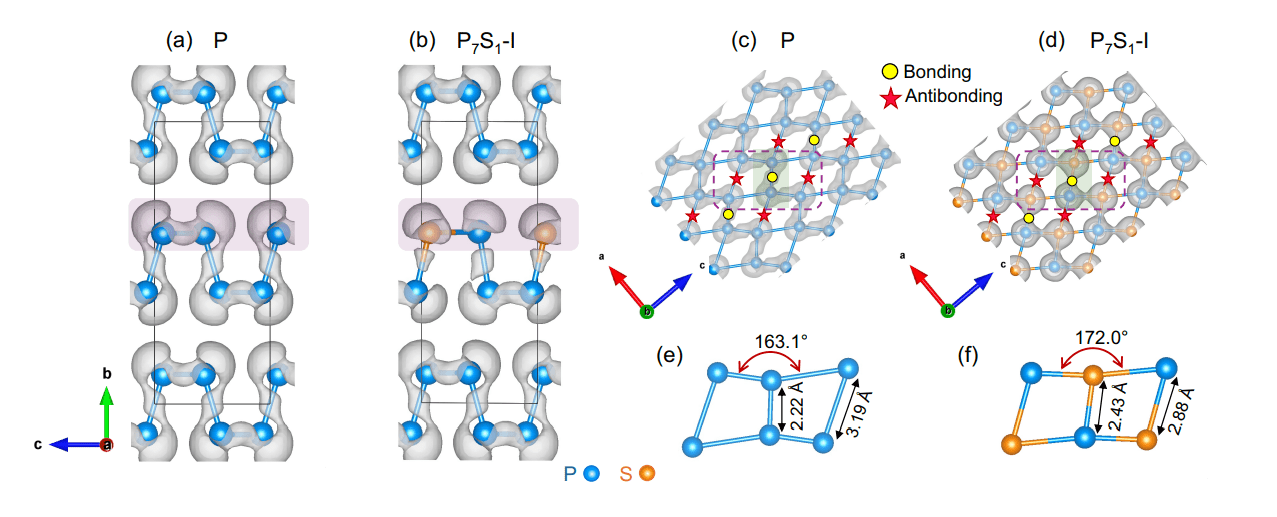
This work presents a detailed investigation into the effects of sulfur substitution on black phosphorus, a two-dimensional material with promising electronic and optoelectronic properties. Researchers systematically explored how incorporating sulfur atoms alters the material’s mechanical and elastic behaviour, revealing a significant suppression of its auxeticity, the unusual property of expanding when stretched. The team discovered that sulfur atoms distort the structural motif responsible for this negative Poisson’s ratio, effectively eliminating both in-plane and out-of-plane auxetic responses. Furthermore, the study demonstrates that increasing sulfur content leads to changes in several key mechanical properties; the material becomes stiffer and its Poisson’s ratio increases, while its Young’s modulus, shear modulus, and thermal properties all decrease. Importantly, the researchers also observed a transition from semiconducting to metallic behaviour as sulfur concentration increases. While sulfur doping is known to enhance the environmental stability of black phosphorus, this research highlights its substantial impact on the material’s fundamental properties, particularly its auxetic behaviour, which is a crucial consideration for designing nanoscale electronic devices.
Sulfur Substitution Distorts Black Phosphorus Structure
This research details computational methods and results supporting studies on sulfur-substituted black phosphorus. The work demonstrates a commitment to scientific rigor through detailed data and explanations. Key findings include significant distortions to the crystal structure of black phosphorus with increasing sulfur concentrations, resulting in unusual elastic properties. At a 50% sulfur substitution, the structure becomes mechanically unstable. Detailed calculations of vibrational velocities and thermal properties show how these change with sulfur substitution, and analysis of electron distribution reveals the bonding characteristics of the sulfur-substituted structures.
Sulfur Substitution Impacts Phosphorene’s Mechanical Properties
Researchers investigated the effects of sulfur substitution on the elastic, mechanical, and electronic properties of β-phosphorene, with a particular focus on its auxetic behaviour. Calculations were performed using a modelling technique that describes the interactions between atoms within the material, accurately accounting for the behaviour of electrons and their interactions with atomic nuclei. The layered structure of β-phosphorene was modelled by creating repeating slabs separated by a vacuum, and the structure was optimised to reach its lowest energy state. The resulting properties, including stiffness, strength, and deformation under stress, were calculated, and the electronic structure was investigated using a method that provides a more accurate description of the material’s energy levels. Analysis of charge distribution revealed the nature of the chemical bonds between sulfur and phosphorus atoms, and calculations assessed the stability of the sulfur-substituted structure, providing a comprehensive understanding of how sulfur substitution affects the structural, mechanical, and electronic properties of β-phosphorene.
👉 More information
🗞 Suppression of auxetic behavior in black phosphorus with sulfur substitution
🧠 ArXiv: https://arxiv.org/abs/2511.02609