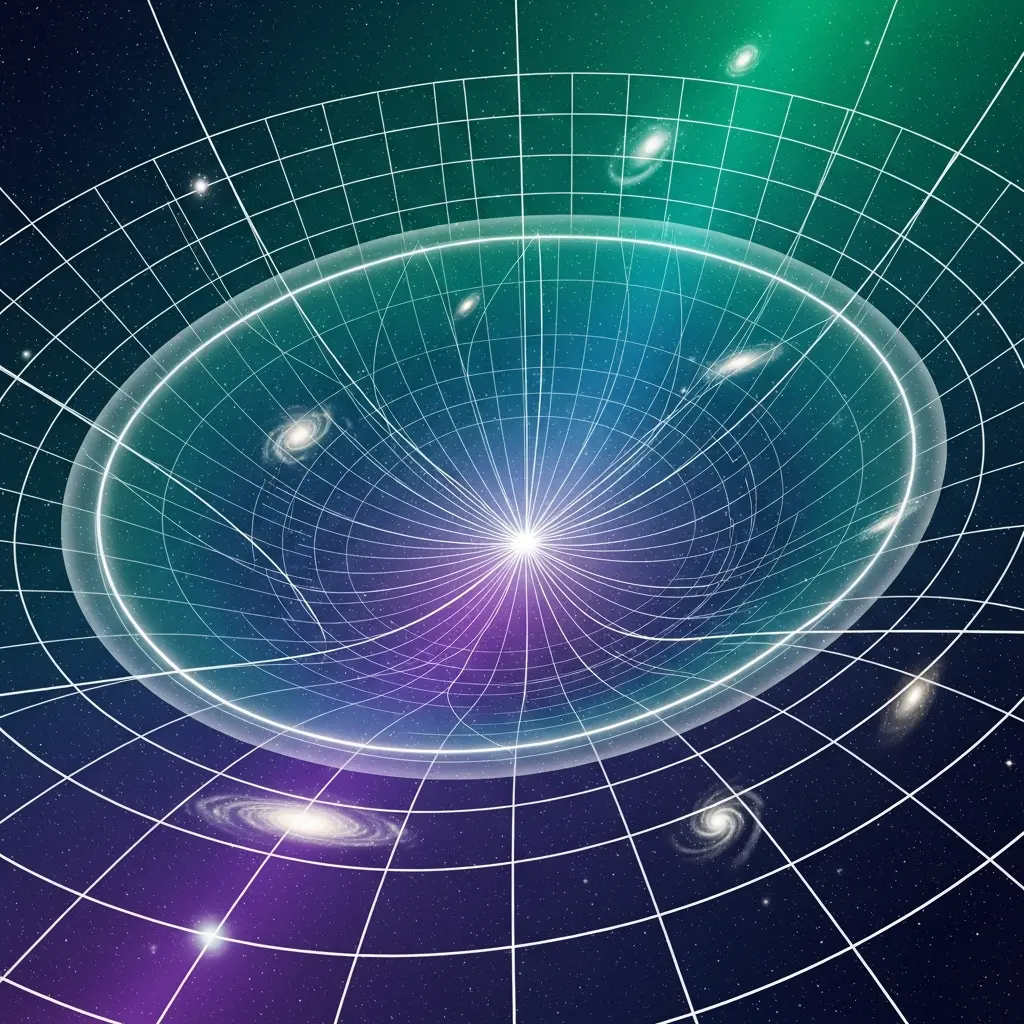
Understanding gravity in the expanding universe presents significant challenges, and recent work by Bin Chen, Jie Xu, and colleagues addresses a fundamental problem in describing observers within de Sitter space. The team develops a new algebraic framework that consistently incorporates the perspectives of multiple observers moving along different paths, a crucial step towards a fully relational theory of gravity. Their approach introduces the concept of a ‘covariant observer’, where the observer’s path itself becomes a dynamic element transforming under the symmetries of de Sitter space, and upon quantization, a fluctuating degree of freedom. This innovative method yields a well-defined measure of entropy and demonstrates a connection between algebraic and generalized entropy for semiclassical states, ultimately extending previous work and paving the way for a complete, covariant description of gravity in expanding universes.
Consistent implementation of the gravitational constraints in de Sitter space requires gauging the full SO(1, d) isometry group. This work develops a framework that enables the gauging of the full de Sitter isometry while consistently incorporating multiple observers on arbitrary geodesics. The team achieves this by introducing the concept of a covariant observer, whose geodesic is a dynamical entity that transforms under the isometry group. Upon quantization, the geodesic becomes a fluctuating degree of freedom, providing a quantum reference frame for SO(1, d). Inspired by the timelike tube theorem, the researchers propose that the algebra of observables is generated by all degrees of freedom within the fluctuating geometry.
Quantum Gravity, Cosmology and Observables
This extensive collection of research focuses on theoretical physics, specifically concerning quantum gravity, holography, cosmology, and the role of observers in quantum mechanics and gravity. The central theme is reconciling quantum mechanics and general relativity, particularly in the context of cosmology and the expanding universe. A significant part of this effort addresses how to define observables and measurements consistently with both theories, and how the choice of observer influences the physics. The references explore holography and AdS/CFT, examining the holographic principle and its implications for gravity, and quantum gravity and cosmology, specifically in de Sitter space, examining quantum fluctuations, the cosmological constant, and the emergence of spacetime.
They also investigate the connection between entanglement, quantum information theory, and gravity, utilizing concepts like entanglement entropy and quantum error correction, and address the role of observers in defining observables and measurements, exploring relational quantum mechanics and the impact of observer choice on spacetime geometry. Black hole physics and the information paradox are interwoven throughout the collection. Several key trends emerge from this body of work. The increasing emphasis on observer dependence suggests a shift in thinking, where the observer is no longer passive but actively shapes the physics.
Quantum information theory is becoming increasingly important in understanding quantum gravity, with concepts like entanglement entropy providing new insights. Cosmology, particularly the study of de Sitter space, is being used as a laboratory for testing theories of quantum gravity. Researchers are also interested in defining the gravitational path integral from the perspective of an observer.
Covariant Observers and Fluctuating Static Patches
This work establishes a complete and covariant framework for describing de Sitter space, extending the construction to accommodate multiple observers on arbitrary geodesics. Scientists developed a method for gauging the full isometry group of de Sitter space by introducing the concept of a “covariant observer”, where the observer’s geodesic itself becomes a dynamic entity transforming under the symmetry group. Upon quantization, this geodesic fluctuates, providing a reference frame for defining observables within a fluctuating static patch, encompassing both field modes and other observers. The team demonstrated that the algebra of these observables is generated by all degrees of freedom within this fluctuating region, establishing its type II character through the construction of a trace and yielding a well-defined von Neumann entropy.
By imposing a UV cutoff in quantum field theory and generalizing the first law of thermodynamics, researchers showed that algebraic and generalized entropies are in complete agreement for semiclassical states. This work generalizes the notion of a local algebra to a “fluctuating region”, representing an average of algebras over all possible static patches and geodesic configurations. Measurements confirm that any timelike geodesic can be uniquely parameterized by a spacelike unit vector, allowing scientists to define a bijection between the isometry group parameters and the transformed reference frame. The team found that under transformations from the Lorentz group, the reference frame transforms according to specific equations, demonstrating that the space of points on timelike geodesics provides a complete reference frame for the SO(1,2) isometry group. Furthermore, the team established criteria for determining causal contact between geodesics, defining conditions under which one observer can access another, based on the inner product of points in the embedding space. These results deliver a complete, covariant, and multi-observer extension of existing constructions, laying the foundation for a fully relational gravitational description of de Sitter space.
Covariant Observers and de Sitter Entropy
This work presents a new framework for consistently describing gravitational constraints within de Sitter space, addressing the challenge of defining local observables when no preferred static patch exists. Researchers successfully gauged the full isometry group of de Sitter space by introducing the concept of a ‘covariant observer’, where the observer’s geodesic itself becomes a fluctuating dynamical entity. This approach allows for the incorporation of multiple observers situated on arbitrary geodesics, effectively averaging over all possible static patches and configurations. The team demonstrated that the resulting algebra of observables is of type II, possessing a well-defined trace and enabling the calculation of von Neumann entropy.
For semiclassical states, they established a correspondence between this algebraic entropy and a generalized entropy, achieved by imposing a UV cutoff and proposing a quantum first law for the cosmological horizon. This achievement extends the established methods from anti-de Sitter space to de Sitter space, overcoming the difficulty of defining a local algebra without an asymptotic boundary. Future research directions include exploring the implications of this fluctuating region algebra for a fully relational description of gravity and investigating its potential connections to other approaches to quantum gravity. This work lays the foundation for a more complete and covariant understanding of de Sitter space, offering a novel approach to defining observables and entropy in a dynamically evolving gravitational background.
🗞 An algebra for covariant observers in de Sitter space
🧠 ArXiv: https://arxiv.org/abs/2511.00622



See today’s quantum computing news on Quantum Zeitgeist for the latest breakthroughs in qubits, hardware, algorithms, and industry deals.