Quantum key distribution promises secure communication, but its practical implementation faces challenges from imperfect devices and noisy channels. Mariia Gumberidze and Vladyslav C. Usenko, from Palacký University, Olomouc, investigate the crucial link between the non-classical nature of light and the security of entanglement-based quantum key distribution protocols. Their work explores how deviations from ideal quantum behaviour, known as non-Gaussianity, impact the ability to generate a secure encryption key, even when detectors are flawed and channels introduce noise. The team demonstrates that assessing the non-Gaussianity of a quantum channel provides a valuable pre-implementation check, offering insights into its suitability for secure communication and potentially streamlining the development of robust quantum networks.
Perfect detection remains a challenge due to dark counts and limited efficiency. This research investigates the connection between quantum non-Gaussianity and the security of quantum key distribution (QKD), asking whether a measure of how non-classical a quantum state is can serve as a pre-check to determine if a communication channel is suitable for secure QKD. The goal is to find a practical way to assess channel quality before attempting a full QKD protocol, potentially saving resources and ensuring security.
Non-Gaussianity as a QKD Security Pre-Check
This research establishes a clear relationship between quantum non-Gaussianity and the security of quantum key distribution (QKD) protocols, specifically device-independent and entanglement-based BB84. Quantum non-Gaussianity refers to quantum states that don’t follow the typical Gaussian probability distributions seen in classical light, and these states are crucial for enhancing the security of certain advanced QKD protocols. By analysing depolarising channels with both thermal and Poissonian noise, and considering realistic detector imperfections such as limited efficiency and dark counts, scientists demonstrate the existence of overlapping regions where both non-Gaussianity is present and secure key rates are achievable. This finding suggests that assessing non-Gaussianity can serve as a practical preliminary check for evaluating the suitability of a communication channel for QKD implementation. The research consistently found a positive correlation between non-Gaussianity and QKD security, robust to realistic detector imperfections. This work builds upon previous studies of prepare-and-measure protocols and extends the understanding of entanglement-based QKD, providing a valuable tool for optimising QKD systems and assessing channel quality.
Non-Gaussian Light Secures Quantum Key Distribution
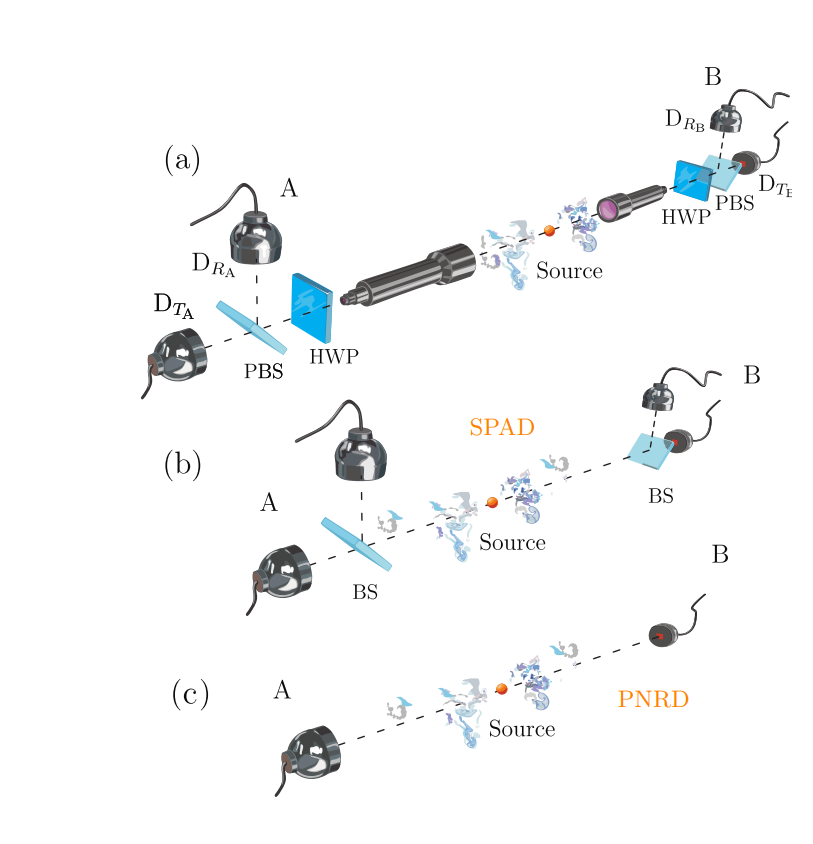
Researchers theoretically analysed device-independent (DI) QKD and entanglement-based BB84 protocols, extending previous studies of prepare-and-measure schemes. They modelled a system utilising Bell state sources, accounting for depolarisation in the communication channel and both thermal and Poissonian noise statistics. They developed criteria to assess non-Gaussianity tailored to each detector type, SPAD and PNRD, and then correlated these measurements with the security of the QKD protocols. Results demonstrate the existence of overlapping regions where both security and non-Gaussianity are present, indicating a potential method for pre-assessing the suitability of a given channel for secure key distribution.
Specifically, for SPAD detectors, the researchers established a non-Gaussianity criterion based on the probability of successful coincidences, requiring this probability to exceed a certain threshold. For PNRD detectors, the criterion simplifies to requiring the coincidence probability to be greater than the error probability. These criteria allow for the determination of whether a channel exhibits sufficient non-Gaussianity to support secure QKD. The study provides a valuable tool for evaluating channel quality before implementing QKD protocols, potentially streamlining the development and deployment of secure communication systems.
Non-Gaussianity Indicates Secure Quantum Key Distribution
This research establishes a clear relationship between quantum non-Gaussianity and the security of quantum key distribution (QKD) protocols, specifically device-independent and entanglement-based BB84. By analysing depolarising channels with both thermal and Poissonian noise, and considering realistic detector imperfections such as limited efficiency and dark counts, scientists demonstrate the existence of overlapping regions where both non-Gaussianity is present and secure key rates are achievable. This finding suggests that assessing non-Gaussianity can serve as a practical preliminary check for evaluating the suitability of a communication channel for QKD implementation. The analyses consistently reveal that non-Gaussianity functions as a reliable indicator within a specific operational transmittance window, allowing for a pre-check of channel suitability. However, the researchers acknowledge that at high noise levels, this overlap diminishes, establishing a natural boundary for the effectiveness of this diagnostic tool. The methodology developed extends beyond the specific correlations examined, offering adaptability to diverse experimental setups and measurement configurations.
🗞 Non-Gaussianity and security of entanglement-based QKD
🧠 ArXiv: https://arxiv.org/abs/2511.01761
See today’s quantum computing news on Quantum Zeitgeist for the latest breakthroughs in qubits, hardware, algorithms, and industry deals.