The fundamental concept of the Unruh effect predicts that acceleration causes empty space to appear filled with particles, yet directly observing this phenomenon demands accelerations far beyond our current capabilities. Researchers, led by Zhenghao Luo, Yi Li, and Xingyu Zhao, have now demonstrated a related effect, known as the timelike Unruh effect, which generates a similar thermal response without requiring acceleration. The team achieves this by utilising a system of trapped ions, where a two-level spin acts as a detector coupled to the ion’s vibrational motion, and studying how the detector responds to the vacuum as it follows a specific path through spacetime. This work establishes a controllable laboratory setup for investigating relativistic physics, opening new avenues for exploring the quantum nature of empty space and validating theoretical predictions about the behaviour of observers in relative motion.
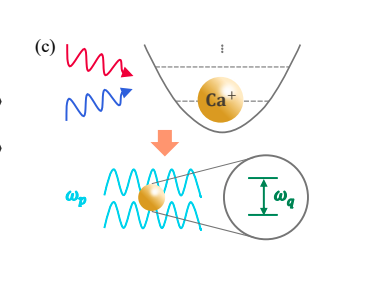
This approach uses a controllable quantum system to mimic complex physical phenomena, connecting quantum information theory with cosmology and the search for experimental tests of fundamental physics. The work addresses the challenges of directly observing the Unruh effect by focusing on robust analog simulations to explore its implications. A significant portion of the research focuses on theoretically describing the detector used in the simulation, which isn’t a traditional physical detector but rather the interaction between a trapped ion, acting as an accelerating observer, and the quantized modes of an electromagnetic field.
The team carefully considered various detector models and the importance of accurately defining the detector’s properties. The theoretical treatment involves constructing the adiabatic vacuum state and emphasizes the role of entanglement between different modes of the quantum field in the Unruh effect. The experimental setup centers on a system of trapped ions, with the ions coupled to an electromagnetic field representing the quantized modes of the vacuum. Researchers precisely control the ions’ motion and measure their interactions with the field, carefully setting experimental parameters to accurately simulate the Unruh effect. Numerical simulations are then performed to model the system’s evolution, validating the simulation results and calibrating the experimental parameters. The team addresses challenges like decoherence and noise, employing strategies to minimize their impact and ensure reliable results.
Timelike Unruh Effect Demonstrated with Trapped Ions
Scientists have successfully demonstrated the timelike Unruh effect using a system of trapped ions, establishing a controllable laboratory platform for exploring relativistic physics without requiring extreme acceleration. The team engineered a two-level spin within an ion to act as a detector, coupling it to the ion’s vibrational motion to represent a quantum field. By carefully controlling the interaction between the detector and the field, they observed a thermal response closely resembling the Unruh effect. The results show clear agreement with theoretical predictions of timelike Unruh radiation, confirming the detector’s thermalization with the quantum field vacuum. Specifically, the team measured the transition probabilities between energy levels of the detector, observing that it behaves as if immersed in a thermal bath, even though it exists in a vacuum. The measurements of excitation and emission processes yielded quantitative results, demonstrating that the final transition probability for both excitation and emission are dependent on the coupling strength, field frequency, and detector energy spacing.
Trapped Ions Demonstrate Timelike Unruh Effect
This research demonstrates the first experimental realization of the timelike Unruh effect, a prediction of quantum field theory, using a trapped-ion system. Scientists successfully constructed a controllable setup where a two-level detector, represented by an ion’s spin, interacts with a quantum field, simulating the experience of an accelerating observer perceiving the vacuum as a thermal bath. By carefully controlling the detector’s motion and its interaction with the field, the team observed a thermal response closely matching theoretical predictions for the Unruh effect, confirming the predicted relationship between the detector’s excitation and emission probabilities. This achievement establishes a novel methodology for exploring relativistic quantum field theory in a laboratory setting, offering a pathway to investigate phenomena typically associated with extreme accelerations or gravitational fields.
The researchers verified that the observed thermal characteristics align with Bose-Einstein statistics and the expected Unruh temperature, providing strong evidence for the thermal nature of Hawking radiation in gravitational fields. The use of phonon fields within the trapped-ion system circumvents the need for extremely fast control mechanisms, simplifying the experimental realization of these effects. The authors acknowledge that their current demonstration utilizes a single-mode field, and future work will focus on extending the experiment to multi-mode fields to explore more complex spectral structures. They also note that the approximations used in their calculations assume low transition probabilities, a condition that will be carefully considered in future investigations. This work establishes a promising platform for studying a wider range of quantum field theory phenomena and opens new avenues for exploring the fundamental connection between quantum mechanics and relativity.
🗞 Experimental Demonstration of the Timelike Unruh Effect with a Trapped-Ion System
🧠 ArXiv: https://arxiv.org/abs/2510.24163




See today’s quantum computing news on Quantum Zeitgeist for the latest breakthroughs in qubits, hardware, algorithms, and industry deals.