The behaviour of quantum vortices, tiny whirlpools within superfluids, presents a fascinating challenge to physicists, and recent work by Alice Bellettini, Enrico Ortu, and Vittorio Penna from Politecnico di Torino, alongside colleagues, sheds new light on how these structures interact with obstacles. The team investigates the scattering of massive vortex-dipole pairs, which arise in mixtures of Bose-Einstein condensates, and demonstrates how their movement is governed by strong nonlinear effects. Through a combination of theoretical modelling and numerical simulations, they identify two distinct scattering behaviours, a direct ‘fly-by’ and a curved ‘go-around’, and establish a clear analytical distinction between them. This research not only clarifies the fundamental dynamics of quantum vortices, but also reveals surprising insights into how interactions with obstacles can lead to unexpectedly simple, massless behaviour under certain conditions.
Bose-Einstein Condensates and Superfluid Vortices
This body of work comprehensively explores Bose-Einstein Condensates (BECs), superfluidity, and the dynamics of vortices within these quantum fluids. The research spans decades, from foundational theoretical work to current investigations, demonstrating a continuously evolving field. Scientists have built upon established principles of quantum mechanics, statistical mechanics, and fluid dynamics to understand these complex systems, bridging theoretical models with experimental observations. The research incorporates both analytical calculations and numerical simulations, highlighting the importance of computational methods in modern quantum fluid research.
Key areas of investigation include the Gross-Pitaevskii equation, which forms the cornerstone of BEC theory, and the behaviour of quantized vortices. Researchers have studied vortex dynamics, turbulence, and the formation of vortex structures in superfluid systems. Current research focuses on specific scenarios, such as scattering from obstacles and the behaviour of vortex pairs, indicating a move towards more specialized and detailed investigations.
Vortex Dipole Scattering in Bose-Einstein Condensates
Scientists investigated how vortex dipoles scatter when encountering obstacles in Bose-Einstein condensates. They developed a point-like model, derived from the physics of binary mixtures, to analyze these interactions. This model predicts two distinct scattering behaviours: ‘fly-by’, where the dipole is deflected around the obstacle, and ‘go-around’, where a vortex is temporarily captured before recombining with its partner. Researchers quantified these behaviours by plotting the deflection angle against the impact parameter, establishing a clear link between initial conditions and resulting trajectories.
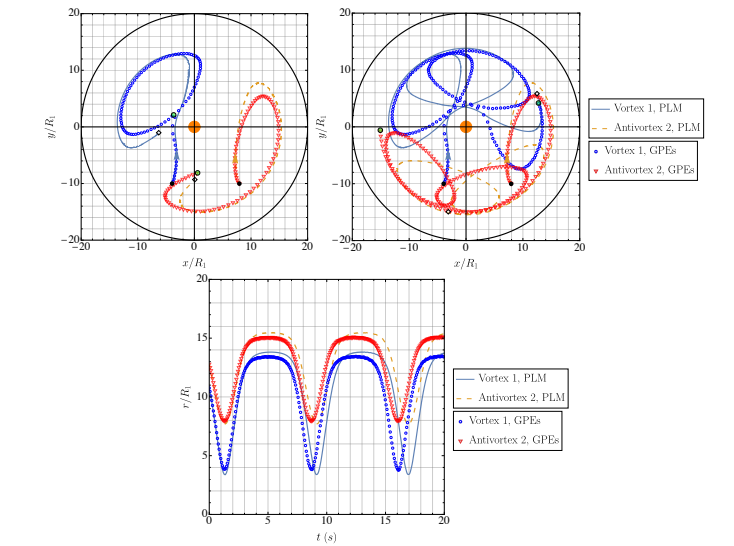
Extending the model to a confined, annular geometry revealed a new dipole splitting mechanism. The boundary captures vortices, creating virtual counterparts and forming new dipoles traveling along the boundary. The accuracy of the point-like model was validated through comparison with numerical simulations of the mean-field Gross-Pitaevskii equations, revealing nearly periodic separations, recombinations, and scattering from central obstacles.
Vortex Dipole Scattering Reveals Fly-By and Go-Around
Scientists have achieved a detailed understanding of how vortex dipoles scatter when interacting with obstacles in quantum fluids. They identified two distinct scattering behaviours, termed ‘fly-by’ and ‘go-around’, depending on how the dipole interacts with the obstacle. Researchers quantified these behaviours by plotting the deflection angle of the dipole against the impact parameter, establishing a clear link between initial conditions and resulting trajectories. The team developed a point-like model, derived from the underlying physics of binary mixtures, to predict these scattering events. This model accurately captures the complex dynamics of the vortex dipoles, revealing that the dipole either deflects around the obstacle or splits, with one vortex circling the obstacle before recombining with its partner. Perturbative analysis confirmed the robustness of the dipole structure, demonstrating the existence of massless-like regimes far from the obstacle. Experiments conducted within a confined, annular geometry revealed a new splitting mechanism, where the vortex and antivortex are captured by virtual counterparts, creating new dipoles traveling along the boundary.
Massive Vortex Dipole Scattering Dynamics Explained
This research details a comprehensive investigation into the scattering mechanisms of massive vortex dipoles in two-dimensional quantum systems when encountering an obstacle. Scientists identified two fundamental scattering behaviours, ‘fly-by’ and ‘go-around’, using a point-like model and validating these predictions through numerical simulations of coupled Gross-Pitaevskii equations. The ‘fly-by’ behaviour involves a deviation of the dipole’s trajectory without disruption of its structure, while ‘go-around’ involves temporary capture of a vortex by the obstacle, leading to dipole disruption and subsequent recombination with a deviated trajectory. Further analysis reveals that the dynamics of massive dipoles converge to those of massless dipoles at sufficient distances from the obstacle, suggesting a degree of universality in the scattering process. However, the influence of vortex mass becomes apparent in subtle deviations of the dipole’s trajectory. This work advances understanding of quantum vortex dynamics and provides a foundation for investigating similar phenomena in other condensed matter systems.
🗞 Scattering of a massive quantum vortex-dipole from an obstacle
🧠 ArXiv: https://arxiv.org/abs/2510.23545
See today’s quantum computing news on Quantum Zeitgeist for the latest breakthroughs in qubits, hardware, algorithms, and industry deals.