Radiotherapy planning demands precise imaging, yet current systems require patients to lie supine, potentially misrepresenting the tumour and surrounding tissues when treatment is delivered upright, a common position for many cancers. Jordan M. Slagowski, Yuhao Yan, and Jessica R. Miller, from the University of Wisconsin, Madison, along with colleagues including John W. Hayes and Carson A. Hoffman, have rigorously assessed a novel vertical computed tomography (CT) system designed to address this challenge. Their work demonstrates that this upright CT scanner achieves acceptable image quality and dose calculation accuracy for both photon and proton radiotherapy, offering the potential to improve treatment precision by accurately representing patient anatomy in the natural, upright position. The team’s comprehensive evaluation confirms the system’s viability for clinical implementation and signifies a step forward in personalised radiation oncology.
Improved patient comfort and more cost-effective proton therapy represent significant goals, achievable by replacing large rotating gantries with a fixed beamline and rotating patient positioner. However, clinical adoption has remained limited due to the lack of available vertical CT systems needed to support both treatment planning and image guidance. This work presents the first technical characterization of image quality, imaging dose, and dose calculation accuracy for a novel upright CT imaging system designed specifically for radiotherapy applications. Traditional CT scans are performed with patients lying down, which can be affected by gravity and lead to variations in organ positioning compared to their natural state. The research demonstrates that upright CT provides comparable image quality to conventional supine CT, making it a viable option for radiotherapy planning. The study highlights how gravity affects organ positioning, particularly in the head, neck, and abdomen.
Upright CT aims to minimize these gravitational effects, leading to a more realistic representation of the patient’s anatomy during treatment. This could lead to more accurate target delineation, better visualization of tumors and surrounding tissues, and improved treatment planning with more precise dose calculations and delivery, potentially reducing side effects and improving efficacy. The authors suggest that upright CT could enable personalized radiotherapy, tailoring treatment plans to the individual patient’s anatomy in a more natural posture. Researchers used phantoms to evaluate image quality and accuracy, and also conducted studies with real patients to assess the feasibility and potential benefits of upright CT.
They compared images obtained from upright and supine
They compared images obtained from upright and supine CT scans to assess differences in organ positioning and image quality, and performed dose calculations based on images from both positions to evaluate the impact on treatment planning. The study utilized a specialized CT scanner designed for upright imaging, standard radiotherapy planning software, and image analysis tools. This research suggests that upright CT has the potential to improve the accuracy and effectiveness of radiotherapy by providing a more realistic representation of the patient’s anatomy. Researchers meticulously characterized the system’s performance, focusing on image quality and dose accuracy essential for precise treatment planning. Measurements of imaging dose revealed values comparable to conventional scanners. Image quality assessments, conducted using a standard phantom, demonstrated that mean CT numbers fell within expected ranges for various materials. Image uniformity was acceptable for both small and large diameter phantoms, and high-contrast resolution was excellent.
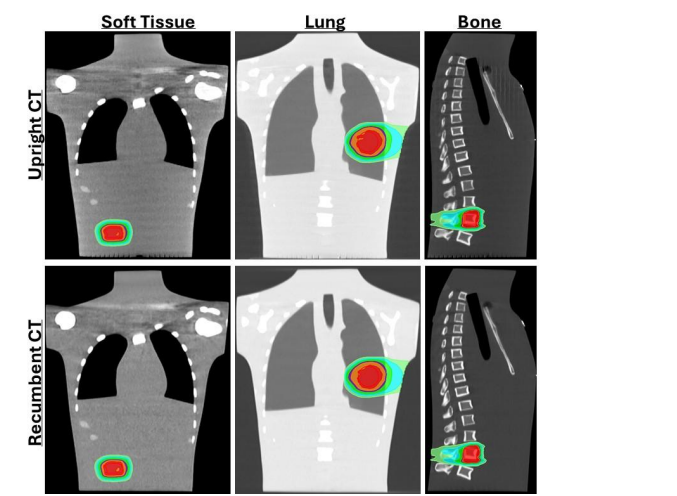
Low-contrast performance yielded a value slightly below a tolerance level. Furthermore, researchers established a strong linear relationship between CT numbers from the upright scanner and a reference scanner. The team measured imaging dose and assessed image quality using established phantoms and metrics, finding that CT dose indices were comparable to conventional scanners. Evaluations of CT numbers, image uniformity, high-contrast resolution, and low-contrast detectability all indicated acceptable performance for radiotherapy planning. Furthermore, the study validated the accuracy of dose calculations derived from upright CT scans by comparing them to those from conventional scans, achieving high gamma pass rates for both photon and proton treatment plans.
Discrepancies in dose calculations were observed in low-density
Discrepancies in dose calculations were observed in low-density lung regions for proton plans, an area the researchers acknowledge requires further investigation. The team notes that spatial integrity was maintained within acceptable limits, confirming the precision of the positioning system. These findings suggest that upright CT imaging, combined with this advanced positioning technology, offers a viable alternative to conventional CT for radiotherapy simulation and treatment planning, potentially enabling anatomical and economic benefits for both patients and treatment facilities.
🗞 Technical assessment of a novel vertical CT system for upright radiotherapy simulation and treatment planning
🧠 ArXiv: https://arxiv.org/abs/2510.21990