

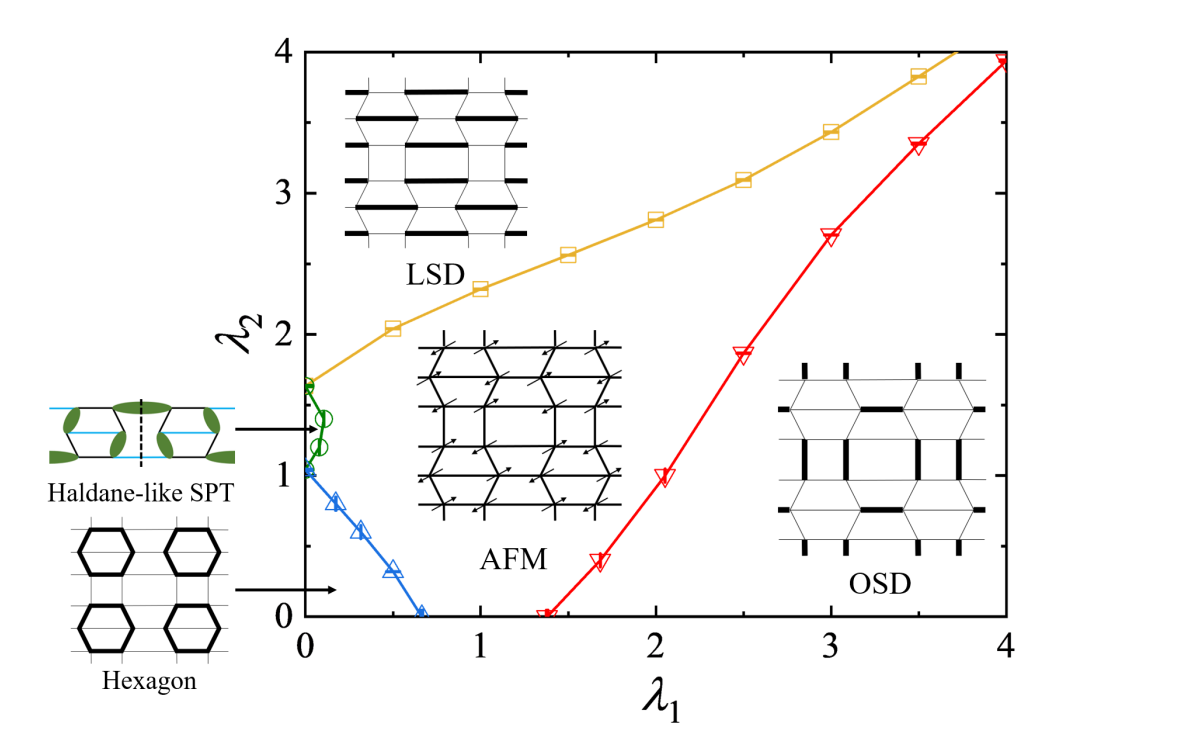
Understanding magnetism in complex two-dimensional materials presents a significant challenge in condensed matter physics, and recent research from Yumeng Luo, Yuehong Li, and Mengfan Jiang, along with colleagues at Sun Yat-sen University, sheds new light on this area. The team investigates the behaviour of the Heisenberg model on a unique square-hexagon-octagon lattice, a structure that allows for a rich variety of magnetic phases. Their calculations reveal a complex ground-state phase diagram containing five distinct phases, including antiferromagnetic, topologically protected, and dimerized states, establishing a framework for understanding magnetism on this lattice. Importantly, the researchers demonstrate that transitions between these phases exhibit behaviour consistent with established theoretical models, furthering our understanding of quantum magnetism in two dimensions.
Scientists employed advanced computational techniques, including Quantum Monte Carlo and Density Matrix Renormalization Group, to explore the ground state properties and phase transitions of these systems, focusing on identifying topological phases and dimerized phases. This work builds upon established concepts in condensed matter physics, such as Haldane phases and symmetry-protected topological order. The study centers on the unique square-hexagon-octagon lattice structure, which introduces unusual interactions and frustration, potentially leading to exotic quantum phases.
Researchers investigated quantum phase transitions and specifically sought symmetry-protected topological phases, characterized by robust edge states and non-local entanglement. The research relies on sophisticated computational methods to simulate quantum systems and analyze critical phenomena. Scientists used Quantum Monte Carlo to study ground state properties and estimate critical parameters, optimizing simulations for efficiency. They also employed Density Matrix Renormalization Group, effective for one-dimensional and quasi-one-dimensional systems, to calculate entanglement entropy and reveal topological order.
Finite-size scaling allowed analysis of the system’s behavior as the lattice size increased, determining critical exponents and identifying the universality class of the phase transition. The results suggest the square-hexagon-octagon lattice supports a rich variety of quantum phases, including potential topological phases and dimerized phases. Researchers have characterized the phase diagrams of the system, providing insights into the interplay between different ordering tendencies in frustrated spin systems. This research contributes to our fundamental understanding of quantum phases of matter and the behavior of frustrated spin systems, potentially guiding the design of new materials with exotic properties and demonstrating the power of advanced computational techniques.
Ground State Phases on SHO Lattices
Scientists investigated the magnetic properties of the Heisenberg model on the two-dimensional square-hexagon-octagon (SHO) lattice using a combination of stochastic series expansion Quantum Monte Carlo and Density Matrix Renormalization Group techniques. The study focused on a spin-1/2 model, incorporating two types of nearest-neighbor interactions, enriching the phase diagram and enhancing topological equivalence to the square lattice. The Stochastic Series Expansion Quantum Monte Carlo method mapped out the ground-state phase diagram across a range of interaction strengths, while the Density Matrix Renormalization Group technique refined the understanding of the system’s behavior and accurately determined phase boundaries. Through these combined methods, researchers identified five distinct phases: a Néel antiferromagnetic phase, a hexagon phase, two dimer phases, and a Haldane-like symmetry-protected topological phase. They thoroughly investigated the topological nature of the Haldane-like phase by examining the degeneracy of the ground-state energy under open boundary conditions and analyzing the entanglement spectrum. To precisely characterize the phase boundaries, scientists calculated the spin stiffness and employed Binder cumulant analysis with comprehensive finite-size scaling.
SHO Lattice Reveals Diverse Magnetic Phases
Scientists have mapped the ground-state phase diagram of the Heisenberg model on a two-dimensional square-hexagon-octagon (SHO) lattice, revealing a rich landscape of magnetic phases and establishing a framework for understanding magnetism on this complex lattice structure. They identified five distinct phases within specific parameter regimes, including a Néel antiferromagnetic phase, a Haldane-like symmetry protected topological phase, a hexagon phase, and two dimer phases. The team employed stochastic series expansion Monte Carlo methods and Density Matrix Renormalization Group techniques to achieve these results, characterizing the topological nature of the Haldane-like phase by examining the degeneracy of ground-state energy under open boundary conditions and analyzing the entanglement spectrum. To precisely define the boundaries between these phases, researchers utilized spin stiffness and Binder cumulant analysis, performing comprehensive finite-size scaling to extrapolate data to the thermodynamic limit. Data collapse confirmed that the nonmagnetic phases transition to the antiferromagnetic phase in a manner consistent with the three-dimensional O(3) Heisenberg universality class. Further investigation of a model with varying interactions between hexagons revealed three phases: the hexagon phase, the Néel antiferromagnetic phase, and an orthogonal staggered dimer phase.
SHO Lattice Reveals Five Magnetic Phases
This research presents a detailed investigation of the ground-state properties and critical behavior of the Heisenberg model on the square-hexagon-octagon (SHO) lattice, a complex two-dimensional magnetic system. By combining stochastic series expansion Monte Carlo and Density Matrix Renormalization Group methods, scientists have constructed a comprehensive phase diagram revealing five distinct phases: a Néel antiferromagnetic phase, a hexagon phase, two dimer phases, and a Haldane-like symmetry-protected topological phase. Detailed analysis, including examination of ground-state energy degeneracy and entanglement spectrum, confirms the unique topological characteristics of the Haldane-like phase. The team’s finite-size scaling analysis further establishes that phase transitions between the non-magnetic phases and the antiferromagnetic phase exhibit critical behavior consistent with the three-dimensional O(3) universality class. This finding provides valuable insight into the nature of magnetic ordering on this lattice structure. While acknowledging the current limitations in synthesizing materials with a precise SHO lattice structure, the researchers suggest their numerical results will serve as a crucial benchmark for future experimental verification.
🗞 Ground-state phase diagram of S = 1/2 Heisenberg model on 2D square-hexagon-octagon lattice
🧠 ArXiv: https://arxiv.org/abs/2510.23376




See today’s quantum computing news on Quantum Zeitgeist for the latest breakthroughs in qubits, hardware, algorithms, and industry deals.



