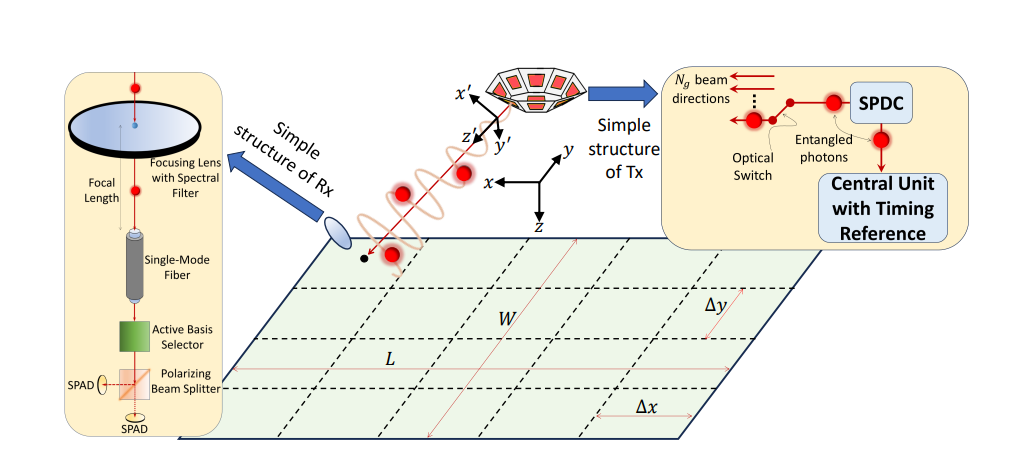
Precise synchronisation represents a significant challenge for future wireless networks, particularly as applications demand increasingly tight coordination between devices, and researchers are now exploring quantum solutions to overcome these limitations. Hossein Safi from the University of Cambridge, Mohammad Taghi Dabiri from Hamad Bin Khalifa University, and Mazen Hasna from Qatar University, alongside their colleagues, demonstrate a novel method for achieving picosecond-level synchronisation in indoor environments using entangled photons. Their system employs a grid-based approach to direct photon pairs from a central transmitter to user devices, enabling robust and accurate timing even with sparse and random photon detection. This breakthrough achieves sub-10 picosecond timing accuracy within a single millisecond, paving the way for advanced wireless systems capable of seamlessly integrating communication, sensing, and precise positioning technologies.
Entangled Photons Enable Precise Time Synchronization
Scientists are pioneering a new approach to precise time synchronization, leveraging the unique properties of entangled photons in free-space optical communication systems. This quantum-based method aims to surpass the limitations of traditional techniques, offering potentially higher accuracy for applications demanding extremely precise timing, such as distributed sensor networks and high-frequency trading. The research combines principles of quantum optics, free-space communication, and advanced signal processing to achieve this goal. The core concept involves using entangled photon pairs, where the state of one photon is intrinsically linked to its partner.
By generating these pairs and transmitting them between locations, scientists can establish a precise time reference. The system relies on generating entangled photons through spontaneous parametric down-conversion, where a laser beam interacts with a special crystal to create correlated photon pairs. These photons are then transmitted through the air using optical links, requiring highly sensitive single-photon detectors to capture the individual photons. The system consists of an entangled photon source, optical transmitters and receivers, and sophisticated timing electronics. Data acquisition and processing systems record photon arrival times and extract the synchronization signal. Achieving high accuracy requires overcoming challenges posed by atmospheric turbulence, photon loss, detector noise, and maintaining entanglement during transmission. Researchers are actively developing mitigation strategies to address these issues, potentially enabling applications including distributed sensor networks, high-frequency trading, quantum key distribution, and future quantum networks.
Entangled Photons Enable Precise Indoor Synchronization
Scientists have engineered a novel indoor optical wireless system for high-precision synchronization, utilizing entangled photon pairs and a grid-based beam steering approach. A central transmitter generates time-energy correlated photon pairs, directing signal photons towards spatially defined grids based on estimated user positions while retaining reference photons for precise timestamping. The room is systematically partitioned into multiple beam-aligned regions, and photon reception probability within each grid is analytically modeled using local coordinate transformations and Gaussian beam optics. To address sparse and random photon detection, the team developed a robust two-stage synchronization algorithm.
This algorithm initially performs sparse bit-pattern matching to coarsely align potential synchronization slots, followed by timestamp averaging to refine the timing offset estimation with picosecond precision. They carefully accounted for both source and detector timing jitter to minimize synchronization errors, meticulously modeling the Poisson statistics of photon pair generation and Gaussian beam propagation. Extensive Monte Carlo simulations were performed to evaluate the system’s performance under realistic conditions, varying synchronization duration, grid resolution, and photon-pair generation rate. Results demonstrate that finer grid configurations and optimized photon-pair rates significantly reduce synchronization error, achieving sub-10ps timing accuracy within 1ms of synchronization time. This work paves the way for scalable, high-precision synchronization in dynamic indoor environments, laying the groundwork for future joint communication, sensing, and positioning systems.
Sub-10ps Synchronization with Entangled Photons
Scientists have developed a novel synchronization framework for indoor optical wireless systems, achieving sub-10ps timing accuracy within 1ms of synchronization time. The work centers on a grid-based beam steering approach, utilizing time-energy entangled photon pairs emitted from a spontaneous parametric down-conversion source. User photons are directed towards spatially defined grids based on estimated user positions, while reference photons are retained for precise timestamping, enabling scalable, high-precision synchronization. The team analytically modeled photon reception probability using local coordinate transformations and Gaussian beam optics to accurately predict signal arrival.
To address the inherent sparsity and randomness of photon detection, they developed a robust two-stage synchronization algorithm that combines sparse bit-pattern matching with timestamp averaging, effectively estimating timing offsets even with limited signal strength. Monte Carlo simulations were then performed to rigorously evaluate the impact of synchronization duration, grid resolution, and photon-pair generation rate on overall synchronization accuracy. Results demonstrate that finer grid configurations and optimized photon-pair rates significantly reduce synchronization error, consistently achieving sub-10ps timing accuracy within 1ms. This level of precision is critical for applications requiring extremely narrow coincidence windows, such as quantum key distribution and entanglement swapping. The breakthrough delivers a scalable solution for high-precision quantum synchronization in dynamic indoor environments, laying the groundwork for future joint quantum communication, sensing, and positioning systems.
Entangled Photons Enable Precise Indoor Synchronization
This research presents a novel framework for synchronising indoor optical wireless systems using entangled photons and grid-based beam steering. The team successfully demonstrated a method where a central transmitter directs time-energy entangled photons towards spatially defined grids, aligning beams with estimated user positions to maximise photon reception. By applying a beam-local coordinate transformation, they analytically modeled photon reception probability, a crucial element for reliable synchronisation, and developed a robust two-stage algorithm to overcome the challenges posed by sparse and random photon arrivals. Simulation results confirm the effectiveness of this approach under practical conditions, achieving sub-100ps mean error within one millisecond.
The study highlights the importance of grid resolution and photon-pair generation rate, identifying an optimal balance between sufficient photon events and minimising invalid multiphoton occurrences. While acknowledging limitations related to photon budgets and noisy channel conditions, the team demonstrated significant improvements in timing accuracy through increased synchronisation duration and finer grid configurations. Future work will focus on extending the system to multi-transmitter environments to broaden spatial coverage and support user mobility. A promising avenue for further research involves integrating this synchronisation technique with quantum communication, sensing, and positioning, potentially enabling sub-centimeter positioning and sub-picosecond synchronisation accuracy, surpassing the capabilities of conventional classical techniques and paving the way for advanced quantum-enabled indoor wireless infrastructures.
🗞 Picosecond Wireless Synchronization with Entangled Photons via Grid-Based Quantum Coverage in Indoor Optical Systems
🧠 ArXiv: https://arxiv.org/abs/2510.20885