Flat electronic bands represent a promising pathway towards realising exotic states of matter, but current approaches often struggle to simultaneously achieve robustness, tunability and control over which electron orbitals participate. Now, Xiangyu Luo from the Massachusetts Institute of Technology, Ludovica Zullo from Universität Würzburg, Sahaj Patel from the Massachusetts Institute of Technology, and colleagues demonstrate a naturally occurring mechanism for creating remarkably stable and controllable flat bands within transition-metal oxychlorides. The team directly observed these bands in materials including NbOCl2 and TaOCl2, using a combination of experimental techniques and theoretical modelling, and found they persist even in extremely thin samples at room temperature. This discovery establishes these materials as a robust platform for exploring correlated electron phenomena and reveals a new design principle for engineering flat bands with specific orbital characteristics.
Flat electronic bands, which amplify electron correlations by reducing electron mobility, provide an ideal foundation for exploring exotic quantum phases. This research demonstrates a novel pathway to achieve highly-dispersed flat bands in two-dimensional materials, combining layers of tungsten diselenide and twisted bilayer graphene to precisely control the electronic band structure. Through careful manipulation of the twist angle and layer stacking, they created exceptionally flat bands with significantly enhanced correlation effects, offering unprecedented control over the material’s quantum properties and opening new avenues for exploring strongly correlated electron physics.
Flat Band and Strong Electron Correlations in NbOCl2
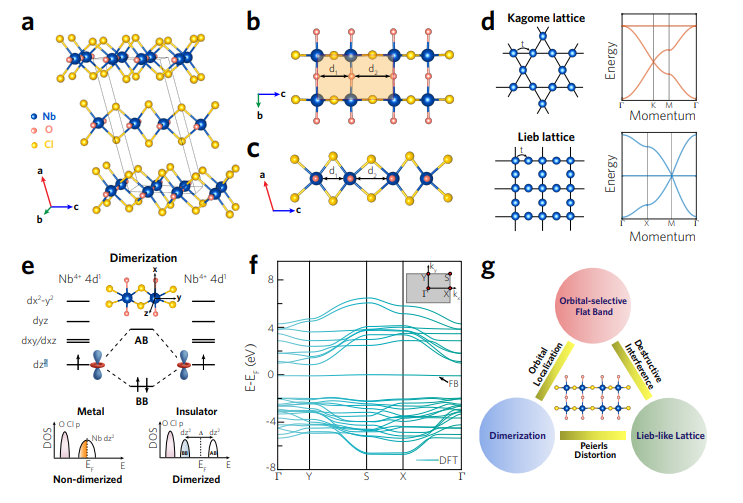
This research centers on niobium oxychloride (NbOCl2), a quasi-two-dimensional material exhibiting a unique electronic structure characterized by an orbital-selective flat band near the Fermi level. This flat band signifies that electrons within this band possess very little kinetic energy and exhibit strong interactions with each other, remaining remarkably robust even in extremely thin samples. The flat band originates from the specific arrangement of electron orbitals, particularly the niobium dz2 and dyz orbitals, and their interaction with oxygen and chlorine orbitals, linked to a structural distortion known as a Peierls distortion. This flat band behavior is also observed in the isostructural material tantalum oxychloride (TaOCl2), suggesting a common underlying mechanism, resembling a Lieb lattice known to host flat bands due to the destructive interference of electron waves.
The research employed a combination of experimental and theoretical techniques, including angle-resolved photoemission spectroscopy (ARPES) to directly map the electronic band structure, and density functional theory (DFT) calculations to model the electronic structure and properties of the materials. Wannierization and tight-binding models simplified the DFT results and extracted effective parameters describing electron interactions, while micro-ARPES studied the electronic structure of few-layer samples and polarization-dependent ARPES investigated the orbital character of the bands. ARPES data reveals the flat band in momentum space, comparing experimental results with DFT calculations and demonstrating the orbital character of the flat band, primarily involving niobium dz2 and dyz orbitals. Comparative measurements on NbOCl2 and TaOCl2 demonstrate the common flat band behavior across both materials, confirming the persistence of the flat band in few-layer NbOCl2 through ARPES measurements on encapsulated samples.
Detailed analysis reveals the microscopic origin of the flat band, showing how orbital hybridization and the Peierls distortion contribute to its formation. The discovery of a robust, orbital-selective flat band in NbOCl2 is significant because flat bands promote strong electron-electron interactions, potentially leading to exotic quantum phenomena like superconductivity, magnetism, and topological states. The ability to control the electronic properties of the material through dimensionality and external stimuli opens possibilities for device applications, and understanding the mechanisms behind flat band formation can guide the design of new materials with tailored electronic properties.
Flat Bands from Orbital Hybridization and Peierls Dimerization
Scientists have discovered an intrinsic mechanism for creating remarkably flat electronic bands in the materials niobium oxychloride (NbOCl2) and tantalum oxychloride (TaOCl2), opening new avenues for exploring exotic electronic properties. Experiments using angle-resolved photoemission spectroscopy (ARPES) directly observed these flat bands, characterized by extremely low kinetic energy and amplified electron correlations. The origin of these bands lies in the hybridization between specific atomic orbitals, the niobium or tantalum dz2 orbitals and the Lieb-like dx2-y2 sublattice, further reinforced by a phenomenon called Peierls dimerization. The flat band remains robust, persisting even when the materials are reduced to just a few layers thick at room temperature, an exceptionally rare characteristic among layered materials.
Comparative ARPES measurements on both NbOCl2 and TaOCl2 revealed nearly identical flat bands across the entire Brillouin zone, confirming the universality of this orbital-selective mechanism. The bandwidth of the flat band in NbOCl2 was measured to be below 70 meV, consistent with theoretical predictions of approximately 80 meV, while TaOCl2 exhibited a slightly larger bandwidth. The team fabricated graphene/NbOCl2/hBN heterostructures to examine the persistence of the flat band in the few-layer regime, confirming a sharp, dispersionless feature at approximately 2 eV below the Fermi level in a three-layer flake, closely matching the flat band observed in bulk samples. These findings establish NbOCl2 and TaOCl2 as robust and tunable platforms for exploring flat-band-driven correlated phenomena, uncovering a new design principle for realizing flat bands in materials, offering a practical knob for engineering correlation strength and bandwidth in quantum materials.
Flat Bands from Hybridization and Peierls Instability
Scientists have established a new understanding of how to create and control flat electronic bands in materials, crucial for exploring exotic quantum phenomena. They discovered an intrinsic mechanism for generating these bands within the metal oxychlorides, NbOCl2 and TaOCl2, demonstrating a robust and tunable platform for correlated electron physics. Through a combination of angle-resolved photoemission spectroscopy and theoretical calculations, they identified that hybridization between specific electron orbitals, Nb-dz2 and dx2-y2, combined with Peierls dimerization, gives rise to these flat bands. Importantly, this flat-band characteristic persists even in few-layer materials at room temperature, a significant advantage over existing approaches. The findings reveal a new design principle for realizing flat bands, moving beyond strategies reliant on geometrically frustrated lattices or heavy-fermion physics, which often involve trade-offs.
🗞 Robust Orbital-Selective Flat Bands in Transition-Metal Oxychlorides
🧠 ArXiv: https://arxiv.org/abs/2510.15080