Hamiltonian simulation, a crucial technique for modelling complex systems and verifying quantum devices, faces significant computational hurdles as the complexity of the system increases, demanding ever more processing power. Yuchao Su, Srikar Chundury from North Carolina State University, and Jiajia Li, along with their colleagues, address this challenge by introducing a novel accelerator, named DIAMOND, specifically designed to speed up the core calculations within these simulations. The team recognised that the unique structure of the matrices used in Hamiltonian simulations, often dominated by prominent diagonals, was not being fully exploited by existing hardware, leading to inefficiencies. DIAMOND overcomes this limitation by transforming sparse matrix calculations into dense computations using a restructured systolic array, achieving substantial performance gains and reduced energy consumption compared to established algorithms like SIGMA, Outer Product, and Gustavson’s method, demonstrating speedups of up to and energy savings of up to.
A key operation in these simulations, matrix exponentiation, becomes increasingly expensive as the system size increases. Scientists are addressing this challenge by developing specialized hardware to accelerate these computations, recognizing that traditional methods struggle with the unique characteristics of these simulations. Hermitian operators, commonly used in these simulations, are often sparse, meaning most of their elements are zero, and exploiting this sparsity is crucial for improving performance.
Quantum Error Correction and Hardware Acceleration
Research in quantum computing and hardware acceleration dominates the field, with numerous studies focused on building and programming quantum computers and accelerating related computations. A critical area of investigation is quantum error correction and mitigation, essential for overcoming the inherent fragility of quantum information. Alongside error correction, researchers are designing novel quantum hardware architectures and developing algorithms to accelerate quantum computations, pushing the boundaries of what’s possible with these emerging technologies. Furthermore, significant effort is dedicated to quantum simulation and benchmarking, creating tools and methods to simulate and evaluate quantum systems, verifying their performance and identifying areas for improvement.
Diagonal Accelerator for Efficient Hamiltonian Simulation
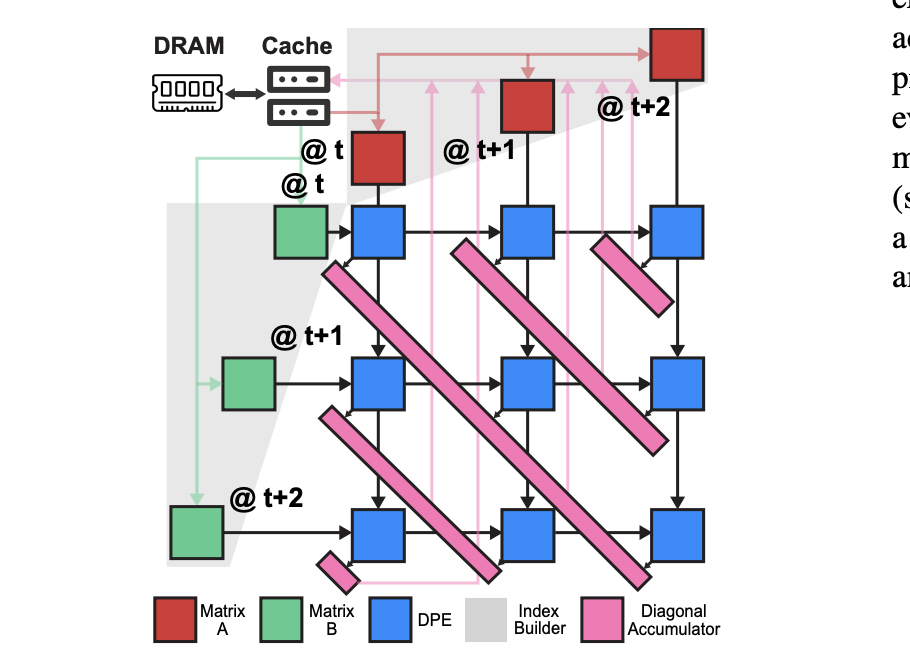
Scientists have developed DIAMOND, a novel accelerator specifically designed for Hamiltonian simulation, a computationally demanding task crucial for studying complex systems and verifying quantum devices. The core challenge in Hamiltonian simulation lies in the exponential growth of computational requirements with increasing qubit numbers, making matrix exponentiation increasingly expensive. This work addresses this challenge by exploiting the diagonal structure commonly found in the matrices used in these simulations. The team’s breakthrough centers on a new Diagonal Processing Element that ensures data correctness and a diagonal accumulator that efficiently collects partial results along diagonals.
This architecture, built around a systolic array-like topology, effectively transforms extremely sparse matrix multiplication into dense diagonal matrix multiplication, maximizing data reuse and performance. A two-level memory hierarchy and efficient blocking strategy further enhance data locality and minimize memory overhead. Experiments demonstrate that DIAMOND achieves average speedups of 10. 26x, 33. 58x, and 53.
15x over existing methods, with peak speedups reaching 127. 03-fold. Notably, the team recorded a remarkable 471. 55-fold reduction in energy consumption. These results stem from the accelerator’s ability to efficiently handle sparse matrices with a quantum-tailored diagonal storage format, eliminating per-entry metadata and enabling memory-aligned access, yielding improved arithmetic intensity and locality. The research highlights the benefits of a specialized architecture optimized for the unique characteristics of Hamiltonian simulation, delivering substantial improvements in both speed and energy efficiency, paving the way for simulating larger and more complex quantum systems.
Diagonality Exploitation for Quantum Simulation Acceleration
Scientists have presented DIAMOND, a novel accelerator specifically designed for sparse matrix computations common in Hamiltonian-based quantum simulations. The team successfully addressed a key challenge in scaling these simulations, which is the computational expense arising from the exponential growth of the Hilbert space dimension. By transforming diagonally sparse matrices into dense computations within a restructured systolic array, DIAMOND achieves significant improvements in both performance and energy efficiency.
🗞 DIAMOND: Systolic Array Acceleration of Sparse Matrix Multiplication for Quantum Simulation
🧠 ArXiv: https://arxiv.org/abs/2510.14172




See today’s quantum computing news on Quantum Zeitgeist for the latest breakthroughs in qubits, hardware, algorithms, and industry deals.