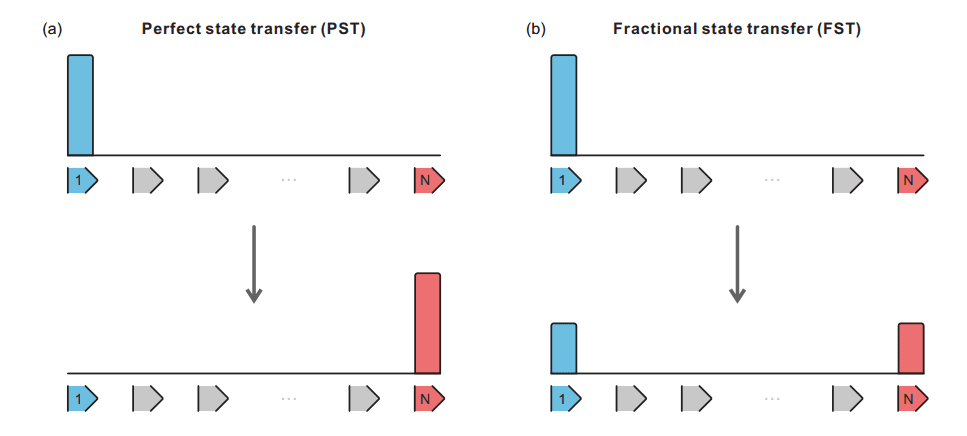
The pursuit of reliable quantum communication and computation demands robust methods for controlling the flow of quantum information, and researchers are now demonstrating significant advances in this area. Tian-Le Wang, Ze-An Zhao, and Peng Wang, alongside colleagues, have developed a new approach to designing Hamiltonians, the fundamental rules governing quantum systems, that dramatically improves the reliability of perfect state transfer and remote entanglement generation. Their work introduces a novel ‘dome model’ Hamiltonian, engineered to be inherently resilient to noise, a major obstacle in building practical quantum technologies. This design not only enhances the stability of quantum information transfer, but also offers a pathway towards scalability, potentially enabling the construction of more complex and powerful quantum networks, particularly suited for implementation on superconducting qubits with tunable couplers.
Superconducting Qubits, Entanglement and Error Mitigation
Current research in quantum information processing centers on superconducting qubits as a leading platform for building powerful quantum systems. Scientists are actively developing methods to build, control, and characterize these systems, with a strong emphasis on achieving efficient quantum communication, generating entanglement, a crucial resource for quantum computation, and mitigating the errors that inevitably arise in quantum systems. A central challenge is combating decoherence, the loss of quantum information caused by interactions with the environment. Key areas of investigation include improving qubit design and fabrication, exploring new architectures for connecting qubits, and developing techniques for detecting and correcting errors.
Researchers are also exploring ways to understand and minimize the impact of various noise sources on qubit performance. This work extends to the development of quantum networks, aiming to connect qubits over longer distances and implement secure quantum communication protocols. Emerging research focuses on designing Hamiltonians, the mathematical description of a quantum system, to achieve specific quantum behaviors, and utilizing topological properties to protect quantum information from decoherence. The field is progressing towards demonstrating practical quantum computation, as evidenced by recent claims of quantum supremacy.
Dome Model Hamiltonian for Robust State Transfer
Scientists have engineered a novel approach to quantum state transfer and entanglement generation using a technique called Hamiltonian inverse engineering. Recognizing that conventional Hamiltonians often lack robustness against noise, the team began with a noise-resilient energy spectrum and constructed a new class of Hamiltonians, termed the “dome model”. This model introduces a tunable parameter that modifies the energy-level spacing, creating a well-structured Hamiltonian offering enhanced stability and facilitating scalability through a cascaded strategy for long-distance transfer. To address the challenges of scaling quantum communication, researchers proposed dividing long-distance state transfer into multiple consecutive steps.
The study pioneered the use of superconducting qubits with tunable couplers, enabling rapid and flexible Hamiltonian engineering, crucial for implementing the dome model. These tunable couplers allow precise control over qubit interactions, facilitating the creation of the desired Hamiltonian structure. The team analytically derived the dome model using the inverse eigenvalue method, a powerful technique for reconstructing Hamiltonians from prescribed eigenvalue spectra, ensuring the resulting Hamiltonian possesses the desired properties for noise resilience and efficient state transfer. Experiments employing superconducting qubits demonstrate the feasibility of the approach, achieving high fidelity in both state transfer and entanglement generation.
The researchers meticulously characterized the system’s performance, demonstrating 92. 5% fidelity for Bell state generation over 57 nanoseconds and 85. 0% for W state generation over 56 nanoseconds in a five-qubit system. This work advances the experimental potential of robust and scalable quantum information processing, paving the way for more reliable and efficient quantum communication networks.
Dome Model Enhances Robust Quantum State Transfer
Scientists have achieved a significant breakthrough in quantum information processing by developing a new class of Hamiltonians, termed the “dome model”, that dramatically improves the robustness of quantum state transfer against noise. This work addresses a critical challenge in building practical quantum technologies, where maintaining the integrity of quantum information is paramount. The team employed a technique called inverse engineering to design these Hamiltonians, beginning with a noise-resilient energy spectrum and constructing a system with enhanced stability. The dome model introduces a tunable parameter that precisely controls the spacing between energy levels, suppressing the population of intermediate qubits during quantum evolution and minimizing errors caused by noise.
Experiments and simulations demonstrate that as this parameter increases, the system becomes increasingly resistant to both coherent and decoherent noise, preserving the fidelity of quantum states over longer periods. This approach provides a unified framework for sequentially realizing both perfect state transfer and fractional state transfer within a single evolution period, streamlining quantum operations. The researchers rigorously tested the dome model’s performance, confirming its ability to achieve high-fidelity quantum state transfer. Specifically, the team demonstrated 92. 5% fidelity for Bell state generation and 85.
0% for W state generation, both achieved within 57 nanoseconds using transmon qubits. Further experiments with different qubit arrangements yielded 90. 2% fidelity for single-excitation transfer and 84. 0% for Bell state transfer, measured over 250 nanoseconds. These results represent a substantial improvement in the reliability and efficiency of quantum communication protocols.
To address the challenge of scaling up quantum systems, the team proposed a cascaded strategy, dividing long-distance state transfer into multiple consecutive steps. This approach, combined with the dome model’s inherent robustness, makes the technology particularly well-suited for implementation on superconducting quantum circuits with tunable couplers, paving the way for more complex and scalable quantum information processing architectures. The breakthrough delivers a pathway towards building practical and reliable quantum technologies capable of tackling complex computational problems.
👉 More information
🗞 Inverse designed Hamiltonians for perfect state transfer and remote entanglement generation, and applications in superconducting qubits
🧠 ArXiv: https://arxiv.org/abs/2510.13584