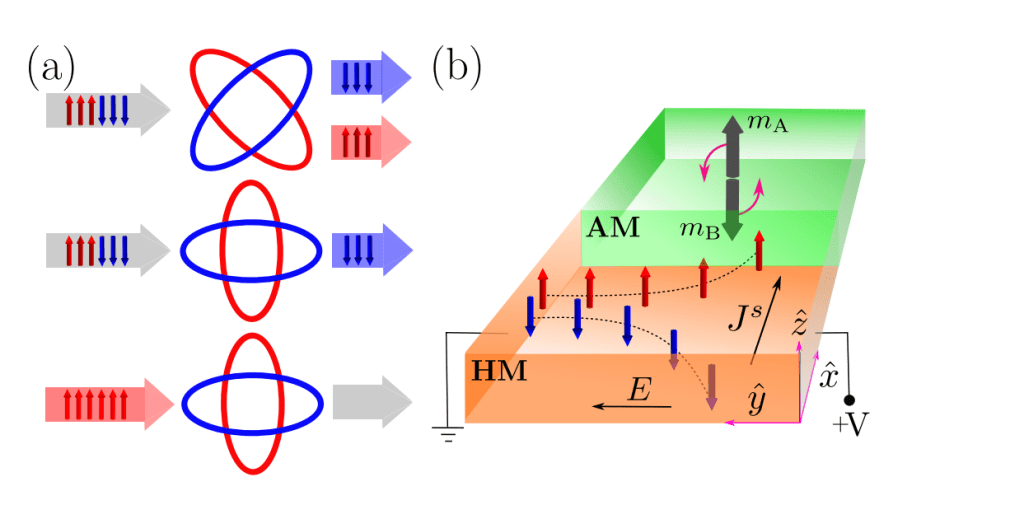
The pursuit of low-power, ultrafast spintronic devices hinges on finding materials where magnetic order can be switched efficiently, and now, researchers are demonstrating a new mechanism for achieving this in a class of materials called altermagnets. Sayan Sarkar, Sunit Das, and Amit Agarwal, all from the Indian Institute of Technology, Kanpur, reveal how asymmetric spin currents within these materials drive deterministic switching of magnetic order, a process previously challenging to control. Their simulations show that, unlike conventional antiferromagnets, altermagnets experience unequal forces on their internal magnetic layers, enabling magnetic reversal without the need for external magnetic fields and on incredibly fast timescales. This discovery establishes an accessible pathway for manipulating altermagnetic order, potentially paving the way for a new generation of energy-efficient spintronic technologies that overcome limitations found in existing materials.
Asymmetric Spin Currents Enable Picosecond Switching
Scientists pioneered a method for switching magnetic order in altermagnets using asymmetric sublattice spin currents, achieving deterministic 180-degree Néel vector reversal on a picosecond timescale. This work addresses a key challenge in spintronics by demonstrating field-free switching, circumventing limitations of conventional antiferromagnetic and ferromagnetic materials. The study centers on exploiting the unique spin-split band structures present in altermagnets, where unequal torques can be applied to individual sublattices due to asymmetric spin splitting of the Fermi surfaces. Researchers developed a theoretical framework and computational model to demonstrate this switching mechanism, focusing initially on doped FeSb2 as a representative d-wave altermagnet.
Simulations, using realistic material parameters, revealed that the Néel vector reorients within approximately 40 picoseconds, demonstrating ultrafast switching capabilities. This approach differs from previous methods relying on staggered Néel spin-orbit torques, which are ineffective in many even-parity altermagnets, or requiring auxiliary magnetic fields. The team established that the asymmetric sublattice spin currents arise naturally in heavy metal, altermagnet heterostructures, leveraging the direction-dependent spin polarization of the altermagnetic Fermi surfaces. They demonstrated that this mechanism is not limited to d-wave altermagnets, extending to g- and i-wave classes, establishing a broadly applicable route for electrical switching of altermagnetic order. This innovative method unlocks the potential for realizing ultrafast, energy-efficient spintronic devices by harnessing the unique properties of altermagnets and providing a pathway for deterministic control of their magnetic order.
Deterministic Switching via Asymmetric Spin Currents
Scientists have demonstrated a deterministic switching mechanism in altermagnets, driven by asymmetric sublattice spin currents, offering a pathway to ultrafast, low-power spintronic devices. Unlike conventional antiferromagnets, which rely on balanced torques, these altermagnets exhibit symmetry-protected spin splitting that generates unequal forces on each sublattice. Simulations using doped FeSb₂ as a model system reveal that this mechanism enables magnetic-field-free and deterministic 180-degree Néel vector reversal on a picosecond timescale. The research establishes that asymmetric sublattice spin currents arise from the direction-dependent spin conduction within the altermagnetic material, where injected spin polarization matches the anisotropic Fermi surface characteristics.
Calculations of the longitudinal spin conductivity in doped FeSb₂ confirm the measurable nature of this effect, validating the principle of asymmetric spin conduction. The team’s simulations, employing the Landau, Lifshitz, Gilbert equation, demonstrate ultrafast, deterministic 180-degree switching within approximately 40 picoseconds. Importantly, this switching mechanism extends beyond d-wave altermagnets to include g- and i-wave varieties, establishing asymmetric sublattice spin currents as a broadly applicable route for field-free electrical switching of altermagnetic order. This breakthrough paves the way for realizing next-generation spintronic devices with enhanced speed and energy efficiency, leveraging the unique properties of altermagnetic materials.
Altermagnet Switching via Spin Currents Demonstrated
This research demonstrates a novel mechanism for switching the magnetic order in altermagnets, achieved through asymmetric sublattice spin currents. Unlike conventional antiferromagnets, these materials exhibit unique symmetry properties that allow for unequal forces to be applied to each magnetic sublattice, enabling deterministic reversal of the Néel vector on picosecond timescales. Simulations using doped FeSb demonstrate that this switching can occur without an external magnetic field, relying instead on spin currents generated by injecting electrons from a heavy metal. The significance of this work lies in establishing an experimentally accessible pathway towards ultrafast, low-power spintronic devices. The demonstrated switching mechanism is broadly applicable to even-parity metallic altermagnets, including those with weak spin-orbit coupling where other switching methods fail. Researchers found that crystalline orientation offers a means to control switching thresholds and current polarity, while the material’s anomalous Hall effect provides a robust method for reading the magnetic state.
🗞 Deterministic Switching in Altermagnets via Asymmetric Sublattice Spin Current
🧠 ArXiv: https://arxiv.org/abs/2510.11362

See today’s quantum computing news on Quantum Zeitgeist for the latest breakthroughs in qubits, hardware, algorithms, and industry deals.