Quantum networks promise revolutionary advances in communication and computation, but efficiently managing their resources presents a significant challenge. Nitish K. Panigrahy from Binghamton University, Leonardo Bacciottini from the University of Massachusetts, Amherst, and colleagues address this problem by developing a novel framework for distributed resource allocation. Their work introduces a system that allows multiple applications to coexist within a quantum network through fully decentralised coordination, optimising performance based on entanglement rate and quality. The team demonstrates that their algorithm, QPrimal-Dual, substantially outperforms existing allocation strategies, scales effectively with network size, and maintains robustness even with network latency and the effects of decoherence, representing a crucial step towards practical, high-performance quantum networks.
Qubit Routing and Resource Allocation Systems
Scientists engineered a sophisticated routing and resource allocation system for quantum networks, designed to manage the unique challenges of quantum communication. This control plane establishes and maintains quantum connections between nodes, manages resources like quantum memory, and ensures reliable communication despite the fragility of quantum states. The system transports quantum information as q-datagrams, analogous to IP packets in classical networks, and intelligently allocates resources to different connections. The control plane mitigates errors and losses inherent in quantum communication through techniques like error correction and loss recovery.
A core component is the Primal-Dual algorithm, a mathematical method that balances the needs of different connections while respecting network limitations. This algorithm is implemented through distributed components, with link controllers managing resources at individual nodes and session controllers establishing end-to-end connections. These controllers estimate qubit flow rates using metrics called Rsum and Msum, tracking requested and allocated rates to make informed decisions about accepting new requests. When q-datagrams are lost, a backpropagation mechanism sends information upstream to correct the state of controllers, ensuring consistency.
A weight mechanism further enhances loss recovery by propagating information about lost q-datagrams, providing accurate rate estimates to downstream controllers. Exponential averaging smooths rate estimates and prevents oscillations. The team developed two variations of the algorithm, QPrimal-Dual, a full version, and QPrimalDual-approx, a simplified version that reduces overhead. The flow of operation involves a source node requesting a connection, link controllers negotiating rates and allocating resources, q-datagrams being transmitted, and loss recovery mechanisms activating when necessary. The distributed Primal-Dual algorithm converges to an optimal solution, balancing the needs of all connections.
Decentralized Quantum Network Control via Optimization
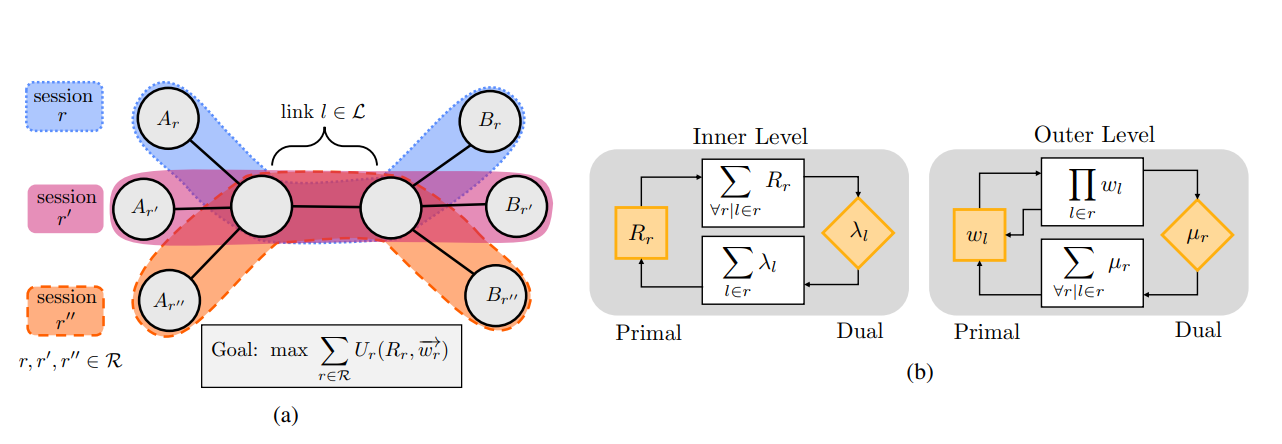
Scientists engineered a distributed resource allocation framework for quantum networks, relying on feedback and fully decentralized coordination to serve multiple applications simultaneously. The study pioneered a network control algorithm grounded in Network Utility Maximization, where utility functions quantify network performance by mapping entanglement rate and quality into a joint optimization objective. To solve this complex optimization problem, researchers developed QPrimal-Dual, a scalable algorithm that strategically places network controllers, enabling operation using only local state information and limited classical message exchange. The team implemented a simulation of a sequential quantum network, modeling it as a graph with nodes and links representing quantum communication channels.
Each link generates heralded bipartite entanglement between adjacent nodes using a single photon entanglement generation scheme, parameterized by a tunable brightness parameter that controls fidelity and rate. Researchers mathematically modeled the generated entangled state as a Werner state, simplifying analysis while maintaining fidelity to the original quantum state, and defined link capacity as a function of entanglement generation rate and brightness. Scientists proved global asymptotic stability for concave utility functions and provided sufficient conditions for local stability with non-concave functions, demonstrating the algorithm’s robustness under varying conditions. They also introduced protocol variants designed to mitigate quantum memory decoherence and reduce explicit control message exchanges, further enhancing network performance. Experiments demonstrated that QPrimal-Dual significantly outperforms baseline allocation strategies, scales effectively with network size, and remains robust against both latency and quantum memory decoherence.
Decentralized Quantum Resource Allocation Achieves Scalable Performance
Scientists have developed a distributed resource allocation framework for quantum networks, enabling multiple applications to operate concurrently. This work centers on Quantum Network Utility Maximization (QNUM), a mathematical approach that defines utility functions to quantify network performance based on entanglement rate and quality. The team introduced QPrimal-Dual, a decentralized algorithm designed to solve QNUM by strategically positioning network controllers that utilize local state information and limited classical communication. Experiments demonstrate that QPrimal-Dual significantly outperforms baseline allocation strategies in simulated quantum network architectures.
The algorithm scales effectively with network size, maintaining robust performance even with increased latency and quantum decoherence. Researchers proved global asymptotic stability for concave, separable utility functions, and established sufficient conditions for local stability in more complex, non-concave scenarios, demonstrating the algorithm’s robustness under varying conditions. To minimize control overhead and mitigate the effects of quantum memory decoherence, the team proposed schemes that locally approximate global quantities and prevent network congestion. These methods allow the network to maintain stable operation while accounting for the inherent limitations of quantum hardware. The results confirm that QPrimal-Dual provides a practical and high-performance foundation for fully distributed resource allocation in quantum networks.
Decentralized Quantum Resource Allocation Achieved
This research introduces a new distributed framework for allocating resources in quantum networks, building upon the mathematical principles of Network Utility Maximization. The team developed a control algorithm, QPrimal-Dual, which enables network controllers to operate using only local information and limited communication, significantly reducing the need for centralized coordination. Theoretical analysis demonstrates global stability for certain network conditions and local stability under broader circumstances, providing guarantees about the algorithm’s reliable operation. Simulations conducted in realistic network architectures show that QPrimal-Dual outperforms existing allocation strategies, scales effectively with network size, and remains robust even with latency and quantum decoherence. The researchers also proposed methods to locally approximate global quantities and prevent network congestion, addressing practical challenges in quantum network management.
🗞 A Framework for Distributed Resource Allocation in Quantum Networks
🧠 ArXiv: https://arxiv.org/abs/2510.09371




See today’s quantum computing news on Quantum Zeitgeist for the latest breakthroughs in qubits, hardware, algorithms, and industry deals.