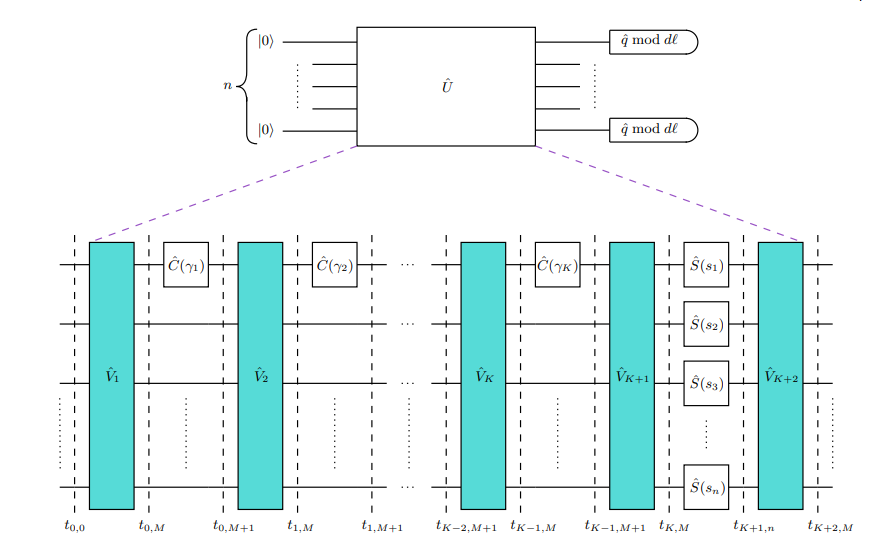
Quantum computation explores multiple approaches to building powerful computers, and a central question concerns the relative strengths of different methods. Alex Maltesson, Ludvig Rodung, and Niklas Budinger, along with colleagues from Chalmers University of Technology and the Technical University of Denmark, investigate the potential for continuous-variable quantum computers to outperform their discrete-variable counterparts. Their work demonstrates that, for a given energy budget, continuous-variable computers offer no fundamental advantage over discrete-variable machines, a finding that challenges assumptions about their potential. The team achieves this result by establishing a novel framework that directly maps quantum circuits between these two distinct paradigms, effectively proving that realistic continuous-variable computations can be efficiently simulated using discrete-variable devices.
Taudingerweg 7, Mainz, Germany. This work examines the ability of gate-based continuous-variable quantum computers to outperform qubit or discrete-variable quantum computers. Gate-based continuous-variable operations refer to operations constructed using a polynomial sequence of elementary gates from a specific finite set, namely those selected from the set of Gaussian operations and cubic phase gates. The results show that for a fixed energy of the system, there is no superpolynomial computational advantage in using gate-based continuous-variable quantum computers over discrete-variable ones. The proof of this result consists of defining a framework, which is of independent interest, that maps quantum circuits.
Discretization Operator Justification for Continuous Variables
This appendix provides rigorous mathematical justifications for approximations made in the main body of the paper. Specifically, it demonstrates that a particular method of discretizing continuous position space, using an operator, does not fundamentally alter the nature of measurements performed on the quantum state. This is crucial for proving the correctness of error bounds and performance guarantees. The goal is to show that continuous-variable quantum computation can be accurately modeled by a discrete-variable one, allowing for easier analysis. The appendix establishes the equivalence between continuous measurements and discrete measurements when a position cutoff is applied, simplifying the analysis of the quantum computation.
The operator discretizes the continuous position variable by projecting the quantum state onto a finite number of position states, effectively creating a cutoff in position space. The research then demonstrates that composing this discretization operator with a measurement operator yields the same result as performing the measurement directly, confirming that the discretization process does not change the measurement outcome. Key takeaways include the validation of discretization, the simplification of analysis, and the establishment of accurate error bounds. The use of periodic boundary conditions ensures a well-defined discretization process. In summary, this appendix provides a crucial mathematical justification for a key simplification, allowing the authors to replace the continuous-variable quantum computation with a discrete-variable one, which is much easier to analyze, and establish the accuracy of their results.
Continuous Variables Offer No Superpolynomial Advantage
Scientists have demonstrated that gate-based continuous-variable quantum computers do not offer a superpolynomial computational advantage over discrete-variable quantum computers, even when utilizing a fixed energy for the system. This work establishes a framework to map quantum circuits between continuous- and discrete-variable paradigms, proving that a realistic gate-based continuous-variable model, with states and operations possessing a total energy polynomial in the number of modes, can be efficiently simulated using discrete-variable devices. The team utilized stabilizer subsystem decomposition to map continuous-variable states to discrete-variable counterparts, allowing them to quantify the error of approximating continuous-variable systems with discrete-variable ones in terms of the continuous-variable system’s energy and the dimension of the corresponding encoding qudits. Experiments reveal that any quantum computation constructed from a polynomial number of elementary continuous-variable gates can be approximated by a discrete-variable quantum computer, with a precision dependent on the energy scale of the continuous-variable system.
The research demonstrates that the error in this approximation is bounded by the energy of the continuous-variable system and the dimension of the corresponding qudits, providing a natural decomposition of states, gates, and measurements from continuous- to discrete-variable systems. This breakthrough delivers a method for simulating continuous-variable quantum computers using classical algorithms already developed for discrete-variable systems, significantly advancing efforts to simulate complex continuous-variable systems, which are often intractable unless they are all Gaussian or contain inherent symmetries. The team outlines a procedure for simulating continuous-variable systems, involving the use of stabilizer subsystem decomposition, identifying a correct dimensionality of a discrete-variable system based on the energy of the state and operations, and then applying existing simulation algorithms for the corresponding qudit system. Measurements confirm that this approach is of independent interest, given the potential of continuous-variable systems for quantum computation and quantum error correction, and the compelling need for classical algorithms to tackle their simulation.
Continuous and Discrete Quantum Computation Equivalence
This research demonstrates that, under realistic conditions, gate-based continuous-variable quantum computation cannot fundamentally outperform discrete-variable quantum computation. The team established a framework to map circuits between these two paradigms, proving that a continuous-variable quantum computer, constrained by realistic energy limitations, can be efficiently simulated using a discrete-variable quantum computer. This finding formally demonstrates the absence of an exponential speed-up achievable through continuous-variable approaches, resolving a key question in the field of quantum information processing. Importantly, the researchers not only proved this equivalence but also developed a method to translate continuous-variable algorithms into discrete-variable hardware.
This translation is achieved by considering realistic constraints on the energy of the system, the precision of measurements, and the resolution of measurement values, all of which reflect the physical limitations of actual quantum devices. The team defined increasingly restricted models of continuous-variable computation, bridging the gap with discrete-variable approaches and facilitating a direct comparison of their computational power. The authors acknowledge that their results rely on the assumption of bounded energy within the continuous-variable system, reflecting practical limitations of bosonic platforms. Future work could explore the implications of these findings for specific quantum algorithms and investigate the potential benefits of continuous-variable approaches within these constrained parameters. The developed mapping framework provides a valuable tool for researchers seeking to implement quantum algorithms on diverse hardware platforms, regardless of the underlying quantum variable paradigm.
🗞 Equivalence of continuous- and discrete-variable gate-based quantum computers with finite energy
🧠 ArXiv: https://arxiv.org/abs/2510.08546
See today’s quantum computing news on Quantum Zeitgeist for the latest breakthroughs in qubits, hardware, algorithms, and industry deals.