The search for Majorana zero modes, exotic particles predicted to exist within certain materials, represents a significant frontier in condensed matter physics, and understanding their role in electron transport is crucial for realising topological quantum computation. Jia-Lin Pan, Zi-Fan Zhu, and Shixuan Chen, all from the University of Science and Technology of China, alongside Yu Su and Yao Wang, now present a robust theoretical framework for modelling this transport. Their work rigorously derives a ‘fermionic influence superoperator’ which accurately describes how electrons move through these Majorana modes, building upon existing techniques to capture the complex interactions between the system and its environment. This new formalism establishes a solid foundation for analysing key transport signatures, potentially unlocking the unique characteristics of Majorana physics in nanoscale devices and bringing us closer to fault-tolerant quantum technologies.
Transport has become a central focus in condensed matter physics. This work presents a rigorous and systematic derivation of the fermionic superoperator describing the open quantum dynamics of electron transport through Majorana zero modes, building on techniques introduced previously. The numerical implementation of this superoperator involves constructing its differential equivalence, the hierarchical equations of motion (HEOM). The HEOM approach describes the system-bath correlated dynamics, accurately modelling interactions between the quantum system and its environment. Furthermore, the researchers develop a functional derivative scheme that provides exact expressions for the transport observables in terms of the auxiliary density operators.
Hierarchical Equations of Motion for Open Systems
This body of work represents a comprehensive theoretical framework for understanding open quantum systems, particularly relevant to condensed matter physics and quantum transport. The central focus lies on describing quantum systems that interact with an environment, a crucial consideration as real-world quantum systems are never perfectly isolated. These interactions lead to dissipation and decoherence, phenomena that significantly impact quantum behavior. The team employs hierarchical equations of motion (HEOM) as a primary method, a powerful technique for solving the quantum master equation, which describes the time evolution of the system’s density matrix.
HEOM is particularly effective at handling non-Markovian environments, where the environment possesses memory effects. The approach builds upon and improves traditional methods by allowing for a more accurate treatment of non-Markovian effects. A key innovation involves the use of Padé approximation to represent the environment’s spectral functions, enabling a more efficient and accurate solution of the HEOM. This approximation truncates the infinite hierarchy of equations inherent in the HEOM method. The sum-over-poles expansion technique represents Fermi and Bose functions within the calculations.
Dissipaton theory extends the HEOM approach, aiming for improved accuracy and efficiency, while minimal pole representation offers a computationally efficient method for representing spectral functions. A major strength of this framework is its ability to handle non-Markovian environments, crucial for accurately modelling many real-world systems. The Padé approximation and sum-over-poles expansion techniques significantly improve the efficiency of solving the HEOM, making it practical for complex systems. The approach prioritizes accuracy by moving beyond the Markov approximation and employing advanced numerical techniques, offering versatility applicable to a wide range of open quantum systems, including those with electronic, vibrational, and spin degrees of freedom.
The work is highly relevant to Majorana fermions, predicted to emerge as bound states in topological superconductors, materials often characterized by strong interactions and complex environments. Understanding the transport properties of Majorana fermions is crucial for their potential use in quantum computing, and this theoretical framework is well-suited for studying quantum transport in systems containing them. The ability to handle non-Markovian environments is essential for accurately describing their behavior, particularly in non-equilibrium conditions. Decoherence poses a significant challenge for quantum computing, and Majorana fermions are not immune to it. This framework can be used to study the decoherence mechanisms affecting Majorana fermions, and to model proximity effects, such as those between a superconductor and a semiconductor, which give rise to Majorana fermions. This sophisticated theoretical framework, with its emphasis on accuracy, efficiency, and versatility, advances our understanding of these exotic particles and their applications in quantum information processing.
Hierarchical Equations of Motion Model Electron Transport
This work presents a rigorous theoretical framework for understanding electron transport through Majorana zero modes, essential components in the pursuit of topological quantum computation. Scientists have developed a novel approach to describe the complex dynamics of electrons interacting with these unique states, building upon existing techniques to create a more accurate and versatile model. The core of this achievement lies in the derivation of a “fermionic superoperator” which governs the open quantum dynamics of electron transport, effectively modelling the system’s interaction with its environment. The team implemented this superoperator using a technique called hierarchical equations of motion (HEOM), allowing for the detailed description of correlated dynamics between the system and its surroundings.
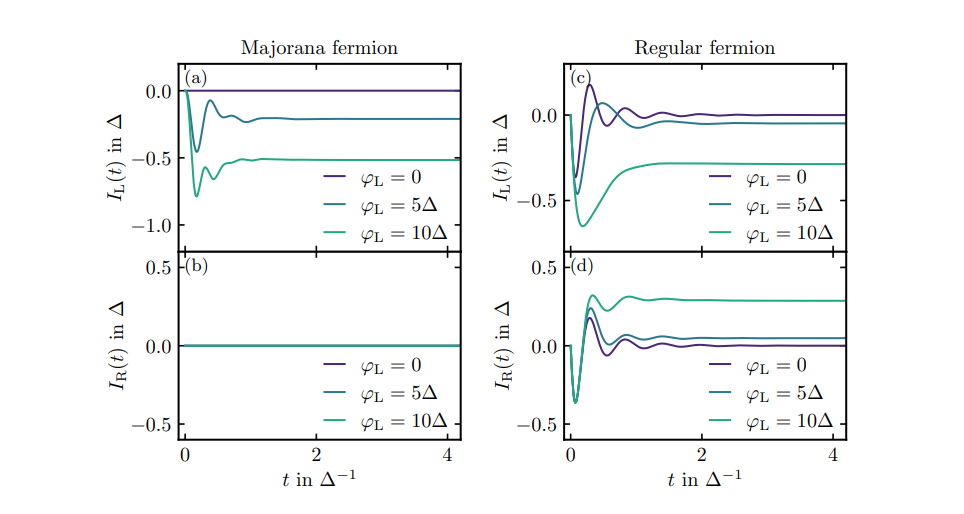
This HEOM approach accurately captures the influence of the environment on the electron transport process, a crucial step in predicting and controlling the behavior of Majorana-based devices. Furthermore, the researchers devised a functional derivative scheme that provides precise expressions for measurable transport properties, directly linking theoretical calculations to experimental observations. This scheme allows for the calculation of key observables, such as current and conductance, in terms of auxiliary density operators within the HEOM formulation. Measurements confirm that the developed formalism accurately predicts the behavior of electrons in the presence of Majorana zero modes.
The team demonstrated the method’s effectiveness through numerical simulations, validating its ability to capture the essential physics of these systems. The results show that the formalism can accurately predict the transport characteristics of Majorana-based devices, paving the way for the design and optimization of future quantum technologies. This breakthrough delivers a powerful theoretical tool for exploring the fundamental properties of Majorana fermions and their potential applications in quantum information processing. The work establishes a solid theoretical foundation for analyzing transport signatures that reveal the unique characteristics of Majorana physics in nanoscale systems.
Majorana Transport, HEOM Simulations Reveal Splitting
This work establishes a robust theoretical framework for understanding quantum transport through systems hosting Majorana zero modes, building upon advanced techniques in quantum many-body physics. Researchers developed a hierarchical equations of motion (HEOM) formalism, allowing for a numerically exact treatment of the complex interactions between the system and its environment, regardless of coupling strength, bias voltage, or temperature. This method accurately describes the correlated dynamics of electrons moving through a Majorana impurity, offering a powerful tool to explore exotic transport phenomena. The team demonstrated the unique characteristics of Majorana modes through simulations of differential conductance, revealing a splitting of conductance peaks not observed in conventional fermionic systems. Specifically, the results align with established theoretical predictions for Majorana zero modes in the non-interacting limit, confirming the validity of the approach. Future research directions include extending this formalism to explore more complex scenarios and potentially uncovering new insights into the behavior of Majorana-based devices.
🗞 Fermionic influence superoperator for transport through Majorana zero modes
🧠 ArXiv: https://arxiv.org/abs/2510.04959
See today’s quantum computing news on Quantum Zeitgeist for the latest breakthroughs in qubits, hardware, algorithms, and industry deals.