Maximally entangled quantum states are fundamental resources for numerous quantum technologies, yet creating a complete and manageable set of these states for any number of quantum bits, or qubits, presents a significant challenge. Chi-Chuan Hwang from National Cheng Kung University and colleagues now demonstrate a method for constructing the complete set of maximally entangled basis vectors for any N-qubit system. The team achieves this by employing a random-number approach to generate both the entangled states and the corresponding quantum circuits needed to create them, crucially detailing the number of necessary quantum operations. This work bypasses the need to store vast amounts of encoding data, offering a practical and scalable technique that advances the development of future quantum devices and applications.
This method avoids the challenges of storing large amounts of encoding data, offering a practical solution for building future quantum devices. Entangled states are widely used in quantum computing and communication, with the well-known Bell states serving as a prime example for two-qubit systems, but generating these states for larger systems presents significant challenges.
Three-Qubit Entanglement via Quantum Circuitry
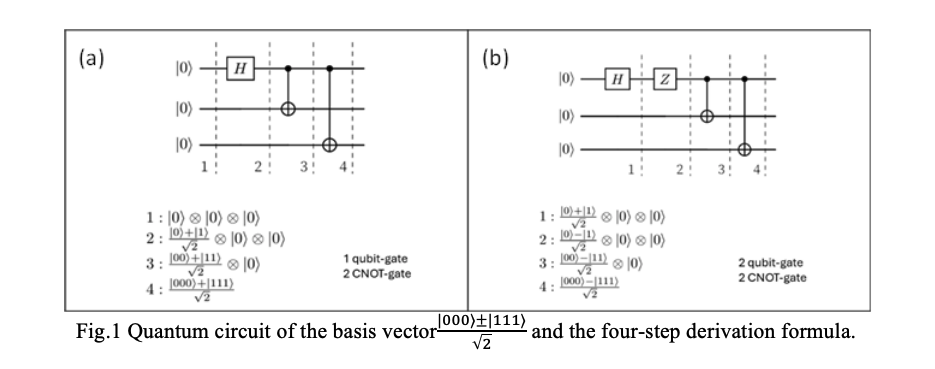
This work addresses the crucial problem of systematically generating a complete set of maximally entangled basis vectors for any number of qubits, with initial demonstrations using a three-qubit system. The researchers first constructed eight maximally entangled basis vectors for the three-qubit case, beginning with an initial state and applying a sequence of Hadamard and controlled-NOT gates. Applying a Hadamard gate to the first qubit, followed by two controlled-NOT gates, generates the |GHZ+⟩ state, and variations of this circuit, including the addition of a Z quantum gate, produce other basis vectors. The team systematically explored combinations of controlled-NOT and inverted-control gates to generate all eight basis vectors for the three-qubit case.
Extending this approach to N-qubit systems, they proposed a method based on generating random sequences, where the arrangement of qubits considers the first qubit as a control. A random sequence of N-1 qubits, consisting of 0s and 1s, determines the placement of controlled-NOT gates, with ‘1’ indicating a gate and ‘0’ representing an identity operation. This process generates a variety of configurations, and adding a Z gate doubles the number of basis vectors. The researchers demonstrated that varying the random sequence generates all 2N maximally entangled basis vectors, ensuring they remain mutually orthogonal. This method provides a convenient and efficient way to construct maximally entangled basis vectors for any N-qubit system, offering a solid theoretical foundation and practical utility for various quantum technologies.
Entangled Basis Vectors Generated via Gate Sequences
This research details a new method for constructing maximally entangled basis vectors, fundamental resources for quantum computing, for systems of any number of qubits. Scientists successfully demonstrated the creation of eight such vectors using a three-qubit system, establishing a practical technique that bypasses the limitations of storing large-scale encoding data. The core of this achievement lies in a systematic approach using Hadamard gates and controlled-NOT gates, allowing for the generation of these entangled states. The team discovered that by strategically applying these gates, combined with optional Z quantum gates, they could derive all possible basis vectors.
Experiments revealed that the arrangement of these gates is directly linked to random number sequences, where a ‘1’ corresponds to a controlled-NOT gate and a ‘0’ to an identity gate. This allows for the construction of 2N maximally entangled basis vectors for an N-qubit system. For the three-qubit case, this method requires the precise application of seven gates to generate the eight basis vectors. Further analysis showed that the number of gates needed scales predictably with the number of qubits. In an N-qubit system, the method requires N-1 controlled-NOT gates and N-M single-qubit gates when no Z gate is present, where M represents the number of ‘1’s in the random sequence.
Adding a Z gate after the initial Hadamard gate alters this slightly, requiring N-M+1 single-qubit gates. This predictable scaling is crucial for building larger and more complex quantum systems. The team demonstrated that the probability of measuring either |0⟩ or |1⟩ at each qubit position remains at 1/2, ensuring the validity of the generated entangled states. This work provides a powerful and scalable method for generating essential quantum resources.
Generating Maximally Entangled States with Circuits
This research establishes a systematic method for constructing quantum circuits capable of generating maximally entangled basis vectors, initially demonstrated with a three-qubit system and then extended to systems with any number of qubits. The team successfully designed circuits for all eight maximally entangled basis vectors in the three-qubit case, detailing the necessary sequence of single-qubit and controlled-NOT gates for each. This approach bypasses the need to store large amounts of encoding data, offering a practical advantage for technological applications. The work demonstrates that any maximally entangled basis vector can be generated from an initial state through the application of a Hadamard gate, followed by controlled-NOT gates, establishing a clear and consistent pattern across all vectors.
By extending this principle, the researchers provide a framework for generating circuits for N-qubit systems, suggesting broad applicability to diverse quantum technologies. While the current study focuses on circuit construction, the team acknowledges that further research is needed to assess the efficiency and scalability of these circuits in real-world quantum devices. This foundational work paves the way for advancements in quantum communication, computation, and fundamental tests of physics, offering a valuable tool for researchers exploring the potential of quantum entanglement.
🗞 Construction of the Complete Set of Maximally Entangled Basis Vectors for N-Qubit Systems
🧠 ArXiv: https://arxiv.org/abs/2510.02685