Quantum researchers at Delft University of Technology in the Netherlands announced on 6 October 2025 that they have built the world’s first chip‑based single‑phonon directional coupler, a device capable of splitting and routing individual quanta of mechanical vibration. The breakthrough, published in the journal Optica Quantum, demonstrates a four‑port circuit that operates at gigahertz frequencies and functions at cryogenic temperatures, opening a new route for linking disparate quantum systems on a single chip.
Tiny Vibrations, Big Possibilities
Phonons, quantized packets of mechanical motion, are the sound waves of the quantum world. While photons carry information over long distances in optical fibres, phonons can shuttle quantum data across a microchip with minimal loss, thanks to their ability to be confined in engineered waveguides. In practice, this means that a single phonon could serve as a carrier of a quantum bit (qubit) from a fast superconducting processor to a long‑lived spin‑based memory, or vice versa. Until now, however, the toolbox for manipulating phonons at the single‑quanta level was incomplete. Existing surface‑acoustic‑wave devices could generate and guide phonons, but they suffered from high loss and required large, two‑dimensional structures that made integration difficult.
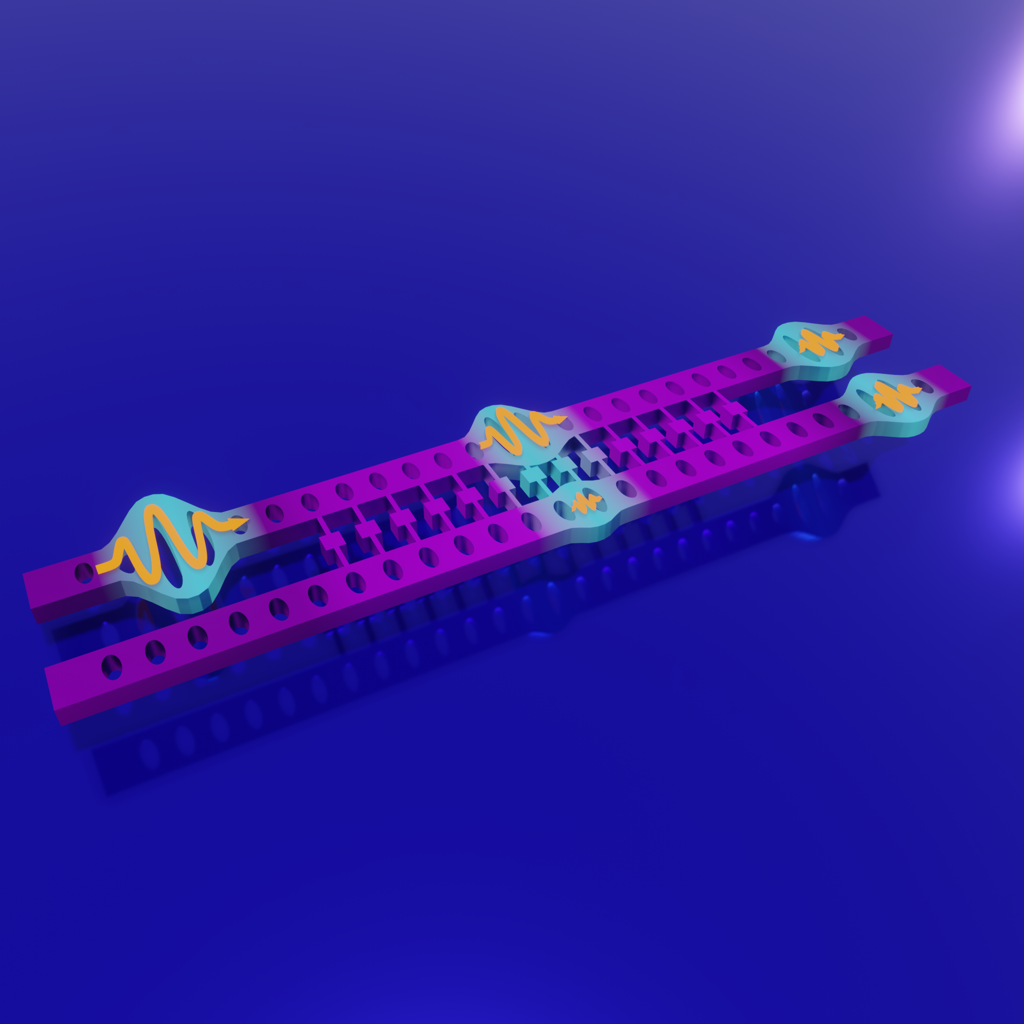
The new coupler addresses this gap by using a phononic‑crystal waveguide to confine gigahertz‑frequency phonons in a tightly controlled one‑dimensional channel. This design reduces cross‑talk between pathways, extends phonon lifetimes, and allows the device to be fabricated on a standard silicon wafer. In effect, the coupler acts like a miniature postal hub, capable of splitting, routing, or recombining quantum vibrations with the precision required for complex quantum networks.
Engineering the Splitter: From Silicon to Quantum
The heart of the device is a four‑port junction patterned onto a silicon chip. Two input ports feed phonons into the waveguide, while two output ports allow the split signal to exit. The waveguide itself is a phononic crystal, a periodic lattice of nanoscale holes that creates a bandgap for mechanical vibrations. By carefully tuning the lattice parameters, the researchers confined phonons to a narrow frequency band around several gigahertz, the sweet spot for quantum coherence at millikelvin temperatures.
Fabrication required nanometre‑scale precision. Electron‑beam lithography etched the lattice, and reactive‑ion etching released the silicon membrane, leaving a freestanding structure that supports the phonons. The coupling length, the distance over which two waveguides run side by side, was varied in successive devices to control the splitting ratio. A shorter coupling length produced a 50:50 split, while a longer length skewed the energy toward one output. The ability to tune the split ratio by design is a key feature for building more elaborate phononic circuits.
Because phonons are mechanical, any imperfection in the lattice can scatter them, increasing loss. The team addressed this by optimizing the etch chemistry and cleaning protocols, reducing surface roughness to a few nanometres. The resulting waveguides exhibited propagation lengths exceeding a millimetre, a substantial improvement over earlier devices.
Quantum Proof: Demonstrating Single‑Phonon Splitting
To prove that the coupler functions at the quantum level, the researchers employed a phonon heralding scheme. A superconducting qubit, coupled to a piezoelectric transducer, generated a single phonon on demand. The phonon entered the coupler, and its presence was inferred by detecting a correlated microwave photon emitted from the transducer after the phonon’s journey. This heralding technique confirmed that the device behaved as a true beam splitter for single phonons, not merely a classical divider.
The experiments revealed controllable splitting ratios even for single‑phonon inputs. By adjusting the coupling length, the probability of finding the phonon in either output port could be tuned from nearly zero to nearly one. Moreover, interference experiments demonstrated that the phonons retained their quantum coherence after passing through the coupler, a prerequisite for any quantum communication protocol.
These results mark the first demonstration of a chip‑based, on‑chip phononic splitter that operates at the single‑quanta level. The device’s performance is comparable to optical beam splitters used in quantum optics, yet it operates in a fundamentally different physical medium, opening new possibilities for hybrid quantum architectures.
Beyond the Lab: Towards Hybrid Quantum Networks
The practical impact of this technology lies in its ability to bridge otherwise incompatible quantum systems. Superconducting qubits, prized for their speed, are limited by short coherence times. Spin‑based qubits, such as nitrogen‑vacancy centres in diamond, store information for much longer but are slower to manipulate. By routing phonons between these platforms, a hybrid network could combine the best attributes of each: fast processing with long‑term storage.
Beyond computation, phonons offer a route to ultra‑sensitive sensing. Because mechanical vibrations interact strongly with their environment, a phononic interferometer could detect minute forces or fields with quantum‑limited precision. The same directional coupler could serve as a building block for such devices, enabling complex routing of phononic signals across a sensor array.
Integration with existing quantum computing platforms remains a challenge. The coupler must be coupled to superconducting qubits or spin ensembles without introducing excess loss. The researchers are already experimenting with embedding the coupler into a cryogenic microwave cavity, a step that could allow seamless interfacing with superconducting circuits. As fabrication techniques mature, it is plausible that future quantum processors will incorporate phononic routers alongside optical and microwave components, creating truly multi‑modal quantum chips.
A New Channel in the Quantum Landscape
The Delft team’s single‑phonon directional coupler represents a pivotal step toward scalable, hybrid quantum networks. By providing a compact, chip‑based means of manipulating individual mechanical quanta, the device fills a critical gap in the quantum toolbox. Its design echoes the role that optical beam splitters play in photonic quantum information. Yet, it operates in a medium that can coexist with solid‑state qubits on the same silicon platform.
As quantum technology races from laboratory curiosities to industrial applications, the ability to shuttle quantum information across diverse platforms will become increasingly valuable. The new coupler demonstrates that phonons can be harnessed with the same precision as photons, offering a versatile channel for quantum communication, computation, and sensing. In the coming years, as researchers integrate phononic components into larger circuits, the humble vibration that once only rattled in a crystal lattice may become a cornerstone of the next generation of quantum devices.
Frequently Asked Questions
What is a phonon splitter?
A phonon splitter is a chip-based device that can divide phonons, which are tiny packets of mechanical vibration used to carry information in quantum systems. This device facilitates the connection of different quantum technologies by enabling the controllable splitting of phonons.
How does the phonon splitter contribute to quantum networks?
The phonon splitter allows for the connection of various quantum devices by splitting phonons, which can serve as quantum messages. This helps create hybrid networks and supports advances in quantum computing and secure communication.
Why is the phonon splitter important for quantum technology?
The phonon splitter is crucial because it enables the linking of different quantum systems, which is essential for building practical phononic circuits. This supports the development of compact, scalable quantum networks and new ways to process quantum information.
When was the phonon splitter device developed?
The phonon splitter device was developed by researchers and reported in an article published on October 6, 2025.
Can the phonon splitter be used in practical applications?
Yes, the phonon splitter can be used in practical applications such as creating microscopic on-chip routers and splitters that link different types of quantum technologies, supporting advances in quantum computing and secure communication.
See today’s quantum computing news on Quantum Zeitgeist for the latest breakthroughs in qubits, hardware, algorithms, and industry deals.