

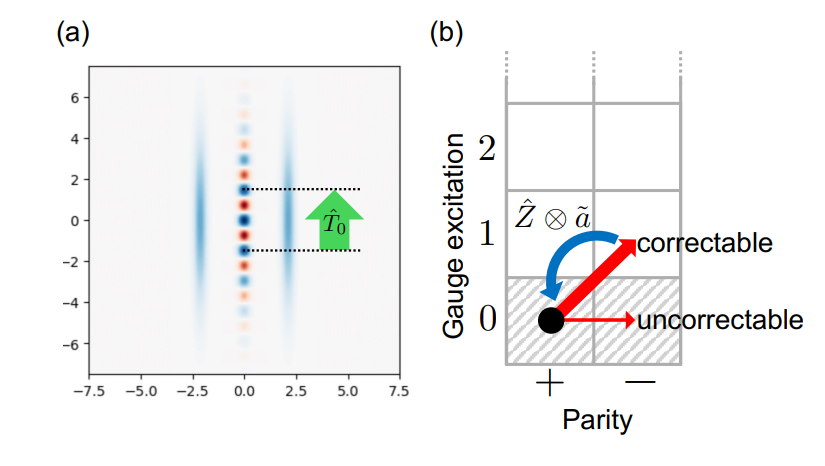
Quantum computing seeks increasingly robust methods for protecting fragile quantum information, and recent attention has focused on squeezed cat codes due to their resilience against common errors. Tomohiro Shitara, Gabriel Mintzer, Yuuki Tokunaga, and Suguru Endo, from NTT Computer and Data Science Laboratories and MIT, now demonstrate the power of a previously overlooked property of these codes, their inherent translational symmetry. This symmetry, the team reveals, unlocks new possibilities for autonomous quantum error correction, enabling the system to correct errors without external intervention, and facilitates reliable logical operations. Furthermore, their work introduces a method for accurately reading quantum information even when measured in a non-standard way, representing a significant step towards building practical and dependable quantum computers.
Dissipative Error Correction with Squeezed Qubits
This work details a quantum error correction scheme for squeezed cat qubits, a promising approach to building more robust quantum computers. The research focuses on dissipating unwanted states, those representing errors, into a harmless form, rather than actively correcting them, simplifying control requirements compared to traditional methods. Scientists demonstrate efficient error correction by focusing on a subsystem of the quantum system, allowing for streamlined operation, and developed methods for implementing fundamental quantum gates using a combination of physical operations and this dissipative error correction. Numerical simulations confirm the effectiveness of this approach, demonstrating successful reduction of errors caused by photon loss, a common source of noise in quantum systems.
Applying a “sharpen-trim” protocol, a key component of the scheme, recovers quantum coherence, and the team designed an improved measurement protocol for the Z operator, achieving significant accuracy improvement with favorable error scaling. These simulations validate theoretical predictions and demonstrate the potential for building more reliable quantum computers. The research highlights the advantages of this dissipative approach, which simplifies control requirements and offers a practical path towards fault-tolerant quantum computation. The ability to implement logical gates and perform accurate measurements is crucial for building complex quantum algorithms, representing a significant step forward in developing robust and reliable quantum computers, paving the way for more complex and powerful quantum technologies.
Squeezed Cat Codes Show Cubic Error Scaling
Scientists have achieved a significant breakthrough in quantum error correction by developing a new measurement scheme for squeezed cat codes. This scheme dramatically reduces the probability of errors, scaling with an error probability proportional to α’−6, representing a cubic improvement over existing methods, which typically scale as α’−2, bringing researchers closer to realizing fault-tolerant quantum computation. The research focuses on precisely reading out the logical state of the squeezed cat code, a promising approach for encoding quantum information robustly against noise. The team developed an improved measurement circuit based on a mathematical technique called “Trotterization,” which approximates complex quantum operations.
This circuit utilizes carefully designed operations to accurately determine the logical state, minimizing errors, and experiments reveal that the proposed circuit significantly reduces the probability of incorrectly identifying the logical state, confirming the cubic improvement in scaling. The team validated these findings through numerical simulations, comparing the new circuit to several alternative measurement protocols. The results demonstrate that this new scheme is particularly advantageous for certain quantum computing architectures, such as those based on superconducting circuits. The improved scaling allows for more reliable quantum computations with fewer resources, representing a crucial step towards building practical and scalable quantum computers, and paving the way for more complex and powerful quantum technologies.
Squeezed Cat Codes Enable Autonomous Error Correction
This research demonstrates the utility of translational symmetry within squeezed cat codes, advancing the field of quantum error correction. Scientists have developed a practical protocol for autonomous quantum error correction, meaning it operates without external feedback or conditioning, offering a significant improvement in hardware efficiency. This achievement builds upon existing methods, but offers a self-correcting nature verified both analytically and numerically. Furthermore, the team introduced methods for performing reliable logical operations, including fundamental quantum gates, and a circuit for precisely measuring the code in a non-orthogonal basis.
Leveraging the unique structure of these codes allows for more versatile quantum computations. Researchers acknowledge that further investigation is needed to fully understand the performance of their protocol on the code space. Future work may explore applying this approach to other types of quantum codes and investigating the error correction capabilities of different quantum states. By introducing a new way to represent the system, scientists aim to further unravel the functionality of dissipative quantum error correction and potentially improve the construction and understanding of quantum codes with translational symmetries, representing a substantial step forward in developing practical and robust quantum error correction schemes.
🗞 Exploiting Translational Symmetry for Quantum Computing with Squeezed Cat Qubits
🧠 ArXiv: https://arxiv.org/abs/2510.00497
See today’s quantum computing news on Quantum Zeitgeist for the latest breakthroughs in qubits, hardware, algorithms, and industry deals.



