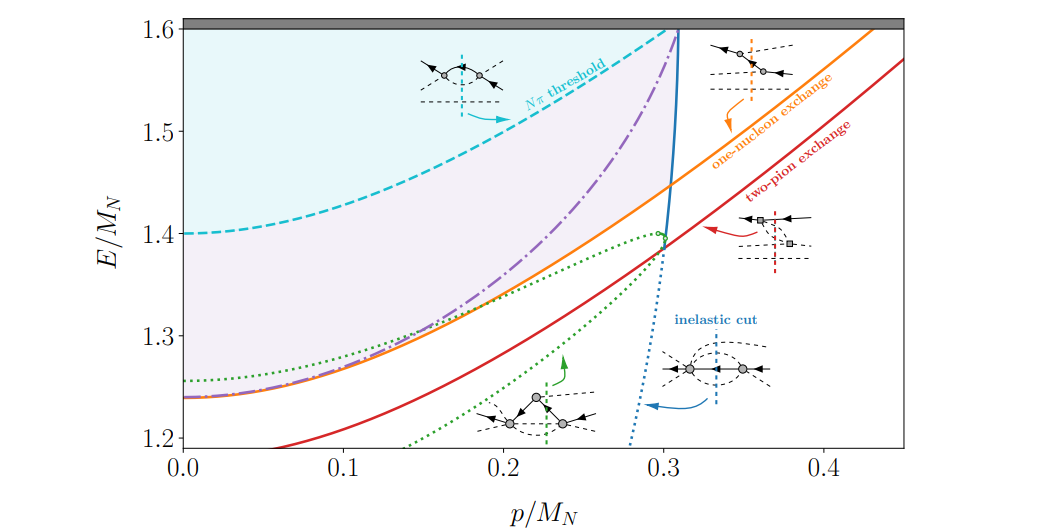
Understanding the strong force that binds protons and neutrons together within atomic nuclei remains a central challenge in physics, and recent work by Maxwell T. Hansen of the University of Edinburgh, Fernando Romero-López of the University of Bern, and Stephen R. Sharpe of the University of Washington, et al., represents a significant step forward in tackling this problem. The team develops a powerful mathematical framework to analyse interactions between particles at maximal isospin, a property related to their internal quantum state, and crucially, this framework allows for precise calculations of scattering processes that reveal the underlying dynamics of the strong force. By extending existing theoretical tools to incorporate the complexities of particle spin and interactions, the researchers provide a foundation for more accurate predictions of nuclear behaviour and a pathway towards a complete understanding of how atomic nuclei are formed and held together, paving the way for future investigations into more complex nuclear systems. This achievement promises to refine our understanding of matter at its most fundamental level and offers new insights into the building blocks of the universe.
Scientists have extended a theoretical framework to study interactions between particles, focusing on systems with multiple pions and nucleons. This work builds upon previous research using relativistic field theory, achieving high precision in calculations that relate the energy levels of particles confined to a limited space to the underlying forces governing their interactions. A central approach involves Lattice Quantum Chromodynamics (LQCD), a powerful numerical method for solving the equations governing the strong force. Calculations are often performed in finite volume, simulating a confined space, to mimic experimental conditions and extract information relevant to the physical world. This allows scientists to study resonances, short-lived excited states, and bound states formed by these particles. A key focus is understanding threshold singularities, points where the behavior of scattering amplitudes changes dramatically as new particles can be created.
These singularities are linked to the fundamental properties of the scattering amplitude and are crucial for interpreting experimental results. Researchers explore the analytic properties of these amplitudes, including symmetries like crossing symmetry and unitarity, which provide constraints on their form and allow for the extraction of physical information. This work also investigates the identification and characterization of resonances and bound states, determining their energy levels and decay properties. Effective Field Theories (EFTs) are used to simplify complex calculations by focusing on the most relevant degrees of freedom at a given energy scale. Computational tools like SOFIA, used for calculating complex mathematical expressions called Feynman integrals, and techniques from Computational Algebraic Geometry are employed to analyze the analytic properties of these integrals. This work focuses on the Nππ system, involving nucleons and pions, and establishes a finite-volume quantization condition that connects the energy spectrum of particles confined to a limited space to the underlying properties of their interactions. The team successfully incorporated nucleon spin into their calculations, adapting techniques from studies of three-neutron systems, and carefully determined the appropriate mathematical framework for different isospin configurations. Detailed calculations were performed to address potential singularities, requiring modifications to standard mathematical functions to ensure accurate results. The team demonstrated the implementation of this formalism using parameters corresponding to heavier-than-physical quarks, allowing for calculations accessible to Lattice QCD. They have developed a method to relate the energies observed in finite-volume calculations to the underlying properties of particle interactions, achieving high precision in their calculations. The study provides detailed analysis of potential singularities, points where calculations become undefined, that can arise in these interactions. Researchers identified conditions under which certain intermediate states could lead to these singularities and subsequently modified their mathematical tools to avoid them, ensuring the reliability of their results. This work lays the foundation for future investigations that will fully account for all possible interactions within the system.
👉 More information🗞Finite-volume formalism for at maximal isospin🧠
🗞 Finite-volume formalism for at maximal isospin
🧠 ArXiv: https://arxiv.org/abs/2509.24778




See today’s quantum computing news on Quantum Zeitgeist for the latest breakthroughs in qubits, hardware, algorithms, and industry deals.