The interaction between light and matter at the quantum level represents a cornerstone of modern physics, and researchers continually seek to refine our understanding of these fundamental processes. Ji Zhou, Yitong Wang, Debao Zhang, and colleagues at Fudan University, along with Wanggui Ye and Xinye Fan, now demonstrate a clear connection between theoretical predictions of quantum optics and the behaviour of light interacting with atomically thin semiconductors. Their work focuses on tungsten diselenide, a two-dimensional material where the team observes quantum effects in the way light excites electrons, specifically at the material’s band edges. The results reveal that the observed optical responses closely match the predictions of the quantum Rabi model, a key theory describing light-matter interactions, and importantly, show how these quantum properties change with temperature and the number of material layers, offering new insights into the fundamental quantum properties of these emerging materials.
A two-level system resonantly coupled with an electromagnetic field represents a central topic within quantum electrodynamics, theorised by the quantum Rabi model, and constitutes a fundamental issue in light-matter interactions. This testing and demonstration holds both scientific and technological significance due to the quick emergence of the second quantum revolution. This work demonstrates a quantum optics demonstration.
Exciton-Polariton Interactions in 2D Semiconductors
This research comprehensively investigates the quantum optical properties of 2D semiconductors, focusing on monolayer, bilayer, and hexagonal boron nitride (hBN) capped tungsten diselenide (WSe2). Scientists aimed to understand how light interacts with excitons, bound electron-hole pairs, within these materials and how these interactions are affected by layer number and environmental factors. The study combined experimental measurements of reflectance and photoluminescence with theoretical modelling based on the quantum Rabi model, allowing precise determination of key parameters like decoherence time, matrix elements, and Rabi frequencies. The team discovered that bilayer WSe2 exhibits a significantly shorter decoherence time compared to monolayer WSe2, while hBN capping extends the decoherence time in monolayers.
Bilayer WSe2 also displays larger matrix elements and Rabi frequencies than monolayer or hBN-capped WSe2. All measured parameters, decoherence time, matrix elements, and Rabi frequency, show a decrease with increasing temperature, though the strength of this decrease varies depending on the number of layers and the presence of hBN. The hBN capping layers modify the properties of monolayer WSe2, with the capping having a more pronounced effect on decoherence. This research provides valuable insights into the quantum optical properties of 2D semiconductors, crucial for developing novel optoelectronic devices and exploring quantum phenomena in these materials.
Controlling decoherence and manipulating excitons opens possibilities for quantum information processing and other advanced applications. Excitons are fundamental excitations in semiconductors, playing a crucial role in their optical properties. Decoherence represents the loss of quantum coherence, limiting the lifetime of quantum states and hindering quantum information processing. Matrix elements quantify the strength of the interaction between light and matter, while the Rabi frequency describes the rate of oscillation of a quantum system driven by light. hBN, a 2D material, acts as a dielectric substrate or capping layer, protecting and modifying the properties of other 2D materials. The quantum Rabi model simplifies the description of the interaction between a two-level quantum system, like an exciton, and light.
Quantum Rabi Model Explains WSe2 Exciton Response
Scientists have demonstrated a quantum optics description of light-matter interactions in atomically thin tungsten diselenide (WSe2) flakes, successfully applying the quantum Rabi model to explain their optical properties. The research focused on elementary excitations, specifically band-edge excitons, in monolayer, bilayer, and hexagonal boron nitride (hBN) capped WSe2, revealing how these materials respond to light at various temperatures ranging from 5 K to 300 K. Experiments revealed that reflectance and fluorescence patterns closely match predictions derived from the quantum Rabi model, confirming its validity for describing these two-dimensional materials. The team measured reflectance spectra, observing a characteristic peak near 1.
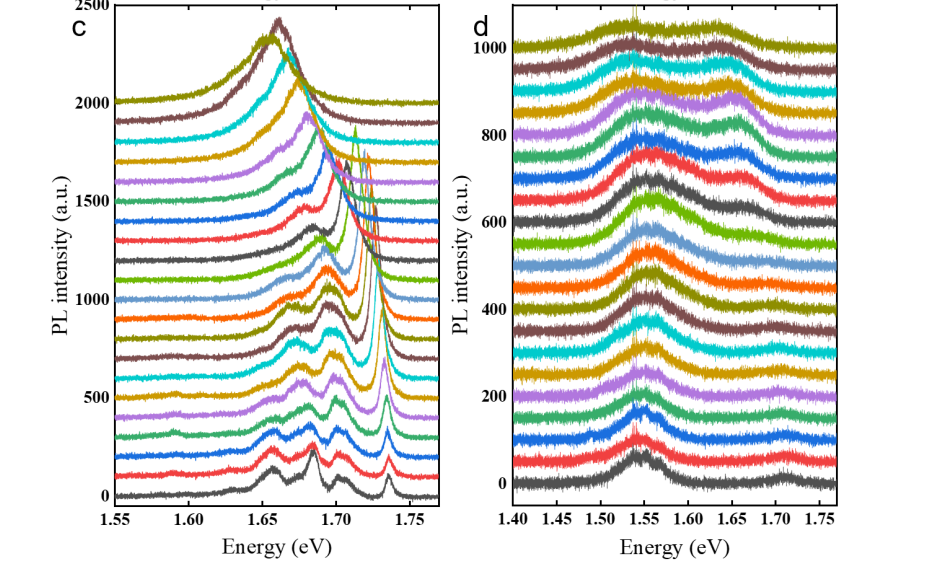
75 eV corresponding to the A exciton resonance in both monolayer and bilayer WSe2 at 5 K. Monolayer WSe2 exhibited enhanced oscillation amplitude in the reflectance spectrum compared to the bilayer, indicating stronger excitonic effects. Analysis of the photoluminescence spectra confirmed the A exciton emission at the highest energy position, with additional peaks attributed to trions and defect-bound excitons. Importantly, the bilayer WSe2 displayed a lower emission energy and weaker intensity, consistent with its indirect bandgap nature. Further investigation revealed a negative correlation between decoherence times, Rabi frequencies, and transition matrix elements with temperature, and a dependence on the number of WSe2 layers and the presence of a capping layer.
The team developed a theoretical framework based on the quantum Rabi model, solving the Bloch equations to describe the interaction between excitons and an external electromagnetic field. Calculations, incorporating corrections to existing models, accurately predicted the observed reflectance spectra, demonstrating the model’s ability to quantitatively explain the optical characteristics of these materials. These findings provide a novel perspective for understanding the fundamental quantum physical properties of two-dimensional materials and pave the way for future explorations in quantum optics and materials science.
Temperature Impacts Excitations in WSe2 Flakes
This research demonstrates a clear connection between theoretical predictions of the quantum Rabi model and experimental observations of light-matter interactions in few-layer tungsten diselenide (WSe2). Scientists successfully measured the optical responses of elementary excitations within monolayer, bilayer, and hexagonal boron nitride (hBN) capped WSe2 flakes across a range of temperatures. The results show that key parameters, decoherence times, Rabi frequencies, and transition matrix elements, all exhibit a negative correlation with temperature and depend on both the number of layers and the presence of a capping layer. Notably, the team found that hBN capping significantly extends the decoherence time of elementary excitations in monolayer WSe2, while bilayer WSe2 exhibits shorter decoherence times and larger matrix elements compared to monolayer samples.
These findings provide a novel understanding of the fundamental quantum physical properties of two-dimensional materials and represent an important step forward in solid quantum optics. The authors acknowledge that the observed temperature dependencies vary between different WSe2 configurations and layers, suggesting a complex interplay of factors influencing these quantum properties. Future research may focus on investigating other elementary excitations, such as dark excitons, within various two-dimensional semiconductors, building upon this demonstrated connection between theory and experiment.
🗞 Quantum Optics Nature of the Elementary Excitations in Few-Layer WSe2 Semiconductors
🧠 ArXiv: https://arxiv.org/abs/2509.24474