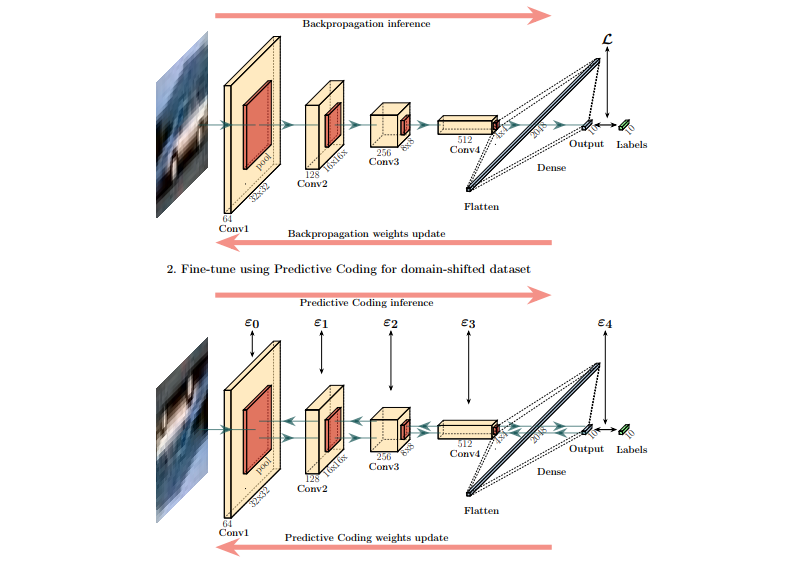
Deep neural networks frequently struggle to maintain accuracy when deployed in real-world settings, as changes in input data, such as variations in lighting or sensor drift, demand continuous model adaptation. Matteo Cardoni and Sam Leroux, from Ghent University and imec, address this challenge by developing a novel training methodology that combines the strengths of two established techniques, backpropagation and predictive coding. Their approach initially trains a network using backpropagation to achieve strong initial performance, then employs predictive coding to adapt the model online, recovering accuracy lost due to shifts in input data. This hybrid strategy offers a computationally efficient solution for continual learning, making it particularly valuable for resource-constrained devices and future hardware accelerators, and demonstrates a significant step towards robust and reliable artificial intelligence systems in dynamic environments.
This work proposes a hybrid training methodology that enables efficient on-device domain adaptation by combining the strengths of Backpropagation and Predictive Coding. The method begins with a deep neural network trained offline using Backpropagation to achieve high initial performance, then employs Predictive Coding for online adaptation, allowing the model to recover accuracy lost due to shifts in the input data distribution. This approach leverages the robustness of Backpropagation for initial representation learning and the computational efficiency of Predictive Coding for subsequent refinement, ultimately enabling effective adaptation to changing environmental conditions.
Predictive Coding for Image Domain Adaptation
Applying Predictive Coding for Image Domain Adaptation
Predictive Coding for Image Domain Adaptation
Scientists investigated whether Predictive Coding can effectively adapt image classification models to new conditions, comparing its performance to traditional Backpropagation. The research focused on training models on one dataset and then testing them on slightly modified versions, simulating real-world scenarios where input data changes. The team experimented with various network architectures, including simplified versions of the VGG network and fully connected Multi-Layer Perceptrons, and introduced different types of noise to the test images, such as inverting colors, rotating images, and adding random noise, to assess the models’ robustness. The researchers carefully tuned key parameters for both Backpropagation and Predictive Coding, including learning rates, weight decay for regularization, and specific parameters controlling the speed of prediction updates.
They employed a systematic search to identify optimal settings that ensured stable training and prevented significant drops in accuracy. Models were trained for ten epochs with a batch size of 128, and data normalization and augmentation techniques were applied to improve performance. The team normalized the CIFAR-10 dataset and applied techniques like zero padding, random cropping, and horizontal flipping to increase the diversity of the training data. Detailed analyses revealed the specific hyperparameters used for training with Backpropagation and Predictive Coding under different noise conditions. This research provides valuable insights into the potential of Predictive Coding as a viable alternative to Backpropagation, particularly when dealing with challenges posed by changing data distributions.
Online Adaptation Using Hybrid Backpropagation Methods
Hybrid Training Adapts Neural Networks Online
Implementing the Hybrid Backpropagation Methodology
Scientists have developed a novel hybrid training methodology that combines Backpropagation and Predictive Coding to enable efficient on-device adaptation of deep neural networks. The work addresses the challenge of maintaining model performance in dynamic environments where input data distributions shift due to factors like sensor drift or changing lighting conditions. The team began by training a deep neural network offline using Backpropagation to achieve high initial accuracy, then employed Predictive Coding for online adaptation, allowing the model to recover performance lost due to these data shifts. Experiments on the MNIST and CIFAR-10 datasets demonstrate the effectiveness of this approach.
The researchers achieved a significant outcome by leveraging the robustness of Backpropagation for initial learning and the computational efficiency of Predictive Coding for continual adaptation. This combination allows for on-device updates without requiring extensive computational resources or communication with the cloud. The method relies on local computations and error-driven updates, aligning well with the distributed nature of emerging neuromorphic architectures. During the Predictive Coding phase, an input sample is applied to the first layer and the last layer is set to the desired output.
Layer-Wise Energy Minimization for Adaptation
Mechanism: Minimizing Energy for Adaptation
The system then iteratively minimizes an energy function, which is the sum of layer-wise prediction errors, to update layer activities. This process allows the model to adapt to changing data distributions by minimizing the discrepancy between predicted and actual activities at each layer. The results demonstrate a promising solution for maintaining model performance in real-time applications on energy-constrained edge devices, paving the way for more robust and adaptable artificial intelligence systems.
Hybrid Learning Adapts to Shifting Data
Successful Online Adaptation to Dynamic Data Sources
This research demonstrates an efficient method for adapting deep neural networks to changing environments, combining backpropagation and predictive coding. The team successfully showed that models initially trained with backpropagation can effectively leverage predictive coding for online finetuning when faced with shifts in input data. This approach enables continued accuracy without requiring complete retraining, offering a promising solution for resource-constrained devices and future computing architectures. Experiments on standard datasets, including MNIST and CIFAR-10, confirm the effectiveness of this hybrid strategy in maintaining performance under altered conditions.
The study acknowledges that adapting deeper predictive coding-based networks may present greater challenges, and that the current implementation relies on supervised learning, which may not always be practical. Future work will focus on evaluating training times on embedded and neuromorphic hardware, and extending the method to more complex network architectures. The researchers also plan to investigate unsupervised and self-supervised learning approaches to broaden the applicability of this technique in real-world scenarios where labelled data is limited. This ongoing research aims to advance computationally efficient domain adaptation, particularly for deployment on specialized hardware platforms.
🗞 Predictive Coding-based Deep Neural Network Fine-tuning for Computationally Efficient Domain Adaptation
🧠 ArXiv: https://arxiv.org/abs/2509.20269