The escalating energy demands of modern artificial intelligence pose a significant challenge to sustainable development, prompting researchers to explore alternatives to the standard backpropagation method for training deep neural networks. Przemysław Spyra from AGH University of Science and Technology, and colleagues, rigorously investigate three backpropagation-free training algorithms, Forward-Forward, Cascaded-Forward, and Mono-Forward, to identify a more efficient solution. This work establishes a comprehensive comparative framework, demonstrating that the Mono-Forward algorithm not only matches but consistently exceeds the classification accuracy of backpropagation on multilayer perceptrons. Crucially, the team’s hardware-level analysis reveals that Mono-Forward reduces energy consumption by up to 41% and training time by up to 34%, offering a substantial step towards a smaller carbon footprint for deep learning applications and challenging conventional assumptions about optimization and efficiency in neural networks.
Mono-Forward and Cascading Forward Learning Algorithms
This research details the experimental setup used to investigate alternative learning algorithms to backpropagation, focusing on Mono-Forward (MF), Cascaded-Forward (CaFo), and Forward-Forward (FF). The study aimed to explore potentially more efficient and biologically plausible learning methods for deep neural networks. Experiments involved implementing each algorithm and comparing its performance against standard backpropagation baselines, utilizing datasets including MNIST, Fashion-MNIST, CIFAR-10, and CIFAR-100, employing both multilayer perceptrons (MLPs) and convolutional neural networks (CNNs) depending on the dataset. Optimization relied primarily on the Adam optimizer, with hyperparameters carefully tuned using Optuna to maximize performance.
Experiment tracking and logging were managed using WandB, while energy consumption and resource usage were monitored with NVML and CodeCarbon. The research team meticulously tracked accuracy, floating point operations (FLOPs), energy consumption, and carbon footprint to provide a comprehensive performance evaluation. Experiments were conducted on a system running Rocky Linux 9, equipped with an AMD EPYC 7742 CPU, an NVIDIA A100-SXM4-40GB GPU, and utilizing PyTorch 2. 4. 0, CUDA 12.
- 0, and Python 3. 10. 4. A SLURM job scheduler managed computational resources. To ensure reproducibility, all source code and experimental logs are publicly available on GitHub, along with detailed instructions for replicating the experiments in the repository’s README file.
Backpropagation Alternatives Benchmarked on Neural Networks
Scientists rigorously investigated three backpropagation-free training methods, Forward-Forward, Cascaded-Forward, and Mono-Forward, to address the increasing energy demands of deep neural networks. The study established a robust comparative framework, implementing each algorithm on its native architecture, multilayer perceptrons for Forward-Forward and Mono-Forward, and convolutional neural networks for Cascaded-Forward, and benchmarking performance against equivalent backpropagation-trained models. Researchers employed Optuna for hyperparameter tuning, systematically searching for the best configuration for each algorithm, and applied consistent early stopping criteria based on validation performance to guarantee optimal tuning. This meticulous approach ensured that observed differences were attributable to the algorithms themselves, rather than suboptimal parameter settings.
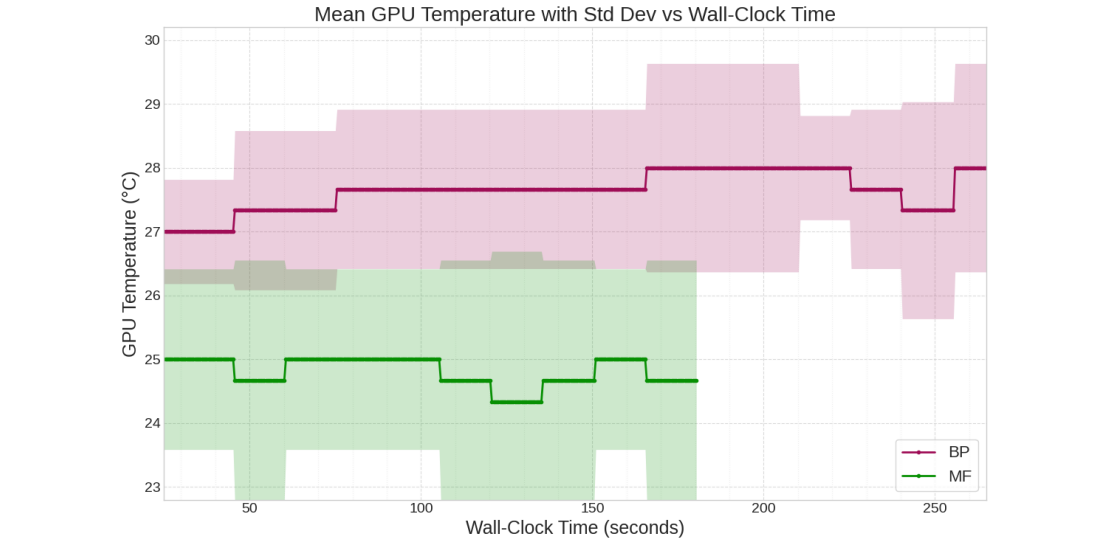
The team measured classification accuracy on each network’s native architecture, revealing that the Mono-Forward algorithm not only matched but consistently surpassed backpropagation performance on multilayer perceptrons. Further analysis revealed that Mono-Forward achieves superior generalization by converging to a more favorable minimum in the validation loss landscape, challenging the assumption that global optimization is essential for state-of-the-art results. Scientists measured energy consumption and training time at the hardware level using the NVIDIA Management Library (NVML) API, demonstrating that Mono-Forward reduces energy consumption by up to 41% and shortens training time by up to 34%. These gains translate to a demonstrably smaller carbon footprint, estimated using the CodeCarbon tool.
Mono-Forward Surpasses Backpropagation in Neural Networks
Scientists achieved a breakthrough in deep learning training, demonstrating that the Mono-Forward algorithm not only competes with but consistently surpasses backpropagation in classification accuracy when implemented on multilayer perceptrons. Experiments reveal that Mono-Forward converges to a more favorable minimum in the validation loss landscape, challenging the long-held assumption that global optimization is essential for achieving state-of-the-art results in neural networks. The research team rigorously compared Mono-Forward, the Forward-Forward algorithm, and the Cascaded-Forward algorithm against equivalent backpropagation-trained models, optimizing hyperparameters with Optuna and applying consistent early stopping criteria to ensure optimal tuning across all models. Measurements confirm that Mono-Forward reduces energy consumption by up to 41% and shortens training time by up to 34% compared to backpropagation, translating to a demonstrably smaller carbon footprint as estimated by the CodeCarbon tool.
This reduction in energy usage represents a significant step towards sustainable artificial intelligence development, addressing the escalating energy demands of increasingly complex deep neural networks. Hardware-level analysis exposed inefficiencies in the Forward-Forward architecture, while validating the computationally lean design of Mono-Forward. Data shows that the team established a robust comparative framework, implementing each algorithm on its native architecture, multilayer perceptrons for Forward-Forward and Mono-Forward, and a convolutional neural network for Cascaded-Forward, to ensure a fair and accurate assessment.
Mono-Forward Outperforms Backpropagation in Efficiency and Accuracy
This work presents a rigorous comparison of three backpropagation-free training methods, Forward-Forward, Cascaded-Forward, and Mono-Forward, against standard backpropagation. Researchers established a robust framework by implementing each algorithm on its native architecture and carefully optimizing hyperparameters to ensure a fair comparison of performance. Results demonstrate that the Mono-Forward algorithm not only achieves competitive classification accuracy on multilayer perceptrons but consistently surpasses backpropagation in this regard. Importantly, this improved performance is coupled with significant gains in energy efficiency, reducing consumption by up to 41% and training time by up to 34%, thereby lowering the carbon footprint of deep learning models.
The study’s detailed hardware-level analysis reveals that these efficiency improvements stem from Mono-Forward’s computationally lean design and its ability to converge to favorable minima in the loss landscape, challenging the assumption that global optimization is always necessary. Researchers also exposed architectural inefficiencies in the Forward-Forward method, providing valuable insights into the design principles of energy-efficient algorithms. Future work should focus on extending this analysis to a wider range of network architectures and datasets to further refine our understanding of sustainable deep learning practices.
🗞 Beyond Backpropagation: Exploring Innovative Algorithms for Energy-Efficient Deep Neural Network Training
🧠 ArXiv: https://arxiv.org/abs/2509.19063
See today’s quantum computing news on Quantum Zeitgeist for the latest breakthroughs in qubits, hardware, algorithms, and industry deals.