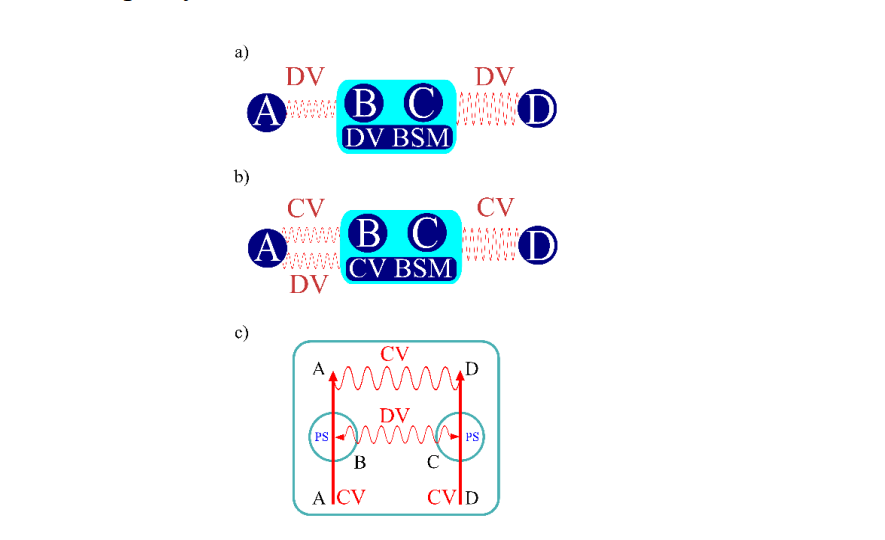
Entanglement, a cornerstone of quantum mechanics, increasingly fuels advances in communication and computation, and researchers continually seek ways to create and manipulate this fragile phenomenon. Mikhail S. Podoshvedov and Sergey A. Podoshvedov, both from South Ural State University, along with their colleagues, demonstrate a novel mechanism for transferring entanglement from a single photon to continuous variable states, even without direct interaction between them. This work establishes a process where entanglement originates from a nonlocal photon and is successfully ‘transferred’ to these states, achieving a probability of over 98% when using specifically prepared initial states. The team’s findings represent a significant step forward, offering a highly efficient method for generating robust, parity-entangled states suitable for practical quantum technologies, and preserving a crucial balance between the reliability and brightness of the resulting quantum signals.
The research focuses on creating these states using beam splitters and single-photon interactions, and precisely predicting the probabilities of different measurement outcomes. This work advances the field of quantum technologies by providing a foundation for manipulating these complex quantum states and builds upon previous research by the authors. The team explores how hybrid entangled states are created by directing a continuous-variable state and a single photon through a beam splitter.
Key to this process are amplitudes, which describe how the continuous-variable state transforms due to the beam splitter and single-photon interaction. These amplitudes, influenced by parameters representing the input state and the strength of the interaction, are crucial for calculating measurement probabilities. The research introduces normalization coefficients and amplitude distortion factors, which account for signal loss and distortion during the beam splitter and single-photon interaction. These factors, dependent on parameters like the number of photons, are essential for accurately modelling the behaviour of the quantum states.
The document then provides equations for calculating the probability distributions of measurement outcomes when performing measurements on the generated states. Furthermore, the research details how to calculate the average number of photons in the measurement-induced states, dependent on parameters and the number of photons. This ability to generate and control these states with precision is crucial for quantum metrology and quantum information processing, such as quantum key distribution and computation. This theoretical framework provides the equations and parameters needed to guide experimental validation of the predictions, offering a valuable resource for researchers in quantum optics and quantum information processing. This process relies on carefully tuned measurements and initial squeezing of the vacuum states, achieving a maximum entanglement transfer probability of 0. 2344, a value considered promising for practical applications. The research demonstrates a pathway to create entangled states without requiring initial entanglement between the light states themselves. A key improvement involves utilizing squeezed vacuum states with one photon initially subtracted.
This “heralded” technique dramatically increases the reliability of
This “heralded” technique dramatically increases the reliability of entanglement transfer, achieving a probability exceeding 0. 98 and effectively transforming a probabilistic process into a nearly deterministic one. This nearly perfect transfer preserves a crucial balance between the probability of success and the brightness of the resulting light states, making it particularly suitable for demanding quantum technologies. Further investigation revealed the importance of beam splitters and their reflectivity in optimizing the transfer process. Highly reflective beam splitters enable a near-unit probability of success for specific measurement outcomes, although this comes at the cost of reduced brightness.
Conversely, using beam splitters with a transmissivity of 0. 221 and initial squeezing of 10. 6 dB allows for entanglement transfer without vacuum measurement, achieving a maximum success probability of 0. 0827 while maintaining comparable brightness to the initial squeezed states. Detailed analysis of amplitude distortion factors revealed that achieving perfect entanglement transfer requires specific parameter values.
While a perfect match could not be found for all measurement scenarios, the team demonstrated that two-photon subtraction using a near-balanced beam splitter can achieve values close to unity for certain parameters. This allows for the realization of probabilities for specific events, paving the way for more efficient and reliable entanglement generation. This process relies on carefully tuned measurements and initial squeezing of the vacuum states, achieving a maximum entanglement transfer probability of 0. 2344, a significant step towards practical applications of this quantum phenomenon. The research highlights a pathway to create entangled states without requiring initial entanglement between the light states themselves. The team discovered that utilizing states from which one photon has been subtracted significantly improved the reliability of the entanglement transfer.
This “heralded” technique elevates the probability of maximum entanglement to greater than 0. 98, effectively transforming a probabilistic process into a nearly deterministic one. This nearly perfect transfer preserves a crucial balance between the probability of success and the brightness of the resulting quantum states. Further investigation into optimizing this transfer revealed the importance of beam splitters and their reflectivity. Highly reflective beam splitters enable a near-unit probability of success for the “no-click, no-click” event, where no photons are detected in initial measurements.
However, this approach significantly reduces the brightness of
However, this approach significantly reduces the brightness of the output entanglement. Conversely, utilizing beam splitters with a transmissivity of 0. 221 and initial squeezing of 10. 6 dB allows for entanglement transfer without vacuum measurement, achieving a maximum success probability of 0. 0827.
This optimization maintains a comparable level of brightness to the initial squeezed states, demonstrating a pathway towards brighter, more practical entangled states. Detailed analysis of amplitude distortion factors revealed that achieving perfect entanglement transfer requires specific parameter values. While a perfect match could not be found for all measurement scenarios, the team demonstrated that two-photon subtraction using a near-balanced beam splitter can achieve values close to unity for certain parameters. The process relies on carefully tuned measurements and initial squeezing of the vacuum states, achieving a maximum entanglement transfer probability of 0. 2344, a promising step towards practical applications. The research highlights a pathway to create entangled states without requiring initial entanglement between the light states themselves.
🗞 Transfer of entanglement from nonlocal photon to non-Gaussian CV states
🧠 ArXiv: https://arxiv.org/abs/2509.17700


See today’s quantum computing news on Quantum Zeitgeist for the latest breakthroughs in qubits, hardware, algorithms, and industry deals.