Fault-tolerant quantum computing requires decoders capable of rapidly and accurately correcting errors, yet current methods struggle with the complex demands of running actual quantum algorithms. J. Pablo Bonilla Ataides, Andi Gu, Susanne F. Yelin, and Mikhail D. Lukin, along with their colleagues, address this challenge by introducing a new neural decoder that learns the intricate relationships created by quantum logic gates. This innovative approach not only achieves decoding speeds comparable to traditional methods, but also demonstrates superior performance when dealing with realistic noise and qubit loss, and importantly, generalises effectively to different quantum algorithms and error-correcting codes. By simplifying decoder design without compromising accuracy and offering insights into the decoder’s decision-making process, this work establishes neural decoders as a practical and versatile tool, paving the way for experimental validation of deep-circuit fault-tolerant quantum computers.
Error correlation remains a significant limitation in quantum error correction. Researchers introduce a modular attention-based neural decoder that learns gate-induced correlations and generalizes from training on random circuits to unseen multi-qubit algorithmic workloads. These decoders achieve fast inference and logical error rates comparable to most-likely-error (MLE) decoders across varied circuit depths and qubit counts. Addressing realistic noise, the team incorporates loss-resolving readout, yielding substantial gains when qubit loss is present. The researchers have developed a neural network-based decoder that adapts to various quantum codes, including surface codes, Reed-Muller codes, and color codes, and different decoding scenarios. This decoder aims to improve performance and efficiency compared to traditional methods, particularly for complex circuits and algorithms. The work details the decoder’s architecture, training strategies, performance benchmarks, and scalability analysis. The central idea is a flexible decoder architecture that isn’t tied to a specific code, learning to decode based on code structure and noise characteristics.
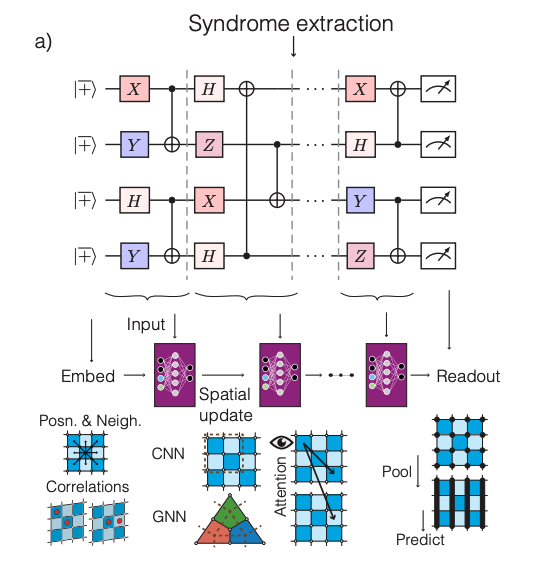
The decoder utilizes neural networks to learn complex relationships between syndromes and errors. Adaptability is achieved by modifying the spatial update layer, which processes the code’s geometry, using convolutions for grid-based codes like surface codes and graph neural networks for more complex geometries like color codes. Key components include the spatial update layer, attention mechanisms to focus on relevant syndrome parts, and loss-aware decoding to incorporate qubit loss information. A key training technique is layered supervision, where the decoder is trained on intermediate outputs at each layer of the circuit, providing more training signal and improving learning.
Mixed-precision training uses half-precision floating-point numbers to accelerate training without sacrificing accuracy, while data augmentation generates multiple noise realizations for each circuit to improve robustness. The decoder is optimized using the AdamW optimizer with specific hyperparameters and a cosine annealing learning rate schedule with a linear warmup. The decoder achieves competitive performance on random Clifford circuits, demonstrating effective error correction. It performs well on logical algorithms implemented with the [[15,1,3]] Reed-Muller code and achieves a memory circuit threshold near 0.
5% for 2D color codes. Specialized architectures achieve sub-microsecond inference per qubit for cluster state circuits. Theoretical complexity is O(d 4 ) due to all-to-all attention, but empirical scaling is approximately O(d 2 ) due to GPU optimization, with inference time nearly independent of logical qubit count for specialized architectures. Surface codes utilize convolutional neural networks for the spatial update layer, while color codes employ graph neural networks to process code geometry. Reed-Muller codes use a dense neural network architecture due to the code’s small size, and cluster states use fixed-kernel convolutions for faster inference.
Simulations use depolarizing noise to model errors in physical qubits and gates, varying the physical error rate and circuit depth to evaluate performance. Logical error rate measures decoder accuracy, and performance is compared to an optimal most-likely-error decoder implemented with Gurobi. Key innovations include the generalizable decoder framework, layered supervision training strategy, GNN-based decoding for color codes, and scalability analysis. This research presents a promising new approach to quantum error correction that leverages machine learning to create a flexible, efficient, and scalable decoder, potentially improving the performance of quantum computers.
Neural Decoder Rivals Optimal Quantum Error Correction
Researchers have developed a new neural decoder architecture designed to address the challenges of fault-tolerant quantum computing, achieving performance comparable to most-likely-error (MLE) decoders while offering significant advantages in speed and adaptability. This work focuses on algorithmic decoding, where errors are correlated due to the operation of logical gates, a complexity absent in previous approaches focused on quantum memory. The team’s modular, attention-based neural decoder learns these gate-induced correlations, allowing it to generalize from training on random circuits to unseen algorithmic workloads without retraining. Experiments demonstrate that the neural decoder achieves fast inference and logical rates comparable to MLE decoders across varied circuit depths and qubit counts.
Performance was evaluated as a function of circuit depth and code distance, revealing the decoder’s ability to maintain accuracy even as computational complexity increases. The architecture incorporates loss-resolving readout, yielding substantial gains when qubit loss is present, and further simplifies decoding by focusing on relevant circuit observables. Validation on multiple error correction codes, including surface codes and 2D color codes, confirms state-of-the-art performance under realistic circuit-level noise. A key achievement is the decoder’s interpretability, enabled by the attention mechanism, which identifies the most relevant correlations being tracked during computation. By probing attention weights, researchers found the model learns to focus on physically meaningful error propagation patterns consistent with entangling gates. This work establishes neural decoders as a robust, accurate, and practical foundation for fault-tolerant quantum algorithms, paving the way for experimental validation of deep-circuit architectures and advancing the field of quantum computing.
Neural Decoder Generalizes Across Quantum Circuits
This research presents a new approach to decoding in fault-tolerant computing, achieving significant advances in both speed and accuracy. Scientists developed a modular attention-based neural decoder that effectively learns the correlations arising from logical gates within quantum circuits. Importantly, this decoder generalizes well, demonstrating strong performance on unseen circuits and various qubit counts after initial training on smaller systems. The method achieves logical rates comparable to established decoding techniques while offering faster inference speeds. The team further refined the decoder by incorporating loss-resolving readout, substantially improving performance when dealing with realistic qubit loss.
By tailoring the decoder to the specific structure of the algorithm and focusing on relevant observables, they simplified the design without compromising accuracy. Validation on multiple quantum codes, including surface and 2D color codes, confirms state-of-the-art performance under circuit-level noise. The attention mechanism itself provides interpretability, revealing which correlations the decoder prioritizes during computation. The authors acknowledge that the decoder’s performance is dependent on the quality of the training data and the complexity of the circuits. Future work will likely focus on expanding the training datasets and exploring the decoder’s capabilities with even more complex algorithmic workloads. This work establishes neural decoders as practical and versatile tools for advancing deep-circuit fault-tolerant algorithms and architectures, paving the way for more robust and efficient quantum computation.
🗞 Neural Decoders for Universal Quantum Algorithms
🧠 ArXiv: https://arxiv.org/abs/2509.11370