Combinatorial optimization, the process of finding the best solution from a vast number of possibilities, presents a significant challenge for modern computing, yet it underpins many practical applications. Xuhao Zhu from Zhejiang University, Zuoheng Zou from Huawei Technologies, and Feitong Jin, also from Zhejiang University, alongside Pavel Mosharev, Maolin Luo, and Yaozu Wu from Huawei Technologies, have developed a new algorithm that leverages the power of quantum circuits to tackle these complex problems. The team demonstrates a hybrid quantum-classical approach, employing a shallow-circuit sampling technique on a superconducting quantum processor with up to 104 qubits, to efficiently navigate the challenging energy landscapes of combinatorial optimization problems. This innovative method achieves demonstrably better solutions than highly optimised classical algorithms, and importantly, suggests a clear pathway towards quantum speedup for these problems as quantum processors continue to scale towards larger qubit numbers.
Quantum Optimization via Variational Algorithms and Annealing
Quantum computing research focuses intensely on developing algorithms to solve optimization problems that challenge classical computers. Key approaches include the Quantum Approximate Optimization Algorithm (QAOA), which receives considerable attention for its potential and ongoing improvements, and Quantum Annealing, explored for its scaling advantages. Researchers also investigate Quantum Monte Carlo methods, aiming to enhance their efficiency with quantum effects. Classical optimization techniques, such as Simulated Annealing, Tabu Search, and Genetic Algorithms, provide a crucial benchmark for evaluating quantum algorithms.
A significant challenge in realizing practical quantum computers lies in mitigating errors. Scientists are actively developing quantum error correction methods, notably surface code error correction, to create logical qubits with improved performance. Progress also depends on advancements in quantum hardware and control, including digital signal processing techniques, and the ability to scale up quantum systems. These algorithms have potential applications in diverse fields, including solving combinatorial optimization problems, studying complex physical systems like Ising models and spin glasses, and potentially enhancing machine learning methods.
Current research emphasizes improving QAOA through parameter optimization, novel circuit designs, and techniques like warm-starting, which uses classical solutions to accelerate convergence. Researchers are also exploring connections between QAOA and statistical physics through the concept of pseudo-Boltzmann states. Scaling quantum systems requires both quantum error correction and increasing the number of qubits in processors. Hybrid quantum-classical algorithms, combining the strengths of both approaches, are proving particularly promising. The ultimate goal remains demonstrating quantum advantage, where quantum computers outperform classical computers on specific problems.
Quantum simulation and quantum-enhanced Monte Carlo methods also represent important research directions. This research field is active and rapidly expanding, with a strong emphasis on making quantum algorithms practical and addressing the challenges of building real-world quantum computers. The research draws on concepts from physics, computer science, mathematics, and engineering, and researchers actively benchmark quantum algorithms against classical methods. The emergence of frameworks like Mindspore Quantum suggests a growing ecosystem of tools and resources for quantum computing, and recent publications indicate a current snapshot of this dynamic field.
Quantum Algorithm Outperforms Classical Optimization Methods
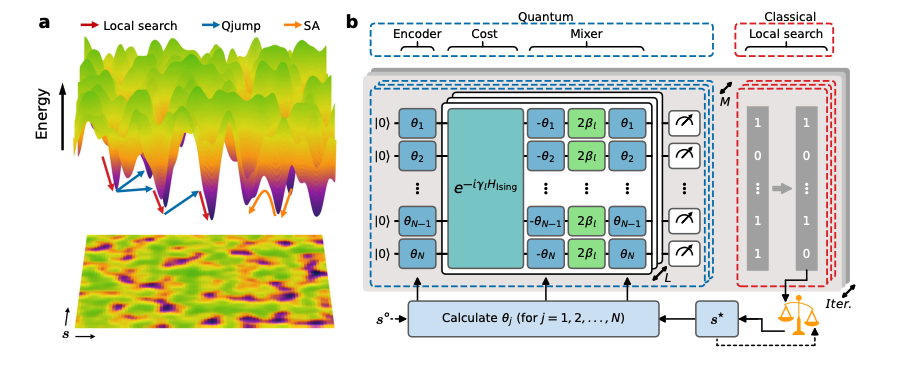
Scientists have achieved a breakthrough in solving complex optimization problems with a new quantum algorithm, named quantum enhanced jumping (Qjump). This algorithm addresses a critical challenge in computing by accelerating solutions to problems that are classically intractable, specifically focusing on finding the ground states of the Ising model, a cornerstone of combinatorial optimization. The team successfully implemented Qjump on a quantum processor containing up to 104 superconducting qubits, demonstrating its ability to find favorable solutions even when compared against a highly-optimized classical simulated annealing (SA) algorithm. Experiments reveal that Qjump navigates the energy landscape of the Ising model more effectively than classical methods, particularly on challenging problem instances.
Researchers generated 4000 random problems and selected the 200 with the highest solution times for classical simulated annealing, ranging from 0. 02 to 0. 4 seconds. The Qjump algorithm then outperformed SA on these difficult problems, demonstrating a promising alternative to traditional heuristics. The algorithm employs a hybrid quantum-classical workflow, utilizing shallow quantum circuits to guide the search procedure and stimulate transitions between promising energy basins while delegating other tasks to a classical computer.
Measurements confirm that Qjump’s performance is particularly notable when considering the time-to-solution metric. Researchers envision a pathway to quantum speedup against SA running on a single-core CPU, based on current superconducting qubit technologies. This suggests that quantum advantage may be achievable on near-term quantum processors with thousands of qubits, without the need for error correction. The team’s results point to the potential applicability of noisy intermediate-scale quantum (NISQ) processors, matched with hybrid quantum-classical algorithms, in solving real-world problems that demand efficient optimization.
Qjump Algorithm Outperforms Classical Optimization Methods
This research demonstrates a new algorithm, Qjump, for solving complex combinatorial optimization problems, specifically those represented by the Ising model. By employing a hybrid quantum-classical approach, the team successfully navigated the energy landscape of these problems using a superconducting quantum processor with up to 104 qubits. Results indicate that Qjump delivers favorable solutions compared to a highly-optimized classical simulated annealing algorithm, even with a relatively small number of qubits. The algorithm’s performance was assessed using a time-to-solution metric, revealing a promising path toward achieving a speedup over classical methods as the number of qubits increases.
Notably, Qjump eliminates the need for parameter optimization, a common requirement in other quantum algorithms like QAOA, by leveraging sampling from circuits with fixed transfer parameters and integrating classical local search routines. The team experimentally verified the algorithm’s effectiveness on their quantum processor, achieving high fidelity in both qubit manipulation and measurement. The authors acknowledge that the computational speed of the quantum hardware and classical CPU are factors influencing performance, and further investigation is needed as hardware capabilities advance. Future work will focus on scaling the algorithm to larger numbers of qubits and exploring its potential for solving a wider range of optimization problems. This work represents a significant step toward harnessing the power of near-term quantum processors for practical applications in fields reliant on solving computationally challenging problems.
🗞 Combinatorial optimization enhanced by shallow quantum circuits with 104 superconducting qubits
🧠 ArXiv: https://arxiv.org/abs/2509.11535



See today’s quantum computing news on Quantum Zeitgeist for the latest breakthroughs in qubits, hardware, algorithms, and industry deals.