The search for robust quantum computers hinges on identifying particles suitable for braiding, a process where exchanging particles manipulates quantum information, but a fundamental challenge remains in confirming the properties of these potential building blocks. Zhiyu Fan from Shanghai Jiao Tong University and Wei Ku demonstrate that, contrary to widespread assumptions, the Bogoliubov quasi-particles found in superconductors possess integer charge and behave as their own anti-particles, rendering them unsuitable for the braiding necessary to encode and process quantum data. This research rigorously proves that these quasi-particles adhere to standard charge quantization, a finding that necessitates a critical re-evaluation of approaches relying on Majorana zero modes for quantum computation. The team’s work further highlights the difficulties in creating and controlling braidable states using realistic physical processes, and it encourages a renewed focus on developing a complete, number-conserving theory of superconductivity that avoids artificial symmetry breaking.
Quasiparticle Charge and Mass Conservation Demonstrated
This work rigorously demonstrates that, within a framework conserving particle number, one-body quasiparticles inherently possess quantized charge and inertial mass identical to their constituent particles. The researchers established this principle through a detailed analysis of the system’s energy, revealing a direct correspondence between the properties of quasiparticles and their underlying building blocks. This analytical framework enabled them to demonstrate that quasiparticles are not merely effective descriptions, but genuine entities with well-defined physical properties. Further investigation revealed that Bogoliubov zero modes, appearing in the vortices or at the edges of superconductors, do not function as their own antiparticles.
This surprising result suggests that these modes cannot be used to braid information, a crucial requirement for topological quantum computation. The team’s analysis challenges the prevailing pursuit of Majorana zero modes, suggesting that alternative pathways to realizing topological qubits may be more viable. The study also highlights the conceptual difficulties in preparing and manipulating states suitable for braiding using conventional methods like thermalization or slow external fields, underscoring the need for innovative experimental techniques. The team’s work reignites the long-standing quest for a comprehensive theory of superconductivity and superfluidity that does not rely on artificially breaking fundamental symmetries.
Quantized Charge Rules Out Zero Mode Braiding
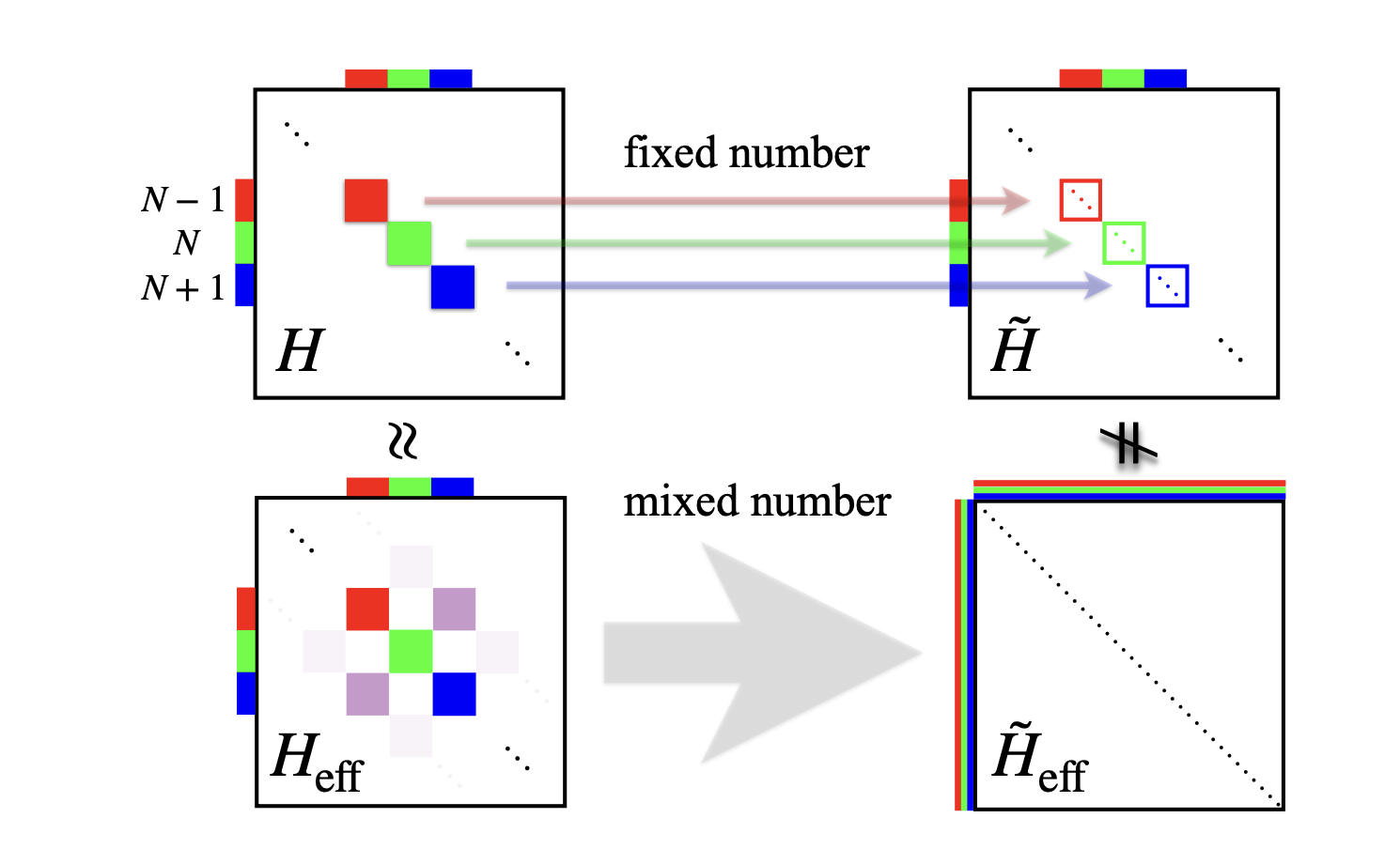
This work presents a rigorous mathematical proof establishing that, under conditions where particle number is conserved, one-body quasiparticles possess quantized charge and inertial mass identical to their original particle counterparts. Consequently, Bogoliubov zero modes, prevalent in the vortices or edges of superconductors, cannot function as their own antiparticles, fundamentally challenging the basis for certain quantum computation strategies. The research demonstrates that these zero modes adhere to standard fermionic statistics, invalidating their direct application in braiding many-body quantum information as currently pursued in the field. The team’s proof relies on a strict application of number conservation, a principle inherent in low-energy condensed matter dynamics where particle fluctuations are negligible.
Analysis reveals that all states of the system exist within a subspace of fixed particle number, ensuring that any quantum state sampled also respects this conservation law. This contrasts sharply with standard superconductivity descriptions, which often invoke states containing varying particle numbers. The study highlights the conceptual difficulty in preparing and manipulating states suitable for braiding using physical thermalization or weak external fields, highlighting the need for a revised theoretical framework.
Quasiparticles Obey Strict Particle Conservation Laws
This research establishes a fundamental theorem concerning the nature of quasiparticles in superconducting and superfluid systems, specifically under conditions where the total number of particles is conserved. Scientists rigorously demonstrate that, within such systems, these quasiparticles possess quantized charge and inertial mass identical to the original constituent particles. This finding challenges the conventional understanding of Bogoliubov quasiparticles, revealing them to be approximations arising from a violation of particle conservation. A proper description necessitates considering quasiparticles as adhering to strict number conservation, impacting how they are understood at larger scales.
The team further proves that, under these number-conserving conditions, quasiparticles generally cannot function as Majorana particles, their own antiparticles, a property heavily pursued for applications in quantum computing. This limitation stems from the inherent asymmetry in the mathematical description of these particles when particle number is strictly conserved, hindering the possibility of braiding quantum information. The authors acknowledge that existing theories relying on the conventional, approximate Bogoliubov quasiparticles have successfully explained certain properties of these systems, but emphasize the necessity of adopting a more accurate, number-conserving framework when considering many-body quantum phenomena.
🗞 Bogoliubov quasi-particles in superconductors are integer-charged particles inapplicable for braiding quantum information
🧠 ArXiv: https://arxiv.org/abs/2509.09663


See today’s quantum computing news on Quantum Zeitgeist for the latest breakthroughs in qubits, hardware, algorithms, and industry deals.