Hyperon physics, the study of particles containing strange quarks, continues to reveal fundamental insights into the strong and weak forces governing the universe, and recent data from the BESIII experiment is significantly advancing this field. Hai-Bo Li and Hong-Fei Shen, from the Institute of High Energy Physics in Beijing, lead a team that has been meticulously analysing a vast dataset collected since 2008, comprising over ten billion particle events. This research focuses on the properties of short-lived hyperons, produced in abundance through the decay of other particles, and allows scientists to probe subtle asymmetries that could explain the observed matter-antimatter imbalance in the cosmos. By precisely measuring the polarisation of these particles and investigating their decay patterns, the team hopes to uncover new physics beyond the Standard Model and deepen our understanding of the fundamental building blocks of nature.
The BESIII detector, operating at the BEPCII collider since 2008, provides excellent resolution, particle identification, and broad coverage for both neutral and charged particles, enabling detailed studies of these particles. Understanding hyperon properties is crucial for probing the strong interaction, specifically quantum chromodynamics, and searching for physics beyond our current understanding, such as exotic hadrons. Studying hyperons presents challenges due to their short lifetimes and complex decay patterns, requiring experiments capable of collecting large datasets with high precision.
The BESIII experiment is uniquely positioned to address these challenges, benefiting from a clean collision environment and high luminosity, which allows for the accumulation of substantial data. This enables precise measurements of hyperon masses, lifetimes, and decay branching fractions, as well as searches for rare decay modes that could reveal new physics. The research focuses on both charged and neutral hyperons, utilising a variety of decay channels to maximise sensitivity and statistical power.
Charmonium Decay Studies Reveal Hyperon Properties
The BESIII experiment, operational since 2008 at the BEPCII collider, has become a leading force in hyperon physics research, leveraging its exceptional resolution, particle identification capabilities, and broad coverage for both neutral and charged particles. The experiment has amassed substantial datasets, including billions of events, enabling detailed studies of these short-lived particles. A central approach involves examining pairs of hyperons and anti-hyperons produced from the decay of charmonium particles, providing a rich source for investigation. Scientists developed a novel method to probe hyperon-nucleon interactions, utilizing hyperon-antihyperon pairs created in charmonium decays as a hyperon source, while the detector materials themselves serve as fixed targets.
This innovative technique circumvents the challenges posed by the extremely short lifetimes of hyperons. The team meticulously reconstructs decay chains and analyzes angular distributions to extract crucial parameters related to hyperon properties and decay dynamics. To search for CP violation, a phenomenon that could explain the matter-antimatter asymmetry in the universe, the team formulates decay amplitudes that incorporate both parity-violating and parity-conserving components. By precisely measuring the resulting angular distributions, scientists can determine decay parameters that reveal any CP-odd characteristics.
For example, in studies of Λ hyperons, the team assembled a dataset of millions of entangled pairs, performing a five-dimensional likelihood fit to extract relevant decay parameters. This analysis yielded a Λ CP asymmetry, representing the most stringent test of CP invariance in hyperon decays to date. Extending these investigations to Ξ hyperons, the team analyzed sequential decay chains to disentangle weak phase differences, a crucial step in understanding CP violation. Utilizing datasets based on billions of J/ψ events, scientists constructed multi-dimensional joint angular distributions, enabling precise measurements of decay parameters. These analyses provide valuable insights into the fundamental properties of hyperons and contribute to a deeper understanding of the strong and weak interactions governing their behavior.
Hyperon Decays Constrain CP Violation Searches
The BESIII experiment, operating at the BEPCII collider since 2008, has delivered a wealth of new insights into the behavior of hyperons, subatomic particles containing strange quarks. By analyzing vast datasets comprising billions of J/ψ events and decays, researchers have conducted precise tests of fundamental symmetries and explored the interactions of these particles with unprecedented accuracy. Analyses of Ξ− and Ξ0 hyperons revealed no evidence of CP violation within a sensitivity of 10−3, establishing stringent limits for future searches and refining our understanding of particle behavior. Furthermore, BESIII has, for the first time, observed significant polarization for both Ξ0 and Ξ− produced in J/ψ decays, providing valuable data for theoretical models.
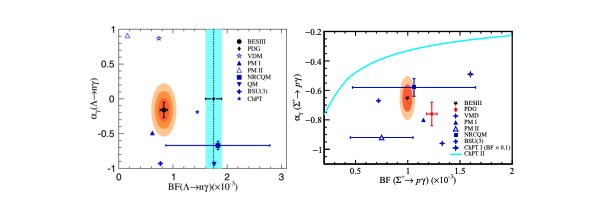
Investigations into the Σ0 hyperon, which decays exclusively via radiative processes, have yielded a strong CP asymmetry, marking the first test of strong CP symmetry within hyperon decays. Complementing these studies, researchers precisely measured the branching fractions for the radiative decays of Λ →nγ and Σ+ →pγ, finding values lower than previous measurements. They also measured the absolute branching fraction for the semi-leptonic decay Λ →pμ− ̄νμ, allowing for a test of lepton flavor universality which remains consistent with current understanding. Beyond decay properties, BESIII has pioneered studies of hyperon interactions.
The experiment successfully measured the cross section for the reaction Ξ0n→Ξ−p using Ξ0-nucleus scattering. In a landmark achievement, researchers established an upper limit for the electric dipole moment (EDM) of the Λ hyperon, an improvement of three orders of magnitude over previous measurements. This result places strong constraints on new physics models seeking to explain the matter-antimatter imbalance in the universe. These advancements, driven by the high-quality data collected by BESIII, are significantly advancing our understanding of hyperon physics and providing crucial insights into the fundamental laws governing the universe.
Hyperon Polarizations and Electric Dipole Moment Limits
The BESIII experiment has made significant progress in hyperon physics through the analysis of a substantial dataset collected at the BEPCII collider. Researchers have observed the transverse polarizations of several hyperons, creating opportunities to investigate potential CP violation in their decays, a phenomenon linked to the matter-antimatter asymmetry in the universe. Precise measurements of decay properties, including branching fractions and interactions with nucleons, have also been achieved, enhancing the understanding of these particles and the forces governing their behavior. Notably, BESIII has established a new, more stringent upper limit on the electric dipole moment of the Lambda hyperon, improving upon previous measurements by three orders of magnitude. This result constrains theoretical models attempting to explain CP violation and provides valuable input for searches for physics beyond the Standard Model. Future research will continue to build upon these findings, with the experiment poised to deliver further high-quality data to the physics community.


See today’s quantum computing news on Quantum Zeitgeist for the latest breakthroughs in qubits, hardware, algorithms, and industry deals.