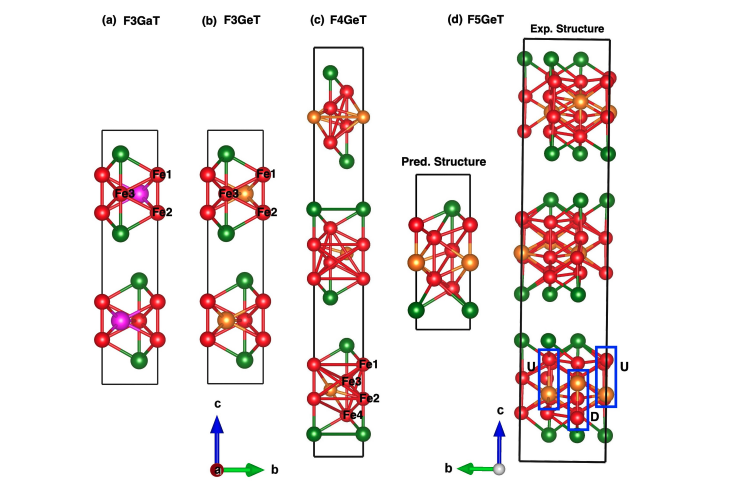
The search for materials with exceptionally high spin polarization drives innovation in spintronics, and recent research focuses on a family of van der Waals ferromagnets. Anita Halder, Declan Nell, and Akash Bajaj, working with colleagues at Trinity College, Dublin and Ca’ Foscari University of Venice, investigate the potential of iron germanium telluride and iron gallium telluride compounds for magnetic tunnel junctions. Their calculations reveal that these materials exhibit nearly half-metallic conductance, meaning they allow electrons with one spin orientation to pass through with minimal resistance while blocking others, achieving spin polarization exceeding 90%. Importantly, iron gallium telluride demonstrates particularly strong half-metallic behaviour, positioning it as a promising candidate for creating devices with exceptionally high tunnel magnetoresistance and advancing the field of spintronics.
Researchers present a systematic, first-principles investigation of linear-response spin-dependent quantum transport in the van der Waals ferromagnets Fe₃GeTe₂, Fe₄GeTe₂, Fe₅GeTe₂, and Fe₃GaTe₂. Employing density functional theory combined with the non-equilibrium Green’s function formalism, they compute the Fermi surfaces, transmission coefficients, and orbital-projected density of states for these materials. All compounds exhibit nearly half-metallic conductance along the out-of-plane direction, characterised by a finite transmission coefficient for one spin channel and a gap in the other. This results in spin polarization values exceeding 90% in the bulk, demonstrating a strong preference for electron flow with a specific spin orientation. Notably, Fe₃GaTe₂ displays particularly promising characteristics for spintronic applications due to its unique electronic structure and high degree of spin polarisation.
DFT Modelling of Electronic Transport Properties
This extensive list comprises scientific publications primarily focused on materials science, condensed matter physics, and computational materials research. The citations span journals such as Physical Review B, Advanced Materials, Nano Letters, and Science Advances, covering topics including electronic transport, two-dimensional materials, and density functional theory calculations. A significant focus lies on spintronics, exploring spin-dependent transport and magnetic materials. Key concepts and methods frequently appear throughout the list. Density Functional Theory (DFT) serves as the primary computational method for materials modelling, utilizing pseudopotentials and exchange-correlation functionals.
Researchers employ k-point sampling to discretize the Brillouin zone in DFT calculations. The Landauer formalism and Non-Equilibrium Green’s Function (NEGF) methods calculate the conductance and electronic structure of systems. Tight-binding methods offer alternative computational approaches, while Grimme’s D3 dispersion correction accounts for van der Waals interactions. Specific research areas highlighted include graphene and other two-dimensional materials, transition metal dichalcogenides, and heterostructures. Researchers investigate molecular junctions and explore defect engineering to enhance material properties. Spintronic devices and topological materials for electronics also receive considerable attention. In summary, this list demonstrates a strong focus on computational materials science and the properties of various materials, particularly two-dimensional and topological materials.
Nearly Half-Metallic Conductance in Van der Waals Ferromagnets
Scientists have achieved a significant breakthrough in materials science, demonstrating nearly half-metallic conductance in a family of van der Waals ferromagnets, Fe₃GeTe₂, Fe₄GeTe₂, Fe₅GeTe₂, and Fe₃GaTe₂, with potential for revolutionary spintronic devices. These materials exhibit exceptional spin polarization, exceeding 0. 9 and approaching unity in Fe₃GaTe₂, meaning they conduct electrons with a preferred spin orientation with remarkable efficiency. This high degree of spin polarization is crucial for developing faster and more energy-efficient electronic components. The research team systematically investigated the electronic and magnetic properties of these compounds using sophisticated first-principles calculations, combining density functional theory with the non-equilibrium Green’s function formalism.
These calculations revealed that all four materials exhibit nearly half-metallic behaviour, characterised by a transmission coefficient for one spin channel and a gap in the other, effectively allowing electrons of only one spin to pass through. Notably, Fe₃GaTe₂ stands out, displaying ideal half-metallic behaviour with the Fermi energy located deep within the spin-down transmission gap, maximising its potential for spintronic applications. Further investigation demonstrated that this high spin polarization is preserved even when these materials are assembled into bilayer magnetic tunnel junctions, structures commonly used in magnetic random-access memory and other devices. These bilayer junctions exhibit a tunnel magnetoresistance, a measure of how much the electrical resistance changes with magnetic field, of several hundred percent, indicating a strong potential for practical applications. The results demonstrate a substantial improvement over existing materials and pave the way for the development of next-generation spintronic devices with enhanced performance and reduced energy consumption. This discovery underscores the promise of Fe₃GaTe₂ in particular, positioning it as a leading candidate for future spintronics technologies.
Half-Metallic Behaviour in Van der Waals Materials
This research presents a detailed investigation of four van der Waals materials, FeGeTe, FeGeTe, FeGeTe, and FeGaTe, demonstrating their potential for spintronic applications. The team employed computational methods to model electron transport through these materials, revealing that all four exhibit nearly half-metallic behaviour, meaning they conduct electrons with one spin orientation much more readily than the other. This is characterised by a strong spin polarisation, exceeding 90% in the bulk materials, indicating a significant preference for electron flow based on spin. Notably, FeGaTe displays the most promising characteristics, exhibiting ideal half-metallic behaviour with a clear gap in transmission for one spin direction at the Fermi energy. Further calculations show this high spin polarisation is maintained when these materials are incorporated into bilayer magnetic tunnel junctions, resulting in a substantial tunnel magnetoresistance, a key property for data storage and other spintronic devices. The findings highlight the potential of these materials, and particularly FeGaTe, for developing advanced spintronic technologies.
🗞 Spin-dependent transport in Fe GaTe and Fe GeTe ( =3-5) van der Waals ferromagnets for magnetic tunnel junctions
🧠 ArXiv: https://arxiv.org/abs/2509.06823