Understanding how accurately we can measure physical properties is crucial for developing advanced technologies and exploring fundamental physics, and recent work by F. Bemani, O. Černotík, and R. Filip addresses this challenge within the field of cavity optomechanics. The researchers develop a new framework for evaluating optomechanical measurements, providing a standardised way to compare different techniques used to detect the motion of microscopic objects. This formalism quantifies both the precision of a measurement and the disturbance it causes to the system, a trade-off dictated by the laws of quantum mechanics, and applies to common optomechanical methods such as displacement detection and noise cancellation. By analysing these measurements, the team identifies strategies for improving the accuracy of ‘nondemolition’ measurements, techniques that minimise disturbance, and proposes a novel approach for levitodynamics, potentially unlocking new possibilities for precision sensing and fundamental investigations.
Levitated Optomechanics and Quantum Measurement Techniques
This collection presents a comprehensive overview of research into levitated optomechanics, quantum measurements, and related topics, demonstrating a thorough understanding of the field. Research encompasses cooling microscopic particles suspended by light, sensing minute forces, and investigating the boundaries of quantum mechanics. Scientists are exploring regimes of strong and ultrastrong coupling, where light and the particle’s motion interact intensely, leading to novel effects, and generating and characterizing non-classical states of motion in macroscopic objects for sensitive measurements of forces and accelerations. The list includes foundational review papers alongside experimental and theoretical work detailing the foundations of levitated optomechanics, including key milestones such as the first demonstration of cavity cooling and ground state cooling.
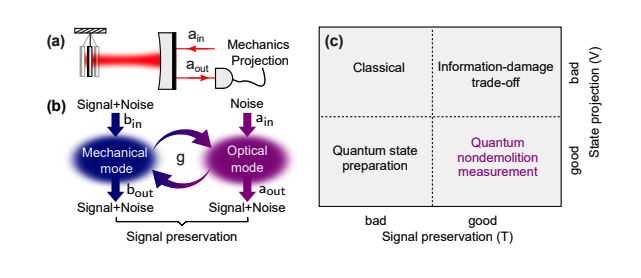
Researchers are actively exploring entanglement between levitated nanoparticles and achieving ultrastrong coupling between light and matter, alongside investigations into quantum measurement and control techniques, including non-classical states of levitated objects and Gaussian entanglement. Theoretical work focuses on backaction-evading measurements and coherent scattering-mediated correlations, exploring spectral evidence of squeezing, vectorial polaritons, and mechanical squeezing via unstable dynamics. This approach defines key figures of merit that assess a measurement’s ability to distinguish between quantum states while preserving the signal amidst measurement noise. The team systematically analysed common optomechanical measurement techniques, including displacement detection, coherent noise cancellation, and quantum nondemolition measurements, to establish a baseline for performance comparison and identify sources of error. Scientists engineered a detailed analysis of errors inherent in optomechanical nondemolition measurements, a crucial step towards improving the precision of these sensitive techniques.
Building on this knowledge, they proposed a novel strategy for performing quantum nondemolition measurements in levitodynamics using coherent scattering, offering a pathway to minimize disturbance of the mechanical system during observation. This methodology involves driving an electromagnetic resonator with a classical pump, creating a strong amplitude within the resonator, and then linearizing the interaction for analysis. This approach allows researchers to control the interaction between the electromagnetic and mechanical modes by tuning the detuning of the pump field, enhancing a beam-splitter interaction for cooling or storage of a quantum state, or amplifying and entangling modes via two-mode squeezing. While displacement detection is typically limited by the standard quantum limit, the team’s work aims to overcome these limitations and develop measurement strategies that minimize or eliminate backaction noise, paving the way for more precise and sensitive optomechanical experiments.
Optomechanical Measurement Limits Quantified and Compared
Researchers have developed a comprehensive framework for quantifying the performance of optomechanical measurements, drawing parallels with established techniques in quantum optics. This new approach characterizes a measurement’s ability to distinguish between quantum states and preserve the signal amidst measurement noise, offering a standardized way to compare different measurement strategies. The team meticulously analysed three common optomechanical measurement techniques, displacement detection, coherent quantum noise cancellation, and quantum nondemolition measurements, revealing key insights into their strengths and limitations. Detailed analysis demonstrates that the accuracy of displacement detection is fundamentally limited by the standard quantum limit, representing a trade-off between imprecision and backaction noise, although strategies such as measuring a single mechanical quadrature or employing interference techniques can mitigate this.
Researchers are actively investigating quantum nondemolition measurements, which aim to minimize disturbance to the mechanical state, and coherent quantum noise cancellation, which utilizes an auxiliary oscillator to eliminate backaction effects. The findings reveal that quantum nondemolition measurements are effective for quantum tomography of mechanical states and have applications in quantum optics and atomic physics, while coherent quantum noise cancellation not only enables backaction-free measurements but also enhances entanglement generation. By applying characterization techniques from quantum optics, researchers provide a detailed comparison of these strategies, paving the way for selecting the optimal approach for specific tasks in quantum metrology, feedback control, and fundamental investigations of cavity optomechanics and electromechanics.
Optomechanical Measurement Limits and Quantum Regimes
This work presents a comprehensive formalism for quantifying the performance of optomechanical measurements, drawing on figures of merit established in quantum optics, specifically, the conditional variance of mechanical motion and transfer coefficients that describe signal preservation. Applying this approach to common measurement scenarios, displacement detection, coherent noise cancellation, and nondemolition measurements, confirmed known results and provided new insights into their limitations. Importantly, the research establishes a clear condition, based on optomechanical cooperativity, for achieving the quantum nondemolition regime in single-quadrature measurements, and investigates the impact of experimental imperfections, such as fast oscillating terms and static bilinear Hamiltonians, demonstrating how these can be characterized and potentially compensated for through techniques like intentional mechanical detuning. This understanding led to a proposed strategy for achieving nondemolition measurements in levitodynamics using coherent scattering, opening possibilities for fundamental physics tests and quantum technology applications. The authors acknowledge that their generalized standard quantum limit is particularly relevant for addressing the effects of counterrotating terms and mechanical squeezing, which can introduce backaction noise into measurements. This work provides a robust framework for understanding and improving the precision of optomechanical measurements, paving the way for advancements in quantum sensing, metrology, and fundamental physics research.
🗞 Characterization of Linear Measurements in Cavity Optomechanics: Examples and Applications
🧠 ArXiv: https://arxiv.org/abs/2508.21419