Solving equations that describe how substances spread and mix, known as the advection-diffusion equation, is crucial in fields ranging from weather forecasting to materials science, yet remains computationally challenging, particularly when dealing with complex flows. Niladri Gomes, Gautam Sharma, and Jay Pathak, from Ansys, Inc and Ansys Software Pvt. Ltd., present a new method that harnesses the power of Hamiltonian simulation, a technique borrowed from quantum physics, to tackle this problem. Their approach offers a potentially more robust and efficient way to model advection-diffusion in both two and three dimensions, even with complicated, changing flows, and importantly, they demonstrate its practical application by successfully implementing a solution to the equation using quantum hardware. This work signifies a step towards utilising quantum computing for solving complex partial differential equations, paving the way for more accurate and efficient simulations in a variety of scientific and engineering disciplines.
Quantum Simulation Solves Advection-Diffusion Equations
Novel Quantum Approaches for Fluid Dynamics Simulation
Novel quantum algorithms for fluid dynamics simulation
Researchers have developed a novel method for solving the advection-diffusion equation, a type of partial differential equation crucial for modeling fluid dynamics and other physical phenomena, using a technique inspired by Hamiltonian simulation. This approach leverages quantum-inspired algorithms to accurately track the movement and dispersal of substances within a given field, offering a promising direction for long-term, fault-tolerant computing. The algorithm successfully accommodates complex, spatially varying transport fields and is applicable to both two- and three-dimensional problems, demonstrating versatility in handling diverse scenarios. Extensive simulations demonstrate the algorithm’s effectiveness in benchmark scenarios involving coupled rotational, shear, and diffusive transport.
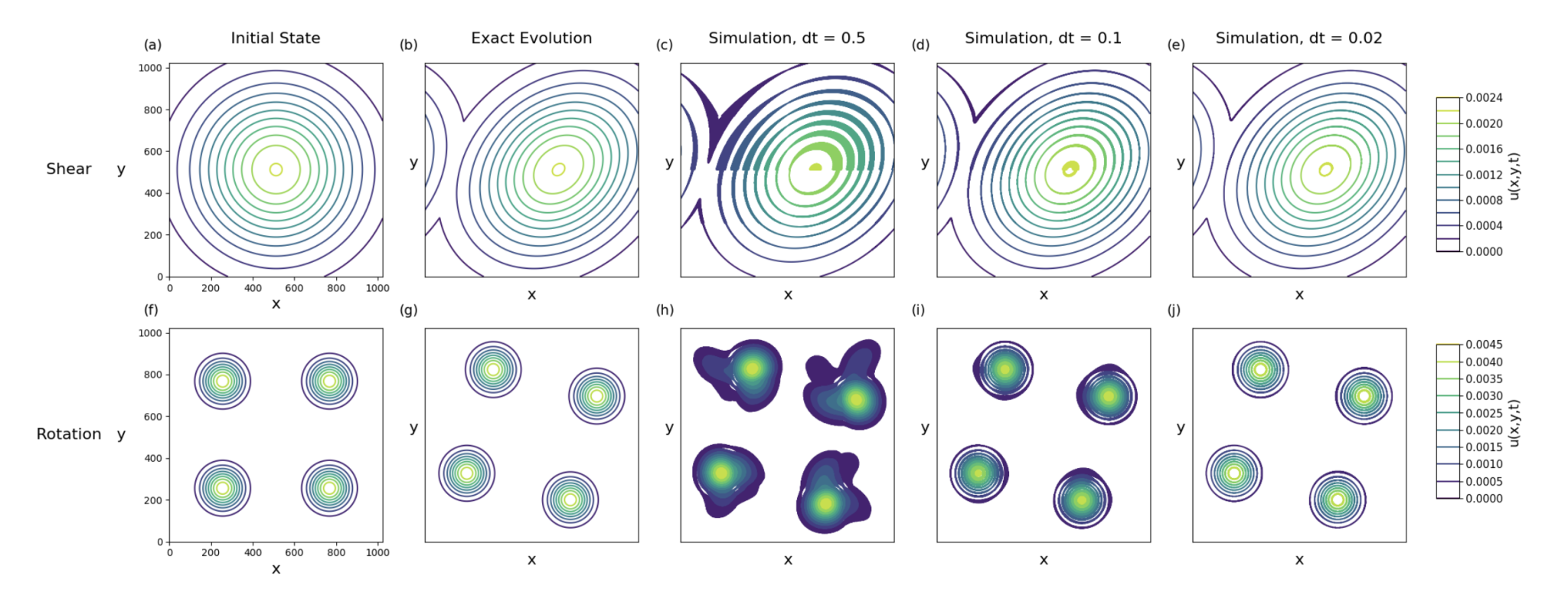
In two-dimensional shear flow, the team achieved results closely matching analytical solutions, with a relative error of 2. 88% for a time step of 0. 5, improving to 0. 59% with a step of 0. 1, and further refining to 0.
23% with a step of 0. 02. Further validation involved simulating a two-dimensional rotational flow, where the algorithm accurately modeled the clockwise rotation of a scalar field around a central point. These results confirm that decreasing the time step size significantly improves the accuracy of the simulation. Notably, the researchers successfully implemented the 2D advection-diffusion equation using 16 qubits on actual quantum hardware, validating the practical applicability and robustness of their method. This achievement marks a significant step towards harnessing the power of quantum-inspired algorithms for solving complex scientific problems and opens avenues for advancements in fields like computational fluid dynamics and materials science.
Quantum Algorithm Solves Complex Fluid Dynamics
Simulating Complex Vorticity Transport Fields Successfully
Handling complex non-zero vorticity transport fields
This work presents a new quantum algorithm for solving the advection-diffusion equation, incorporating complex, non-zero vorticity into the calculations. The researchers successfully demonstrated the algorithm’s ability to handle non-trivial transport fields, such as those found in shear and rotational flows, in both two and three dimensions, scaling simulations up to 30 qubits. The team focused on making the algorithm suitable for near-term quantum computers by introducing approximations that reduce the complexity of the quantum circuits. Results from the hardware implementation, using a 19-qubit system, demonstrate the algorithm’s ability to simulate advection and diffusion on a 256×256 grid.
Future directions and measuring macroscopic observables
Extracting Macroscopic Observables for Future Research
The authors emphasize the importance of focusing on measurable macroscopic observables when extracting information from quantum simulations. Future research will explore the calculation of observables like flux and kinetic energy, and the application of classical shadows to efficiently retrieve key features from the quantum output. The team also intends to extend the framework to handle more complex transport fields and to scale the algorithm to a larger number of qubits through circuit optimisation. Ultimately, the researchers envision applying this Hamiltonian-based approach to a wider range of partial differential equations beyond fluid dynamics.
🗞 Hamiltonian Simulation for Advection-Diffusion Equation with arbitrary transport field
🧠 ArXiv: https://arxiv.org/abs/2508.16728
The core of the methodology lies in reformulating the continuous partial differential equation into a discretized, unitary evolution operator suitable for quantum circuit implementation. This process typically involves mapping the spatial grid points and the associated transport coefficients onto the Hamiltonian term, $H$. The computational complexity is then governed by the number of required qubits and the circuit depth necessary to approximate the exponential time evolution operator, $e^{-iHt}$, which describes the system’s state change over time.
From a theoretical standpoint, this quantum approach offers a potential advantage over classical solvers, particularly for regimes characterized by high Reynolds numbers or complex turbulence modeling, where classical computational cost scales rapidly. The ability of quantum systems to inherently handle superposition and entanglement allows them to explore the solution space simultaneously, potentially achieving a quantum speedup over the best known classical numerical schemes for certain spectral components of the flow field.
A key challenge remains the transition from proof-of-concept experiments on small qubit counts to realizing industrially scalable algorithms. Current quantum hardware operates in the Noisy Intermediate-Scale Quantum (NISQ) era, meaning decoherence and operational noise severely limit the circuit depth. Future work must focus on developing advanced error mitigation and quantum error correction techniques to maintain fidelity across the increasingly deep circuits required for accurate, long-duration fluid dynamic simulations.