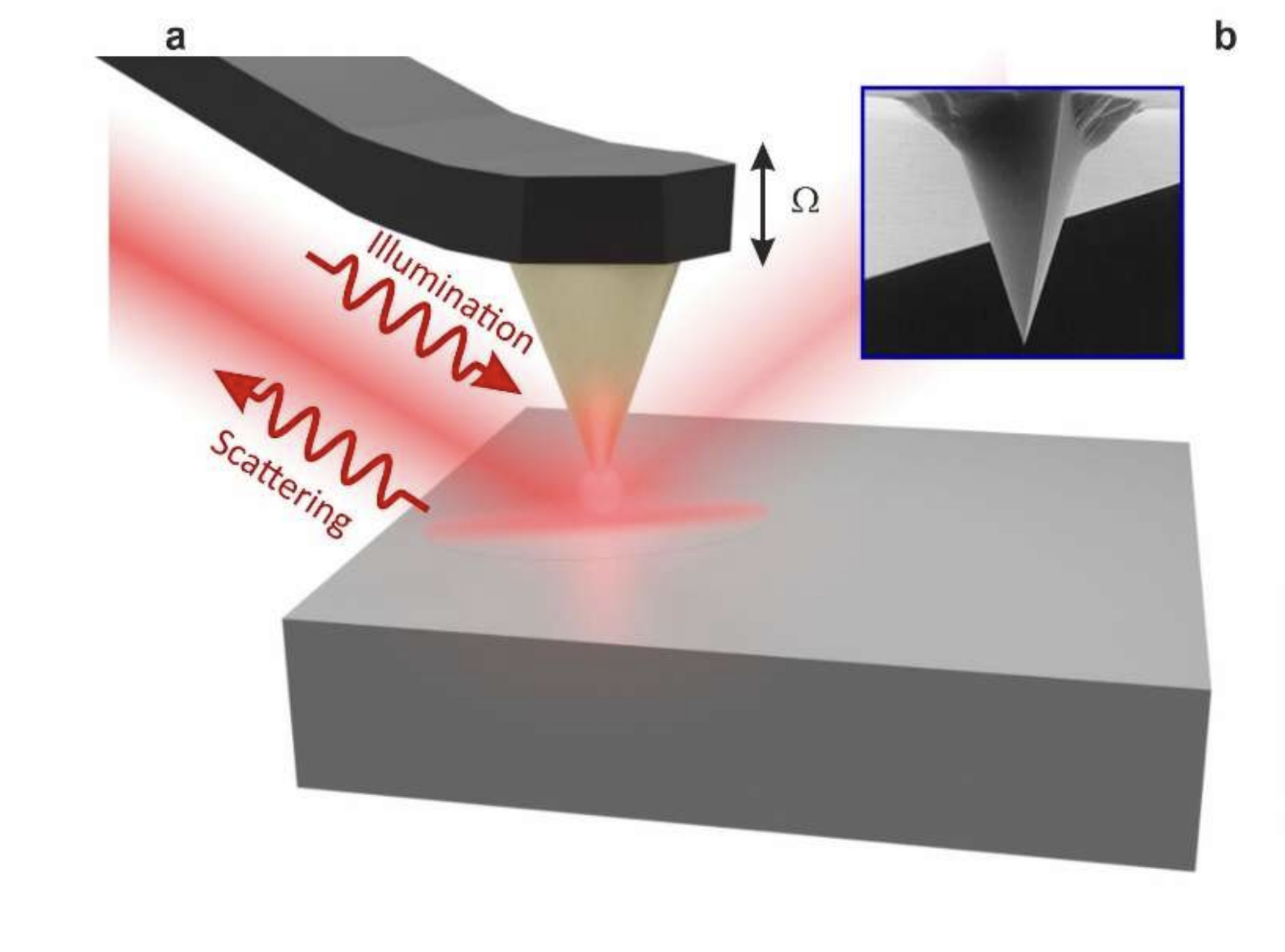
Scattering-type scanning near-field microscopy pushes the boundaries of optical observation, allowing scientists to investigate materials at the nanoscale, well beyond the usual limits of light. Kirill Voronin, Iker Herrero León, Rainer Hillenbrand, and colleagues at the Donostia International Physics Center and CIC nanoGUNE BRTA have developed a new analytical model that significantly improves the quantitative analysis of data from this technique. Current theoretical approaches often rely on complex computer simulations or simplified models requiring extensive calibration, hindering detailed spectral interpretation. This new model provides a rigorous and efficient solution for understanding how light interacts with nanoscale structures, offering greater accuracy than existing methods and paving the way for more reliable predictions, systematic investigations, and the creation of training data for advanced machine learning applications in materials science.
Simulating Infrared Nanospectroscopy with s-SNOM
This research details a sophisticated theoretical framework and numerical modeling approach for scattering-type scanning near-field optical microscopy (s-SNOM), particularly focusing on infrared (IR) nanospectroscopy. The technique uses infrared light to probe the vibrational modes of molecules, revealing their chemical composition and structure. Accurate modeling is crucial because the s-SNOM signal is complex and influenced by factors including tip shape, tip-sample interaction, and the optical properties of both components. The team aimed to create a robust and reliable method for interpreting experimental s-SNOM data and extracting quantitative information about materials at the nanoscale.
Researchers focused on accurately representing the s-SNOM tip, utilizing prolate spheroidal coordinates which provide a more realistic depiction than simpler shapes. They employed advanced mathematical techniques to solve the electromagnetic equations governing the interaction between the tip and the sample, also considering the polarization of light and the influence of the substrate. Furthermore, the team explored integrating machine learning algorithms to enhance data analysis, including denoising signals, extracting quantitative material properties, and predicting s-SNOM signals based on material characteristics. This work provides a more accurate method for modeling s-SNOM measurements, enabling more precise nanoscale analysis and advancing the technique as a powerful tool for materials science, chemistry, and biology.
Fast, Accurate Modeling of Near-Field Microscopy Spectra
Researchers have developed a new analytical solution for modeling scattering-type scanning near-field optical microscopy (s-SNOM), a technique used to investigate materials beyond the limits of conventional optical microscopes. This breakthrough delivers a significantly more efficient and accurate method for interpreting s-SNOM spectra, overcoming limitations found in previous computational and empirical approaches. The team’s solution accurately computes charge distribution on the s-SNOM tip, even when the tip is very close to the sample surface, a scenario that previously caused problems with existing models. The newly developed method achieves a remarkable 103-fold reduction in computation time, decreasing analysis from days to minutes, while maintaining a high degree of accuracy validated through comparison with detailed numerical simulations.
This speed allows for rapid exploration of how key parameters, including tip curvature, oscillation amplitude, and material properties, influence the measured signals. Through this analysis, scientists identified the radius of curvature and the minimum tip-sample distance as the most critical parameters affecting s-SNOM results. To demonstrate the practical utility of their model, researchers compared calculated spectra with experimental data obtained from poly(methyl methacrylate) (PMMA) and quartz, materials exhibiting weak and strong optical resonances. The results demonstrate the model’s ability to accurately predict s-SNOM signals for diverse materials. This advancement promises to accelerate materials research and enhance the capabilities of nanoscale imaging techniques.
Prolate Spheroid Model Validates s-SNOM Spectra
This research presents a quantitative analytical model for interpreting data acquired through scattering-type scanning near-field optical microscopy (s-SNOM). The model, based on a prolate spheroid approximation of the tip and operating within the quasi-electrostatic limit, allows for efficient and reliable computation of near-field spectra for bulk materials without relying on empirical fitting parameters. Validation through comparison with numerical simulations and experimental spectra from PMMA and quartz demonstrates the model’s accuracy and robustness in interpreting s-SNOM data. The developed model facilitates both the reconstruction of a sample’s dielectric function and systematic analysis of the influence of geometric and material parameters on the near-field signal.
While precise determination of the minimum distance between the tip and sample remains a challenge in current experiments and currently functions as a fitting parameter, the authors suggest improved methods for measuring this distance will further enhance the model’s applicability. Furthermore, the model’s speed and accuracy make it a valuable tool for generating synthetic datasets to train machine learning algorithms for advanced spectral analysis. The researchers have made their model publicly available to promote further research and wider adoption within the s-SNOM community.
🗞 Quantitative Analytical Model for Scattering-type Scanning Near-field Optical Spectroscopy
🧠 ArXiv: https://arxiv.org/abs/2508.16365