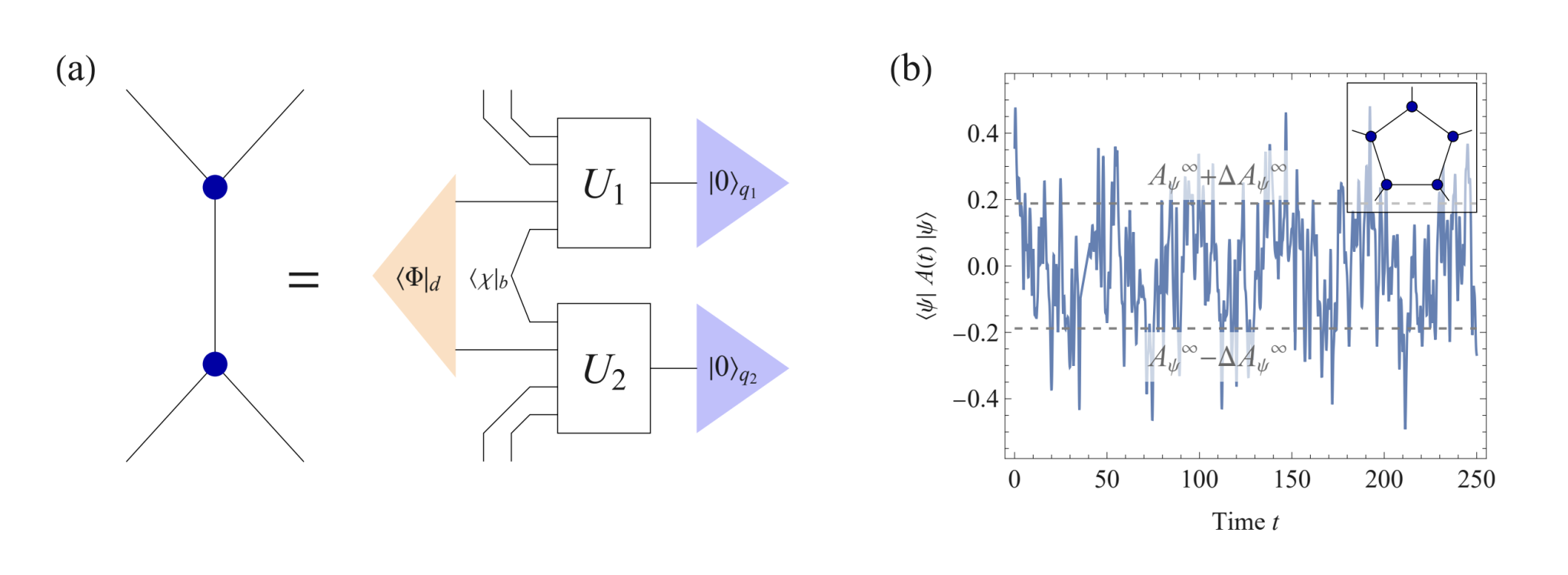
Random tensor networks increasingly provide powerful tools for understanding complex systems, and recent work focuses on applying them to model holographic dualities, a theoretical framework connecting gravity and quantum mechanics. Shozab Qasim, Jens Eisert, and Alexander Jahn, all from Freie Universität Berlin, now demonstrate that these networks exhibit a surprising property: they naturally evolve towards equilibrium under a broad range of conditions. The researchers prove that these networks equilibrate at large bond dimensions and across various geometries, including those resembling black holes, revealing a hierarchy of behaviour that mirrors the expected relationships between different phases of matter. This discovery establishes a connection between the late-time dynamics of many-body systems and the principles of statistical mechanics, offering a novel pathway to explore holographic dualities and potentially unlock new insights into the fundamental nature of spacetime.
Coulomb Gases and Random Matrix Theory Connections
This research establishes a deep connection between statistical mechanics, Coulomb gases, and random matrix theory (RMT). The study demonstrates that the probability distribution of eigenvalues in a specific RMT ensemble, the Circular Unitarian Ensemble (CUE), can be understood as the equilibrium state of a one-component Coulomb gas. This connection allows researchers to apply techniques from statistical mechanics to problems in RMT, and vice versa. The work outlines the foundational principles of statistical mechanics, including the canonical ensemble and the Boltzmann factor, which describe the probability distribution of states based on energy and temperature.
The research explores the concept of a one-component Coulomb gas, a system of particles interacting via electrostatic repulsion confined to a specific area. The study then introduces random matrix theory, focusing on the CUE, and the statistical properties of their eigenvalues. The. The findings have significant implications for bridging disciplines, providing new tools and techniques for studying random matrices, and offering applications in diverse areas such as nuclear physics, quantum chaos, number theory, and mathematical physics. This work provides a comprehensive and rigorous exploration of the connection between Coulomb gases and the CUE, offering valuable insights into the interplay between different areas of science.
Dynamic Equilibration in Random Tensor Networks
Researchers have developed a new methodology to investigate the dynamics of complex systems using random tensor networks (RTNs). The study focuses on how these networks evolve over time and reach equilibrium, modeling systems exhibiting holographic duality, a concept linking gravity and quantum mechanics. Instead of analyzing static snapshots, the team examined the dynamic evolution of RTN states, demonstrating that they exhibit equilibration of operator expectation values under a wide range of Hamiltonian conditions. To achieve this, scientists leveraged Weingarten formulas to derive an effective dimension for the RTNs, quantifying their complexity and information distribution.
Rather than calculating this dimension for specific energy states, the team assumed a broad overlap between the RTN states and various energy eigenstates, simplifying the calculation and allowing for a more general analysis. This innovative approach enabled them to prove that RTNs generally equilibrate when the bond dimensions are sufficiently large, and also in specific scaling limits for different network geometries, including matrix product states and hyperbolic tilings. Researchers demonstrated that fluctuations in the norm vanish as the physical and bond dimensions increase, ensuring the reliability of their calculations. They validated this approach through numerical checks, confirming that the norm converges rapidly. By carefully analyzing the behavior of these networks, the team established a hierarchy of equilibration, suggesting a connection between different many-body phases and reproducing a holographic degree-of-freedom counting, a crucial test for the validity of the approach. This work demonstrates the power of RTN techniques to probe the late-time dynamics of complex systems and offers a new pathway for exploring holographic dualities using the tools of statistical mechanics.
Random Tensor Networks Model Quantum Equilibration
Recent research demonstrates an advancement in understanding the dynamics of complex quantum systems using random tensor networks (RTNs). These networks are increasingly valuable tools for modeling holographic dualities, a concept linking quantum gravity and conformal field theory. Scientists have now proven that RTNs can accurately describe the equilibration of quantum states, even under a wide range of Hamiltonian conditions, resolving a long-standing challenge in the field. This breakthrough establishes that RTNs can model the time evolution of quantum many-body systems, opening new avenues for exploring the dynamics of holographic boundary theories.
The team discovered that RTN states exhibit a remarkable tendency towards equilibration, meaning that the time-averaged expectation values of operators settle into a stable state over time. This equilibration occurs reliably as the local dimension of the network’s components becomes infinitely large, and as the size of the network itself expands without limit. Importantly, the researchers proved perfect equilibration, defined as zero fluctuations of local observables at late times, for RTNs, demonstrating a high degree of predictability in their behavior. This finding extends beyond generic RTNs, with specific proof of equilibration in three distinct geometries: linear chains known as matrix product states, regular hyperbolic tilings, and single “black hole” tensors.
These results demonstrate a hierarchy of equilibration between different types of RTN geometries, mirroring a corresponding hierarchy between various many-body phases. The research reproduces a holographic degree-of-freedom counting, effectively determining the effective dimension of each system, and provides a crucial link between the structure of the tensor network and the properties of the quantum system it represents. By establishing that RTNs can model both static and dynamic properties, scientists have unlocked a powerful new approach to studying complex quantum systems and exploring the intricacies of holographic dualities using techniques borrowed from statistical mechanics.
Tensor Network Equilibration and Geometry’s Role
This research demonstrates that random tensor networks (RTNs) exhibit equilibration of averaged properties over time, even with complex interactions, and that this equilibration is sensitive to the geometry of the network. The team proved that RTNs generally reach equilibrium at sufficiently large bond dimensions and for specific geometries including matrix product states, regular hyperbolic tilings, and single “black hole” tensors. Importantly, they established a hierarchy of equilibration strength, with single random tensors exhibiting the strongest equilibration, followed by hyperbolic geometries, and then random tensor networks without bulk tensors. This hierarchy mirrors a corresponding hierarchy between different many-body phases and reproduces a degree-of-freedom counting consistent with holographic principles.
The findings suggest that RTN techniques offer a novel approach to understanding the late-time dynamics of many-body systems and provide a new way to explore holographic dualities using tools from statistical mechanics. The authors acknowledge that their results primarily focus on the scaling limit of large systems and that further investigation is needed to fully understand the behaviour of smaller networks. Future research directions include exploring the implications of different RTN geometries on entanglement entropies and extending these techniques to more complex physical systems, potentially offering insights into the behaviour of quantum gravity and black holes.
🗞 Emergent statistical mechanics in holographic random tensor networks
🧠 ArXiv: https://arxiv.org/abs/2508.16570




See today’s quantum computing news on Quantum Zeitgeist for the latest breakthroughs in qubits, hardware, algorithms, and industry deals.