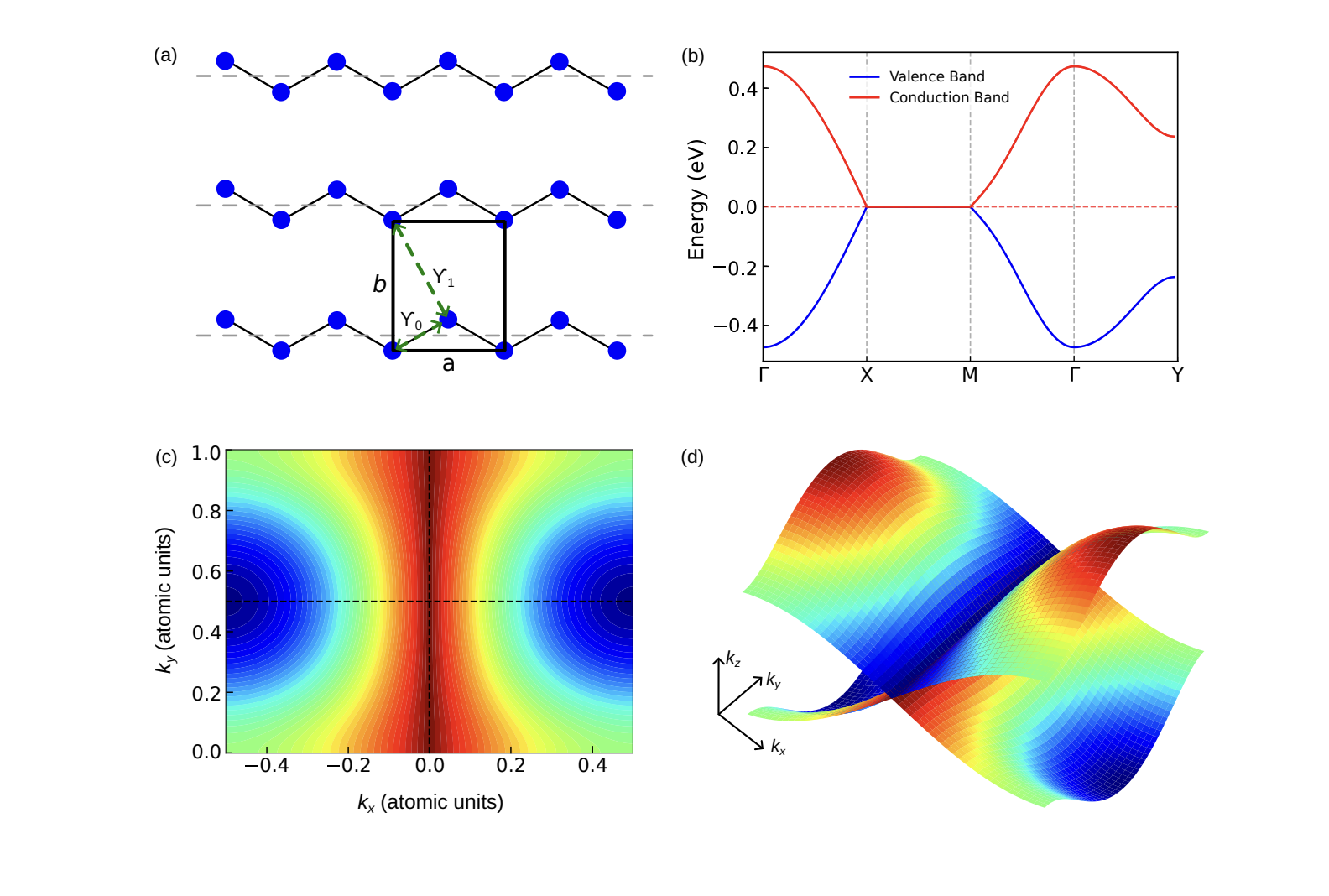
Nodal-line semimetals represent a fascinating new class of materials with unique electronic properties, and recent research explores how these materials respond to intense laser light. Navdeep Rana from Louisiana State University, M. S. Mrudul from Uppsala University, and Amar Bharti from the Indian Institute of Technology Bombay, along with their colleagues, investigate the nonlinear optical behaviour of these materials, specifically focusing on the NbSiTe system. Their work demonstrates that the fundamental symmetry of nodal-line semimetals profoundly influences how they generate harmonics when exposed to laser pulses, leading to the exclusive production of odd-order harmonics. This discovery is significant because it reveals a pathway to control light emission within these materials, potentially paving the way for the development of ultrafast photonic and optoelectronic devices with tailored properties, and offering new possibilities for manipulating light at the nanoscale.
Intense laser-driven nonlinear optical phenomena in two-dimensional (2D) nodal-line semimetals (NLS) exhibit complex mechanisms, particularly in materials characterised by nonsymmorphic symmetry-protected band degeneracy. This research investigates how this symmetry fundamentally influences a material’s nonlinear optical responses.
High Harmonic Generation in 2D Materials
This collection of research focuses on high-harmonic generation (HHG), a process where intense laser light interacts with materials to create new frequencies of light. The core topic is achieving HHG not just in gases, but in solid materials, particularly two-dimensional materials and topological materials like Weyl and Dirac semimetals. This field is rapidly expanding, driven by the unique electronic properties of these materials. Researchers are exploring how to control HHG through material properties such as strain, doping, and symmetry. Research has explored HHG in various materials, including graphene, Weyl semimetals, and nodal-line semimetals.
Studies have investigated the effects of strain on graphene’s HHG efficiency and the role of topological charges in nonlinear optical responses. Theoretical work has focused on developing models to accurately describe HHG in complex materials. Potential research directions include tailoring materials with specific band structures to enhance HHG, controlling the polarization of generated harmonics, and using HHG to probe topological properties. Researchers are also exploring new materials and potential applications of HHG in areas like ultrafast spectroscopy and data storage. This body of work represents a comprehensive overview of the evolving field of HHG in condensed matter, with a strong focus on 2D materials and topological materials.
Glide-Mirror Symmetry Dictates Harmonic Generation
Researchers have discovered a remarkable connection between material symmetry and the generation of light in two-dimensional nodal-line semimetals (NLS). These materials exhibit nonlinear optical properties that allow them to generate harmonics with unprecedented control. Experiments reveal that the arrangement of atoms within these NLS, governed by nonsymmorphic symmetry, fundamentally influences how light interacts with the material and dictates the types of harmonics produced. The team demonstrated that these materials exclusively generate odd-order harmonics, a phenomenon directly linked to the presence of glide-mirror symmetry.
Analysis of the generated harmonics shows they are emitted in directions both parallel and perpendicular to the laser’s polarisation, with the relative strength of each component varying depending on the laser’s direction. Further investigation revealed distinct mechanisms contributing to harmonic generation, stemming from interactions within and between the material’s atomic chains. This discovery opens new avenues for controlling light at the nanoscale and has significant implications for the development of ultrafast photonic and optoelectronic devices.
Nonsymmorphic Symmetry Dictates Harmonic Generation Direction
This research investigates nonlinear optical phenomena in two-dimensional nodal-line semimetals, specifically focusing on the material NbSiTe₂ and how its unique symmetry influences harmonic generation when exposed to intense laser light. The findings demonstrate that the material’s nonsymmorphic glide-mirror symmetry leads to the exclusive production of odd-order harmonics. Importantly, the study reveals that these harmonics are emitted in directions both parallel and perpendicular to the laser’s polarisation, originating from distinct processes occurring within and between the material’s atomic chains. The research team established that the relative contribution of these processes varies significantly depending on the laser’s polarisation. Analysis of the laser’s ellipticity further illuminates the interplay between different mechanisms. These insights open possibilities for controlling light emission and developing new photonic devices based on these materials.
🗞 Nonlinear Optical Spectroscopy of Nodal-Line Semimetals
🧠 ArXiv: https://arxiv.org/abs/2508.16494