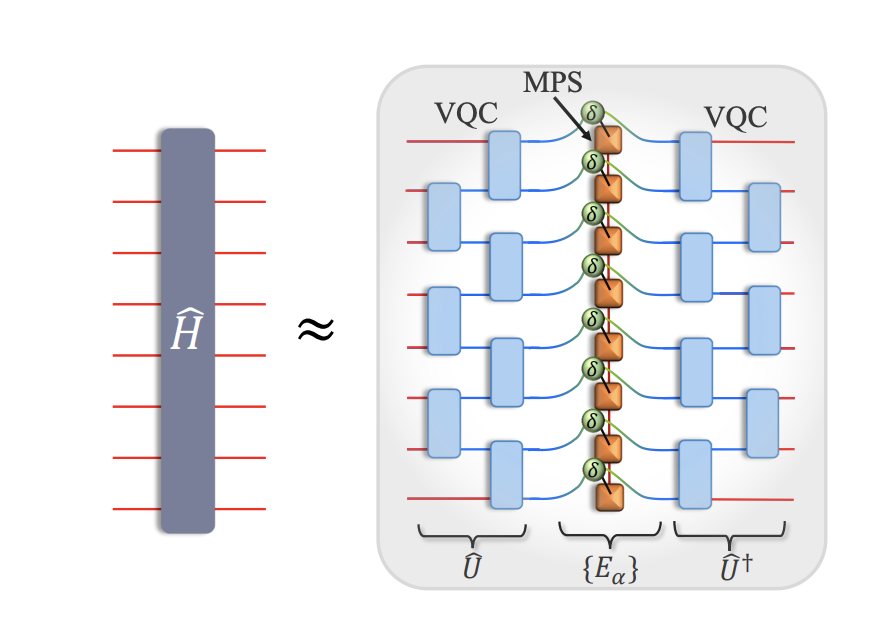
Understanding the behaviour of complex quantum systems presents a significant challenge in modern physics, as the computational demands grow exponentially with the size of the system. Peng-Fei Zhou, Shuang Qiao, An-Chun Ji, and colleagues at Capital Normal University now present a new method, tensor network variational diagonalization, which dramatically reduces this computational burden. Their approach encodes the energy spectrum of a quantum system into a more manageable form using both tensor networks and variational quantum circuits, effectively changing the computational complexity from exponential to polynomial. This breakthrough enables the study of systems far larger than previously possible, and importantly, offers a potential pathway to tackling even the most complex quantum Hamiltonians that defy traditional computational methods, opening new avenues for exploring the fundamental laws governing matter.
Larger Quantum Systems Modelled with Tensor Networks
Researchers have developed a new computational technique, tensor network variational diagonalization (TNVD), that significantly expands the scale of quantum systems that can be accurately modeled. Traditional methods, like exact diagonalization, become computationally prohibitive as system size increases, but TNVD overcomes this limitation by encoding energy levels into a matrix product state and representing quantum states using a variational quantum circuit. This reduces computational complexity, allowing for simulations of much larger systems. The team demonstrated TNVD’s capabilities by simulating quantum Ising chains with up to 100 quantum spins, exceeding the limits of conventional methods.
They verified its accuracy by comparing results to exact diagonalization for smaller systems and confirmed its reliability at larger scales where direct comparison is impossible. A key aspect of TNVD’s success lies in its ability to efficiently represent energy levels, exploiting the sparsity inherent in quantum systems. This allows the technique to accurately capture essential physics without excessive computational resources, and the use of a variational quantum circuit provides a flexible and accurate representation of quantum states. The team’s analysis revealed that TNVD’s efficiency is linked to the entanglement within the system, with systems exhibiting less entanglement being easier to model. This connection allows researchers to optimize TNVD for specific systems and further improve its performance, establishing it as a powerful and scalable approach for tackling complex many-body problems.
TNVD Efficiently Diagonalizes Large Quantum Systems
This work introduces tensor network variational diagonalization (TNVD), a new approach to diagonalizing many-body Hamiltonians that overcomes the computational limitations of exact diagonalization. TNVD encodes the energy spectrum and eigenstates within a matrix product state, leveraging a variational quantum circuit to achieve polynomial complexity with system size. The researchers investigated the relationship between TNVD’s efficiency and the entanglement properties of eigenstates, focusing on the quantum Ising chain in a random field. They identified characteristic patterns in entanglement entropy distribution that correlate with high efficiency, providing indicators of whether a system adheres to area laws of entanglement or exhibits volume-law entanglement. The authors acknowledge that the efficiency of TNVD is linked to the entanglement structure of the eigenstates, and that systems with volume-law entanglement present a greater challenge. Future work may focus on applying this method to such systems, potentially paving the way for quantum computational approaches to tackle currently inaccessible problems.
Variational Quantum Eigensolver with Tensor Networks
Researchers are developing new methods to simulate many-body quantum systems, particularly those exhibiting many-body localization (MBL). They propose a variational quantum eigensolver (VQE) approach, utilizing tensor networks (specifically Matrix Product States, or MPS) as the variational ansatz. This combines the strengths of VQE, suitable for near-term quantum computers, with the efficiency of tensor networks in representing certain quantum states. Many-body localization is a phase of matter where quantum coherence is suppressed due to strong disorder, breaking ergodicity and retaining memory of initial conditions.
Simulating these systems is computationally challenging, and VQE is a hybrid quantum-classical algorithm used to find the ground state energy of a quantum system. Matrix Product States efficiently represent one-dimensional (or quasi-one-dimensional) quantum states and are widely used in classical simulations of condensed matter physics. The central innovation of this work is to use MPS as the variational ansatz within a VQE framework, allowing the quantum computer to prepare the MPS state and the classical computer to optimize the tensor elements to minimize the energy. Using MPS reduces computational complexity, allowing for simulations of much larger systems, and efficiently represents the vast number of possible energy levels by compressing redundant information. The accuracy of the method is closely linked to the entanglement within the system, with systems exhibiting less entanglement being easier to model.
🗞 Diagonalizing large-scale quantum many-body Hamiltonians using variational quantum circuit and tensor network
🧠 ArXiv: https://arxiv.org/abs/2508.06159
See today’s quantum computing news on Quantum Zeitgeist for the latest breakthroughs in qubits, hardware, algorithms, and industry deals.