The search for materials exhibiting exotic quantum properties continues to drive innovation in physics and materials science, and recent research focuses on manipulating these properties through external stimuli. Zesen Fu from Xinjiang University, Mengli Hu from the Leibniz Institute for Solid State and Materials Research, and Aolin Li, along with colleagues, demonstrate how strain can dramatically alter the quantum behaviour of a two-dimensional material known as an altermagnet. Their work reveals that carefully applied strain can drive transitions between different quantum phases, including a unique state where the material’s topological charge, a property governing its electronic behaviour, can be reversed simply by changing the direction of the strain. This discovery establishes strain engineering as a powerful and potentially versatile method for controlling topological properties in two-dimensional materials, opening new avenues for designing advanced electronic devices and exploring fundamental physics.
The research presents a theoretical and first-principles study of two-dimensional altermagnets, focusing on how their spin and movement of electrons are linked and how strain can tune their unique electronic phases. Researchers constructed a detailed model to investigate the material’s behaviour, demonstrating that applying biaxial strain can induce a transition from a simple insulator to a type-II quantum spin Hall phase, and further induce anomalous Hall phases. Furthermore, the team developed a theoretical framework which identifies critical strain levels, effectively dividing the material’s behaviour into four distinct regions corresponding to different electronic states, including two quantum anomalous Hall states.
Altermagnet Topology via Tight-Binding Modelling
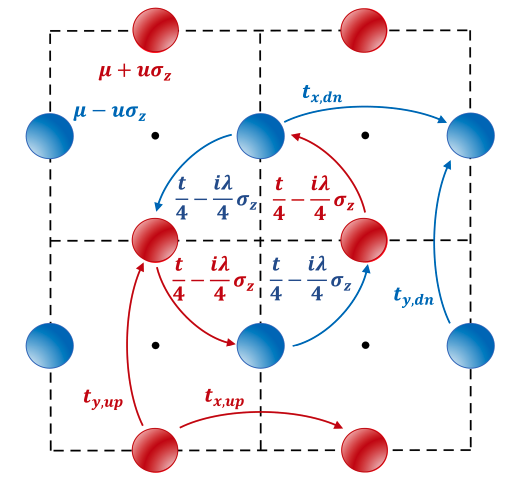
Researchers employed a combined theoretical and computational approach to investigate the topological properties of a specific class of two-dimensional materials known as altermagnets. These materials are notable for possessing opposing magnetic moments on different atomic sites, resulting in zero net magnetization but unique electronic characteristics. The investigation began with the construction of a detailed theoretical model, a four-band framework, designed to capture the essential physics governing these materials and their response to external stimuli. This model incorporates key features such as the arrangement of magnetic atoms and the interactions between them, allowing researchers to predict the material’s behaviour under different conditions.
Specifically, the model accounts for how electrons move between atoms, as well as spin-dependent interactions that mimic the effects of spin-orbit coupling. By carefully tuning these parameters, researchers could simulate the material’s electronic structure and explore how it changes in response to external strain. This approach allowed for a systematic investigation of the material’s topological properties, including the emergence of band gaps, and spin-polarized edge states. To validate the theoretical predictions, researchers performed first-principles calculations based on density functional theory, using monolayer chromium oxide as a test case.
These calculations provide a highly accurate description of the material’s electronic structure and allow for a direct comparison with the theoretical model. By combining these two approaches, researchers were able to demonstrate that applying strain can induce significant changes in the material’s topological properties, driving transitions between different phases. Notably, the direction of the applied strain can be used to reverse a key topological property, without the need for magnetic fields or doping. This innovative aspect of the research lies in the ability to control the material’s topological properties through purely mechanical means, specifically by applying strain. This offers a promising pathway for developing novel spintronic devices that are energy-efficient and robust against external perturbations.
Strain Controls Topological Phases in Altermagnets
Researchers have discovered a new pathway to control the flow of electrons in two-dimensional materials, leveraging the unique properties of a class of materials called altermagnets. These materials exhibit a special connection between an electron’s spin and its movement within the material’s structure, a phenomenon known as spin-valley locking. This research demonstrates that applying strain, essentially stretching or compressing the material, can dramatically alter its electronic properties, driving transitions between different topological phases. The team’s work reveals that by carefully tuning the strain, it is possible to move between a standard insulating state, a type-II quantum spin Hall phase characterized by spin-polarized edge currents, and even exotic anomalous Hall phases where electrons are deflected at right angles without a magnetic field.
Remarkably, the researchers found they could reverse the direction of this deflection simply by changing the direction of the applied strain, without altering the material’s magnetization. This level of control is unprecedented and opens up possibilities for designing novel electronic devices. The research establishes a clear relationship between two key parameters within the material, the strength of the local magnetic moment and the crystal anisotropy, and how these respond to strain. Compressing the material reduces the magnetic moment while simultaneously increasing the anisotropy, creating a predictable pathway to induce topological phase transitions. The team validated their theoretical model with detailed first-principles calculations on chromium oxide, confirming that the material behaves as predicted and exhibits these strain-induced transitions.
Strain Controls Chern Numbers in Altermagnets
This research presents a theoretical and computational study of two-dimensional altermagnetic materials, revealing a novel pathway to control their topological properties through strain engineering. The team demonstrates that applying biaxial strain can drive a transition from an insulating state into a type-II spin Hall phase, and further induce anomalous Hall phases characterized by distinct Chern numbers. Importantly, the researchers identify that the direction of strain can reverse the Chern number without altering magnetization or applying external magnetic fields, offering a unique mechanism for topological control. The study validates these theoretical predictions with first-principles calculations performed on monolayer chromium oxide, successfully replicating the strain-driven topological transitions. This confirms the potential of strain engineering as an effective strategy for designing and manipulating topological phases in two-dimensional altermagnets.
🗞 Strain-Controlled Topological Phase Transitions and Chern Number Reversal in Two-Dimensional Altermagnets
🧠 ArXiv: https://arxiv.org/abs/2507.22474
See today’s quantum computing news on Quantum Zeitgeist for the latest breakthroughs in qubits, hardware, algorithms, and industry deals.