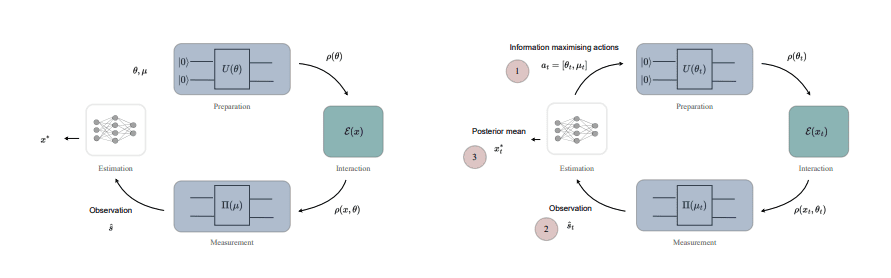
Quantum sensing promises to revolutionise precision measurement, exceeding the capabilities of traditional technologies for detecting time, fields, and acceleration, but designing effective quantum sensors presents a significant challenge. Ivana Nikoloska, Ruud van Sloun, and Osvaldo Simeone, from Eindhoven University of Technology and King’s College London, address this problem by introducing a new adaptive approach to optimise quantum sensing policies. Their research demonstrates a method that uses Bayesian inference to maximise information gained from each measurement, allowing for efficient optimisation even when only a single sensor is available. This innovative technique not only streamlines the process of finding suitable sensors, but also enables the integration of data from multiple sensing devices, paving the way for more powerful and versatile quantum sensing applications
Measurements of physical quantities such as time, magnetic and electric fields, acceleration, and gravitational gradients often demand sensitivities exceeding the limits of classical sensors. Identifying suitable sensing probes and measurement schemes, however, can prove a classically intractable task, as it requires optimisation over complex possibilities. Researchers have now developed new approaches to quantum sensing that overcome these limitations, allowing devices to more effectively measure these quantities and surpass the capabilities of traditional methods.
Adaptive Bayesian Inference for Quantum Sensing
This research focuses on efficiently and accurately estimating parameters in quantum sensing scenarios, moving beyond the limitations of traditional methods that can be computationally expensive or require significant prior knowledge. The team leverages a combination of Bayesian inference, adaptive sensing, and machine learning to achieve this goal. Bayesian inference provides a probabilistic framework for updating beliefs about parameters based on observed data, allowing the incorporation of prior knowledge and quantification of uncertainty. Adaptive sensing dynamically adjusts the sensing strategy to maximize information gain.
The research introduces online conformal inference, a method for quantifying the reliability of predictions made by generative models, allowing for robust parameter estimation even with noisy data and model uncertainties. The team also demonstrates the power of fusing information from multiple sensors or different measurement settings to improve accuracy and reliability. Furthermore, they utilize equivariant quantum graph circuits, employing graph neural networks to represent quantum systems and design efficient quantum circuits that respect the system’s symmetries, reducing computational costs. This work has potential applications in quantum metrology, improving precision in fields like materials science and biology.
It also promises advancements in quantum imaging, radar/sonar, medical diagnostics, environmental monitoring, and fundamental physics. The research combines concepts from quantum physics, machine learning, statistics, and information theory, offering a rigorous theoretical framework with practical applications and the potential for significant impact. Future research directions include improving scalability, robustness, and real-time implementation, as well as integrating the methods with quantum hardware and exploring new machine learning models.
Adaptive Quantum Sensing Maximizes Information Gain
Researchers have developed a new approach to quantum sensing that allows devices to more effectively measure physical quantities like time, magnetic fields, acceleration, and gravity. This advancement addresses a significant challenge in sensing, identifying the optimal way to probe a system when the possibilities are vast and complex. The team’s method utilizes a quantum sensor that actively learns and adapts its measurement strategy, rather than relying on pre-programmed settings. This adaptive strategy is particularly valuable when dealing with parameters that change over time, as the sensor can adjust its approach to track these evolving conditions.
The system builds a “world model” to predict future parameter values, enabling proactive sensing action planning. Extending this concept, the researchers demonstrated that multiple sensors can work together, integrating their data through a principled Bayesian approach. This sensor fusion strategy not only improves accuracy but also compensates for the limitations of individual sensors, creating a more robust and reliable measurement system. The results show that the proposed protocol can accurately estimate parameters using a single probe, even in challenging environments. This suggests the potential for developing highly sensitive and reliable quantum sensors for a wide range of applications, from precision navigation to medical diagnostics and fundamental physics research.
Bayesian Learning Boosts Quantum Sensing Precision
This work introduces a new approach to quantum sensing, focusing on the use of parameterized quantum circuits to estimate physical parameters with high precision. Researchers demonstrate that by employing a Bayesian inference protocol, quantum sensors can actively learn a model of the environment and maximize information gain during each measurement. This allows for precise estimation using a single measurement, a significant advantage in scenarios where repeated measurements are impractical. The findings suggest that fusing estimates from multiple independent sensing agents leads to more consistent and reliable results compared to relying on a single agent. Future research directions include exploring more sophisticated collaborative policies for multi-agent systems and investigating the integration of more complex world model architectures, potentially enabling the sensor to perform additional tasks beyond parameter estimation.
👉 More information
🗞 Adaptive Bayesian Single-Shot Quantum Sensing
🧠 DOI: https://doi.org/10.48550/arXiv.2507.16477