The search for gravitational waves has opened a new window onto the universe, and future detectors like LISA promise to reveal signals from extreme mass ratio inspirals, compact objects spiralling into massive black holes. Lukáš Polcar and Vojtěch Witzany, from the Institute of Theoretical Physics at Charles University in Prague, and their colleagues, have developed a new theoretical framework to model these inspirals as they occur within realistic astrophysical environments containing surrounding matter. This research significantly advances our ability to predict the gravitational wave signals emitted during these events, because it accounts for the complex gravitational influence of matter surrounding the black hole, something previous models often simplified or ignored. By developing a fully relativistic approach and incorporating the dynamics of a surrounding matter shell, the team provides crucial insights into the global dynamics of gravitational radiation and lays a complete theoretical foundation for accurately modelling inspiral waveforms in these complex tidal environments
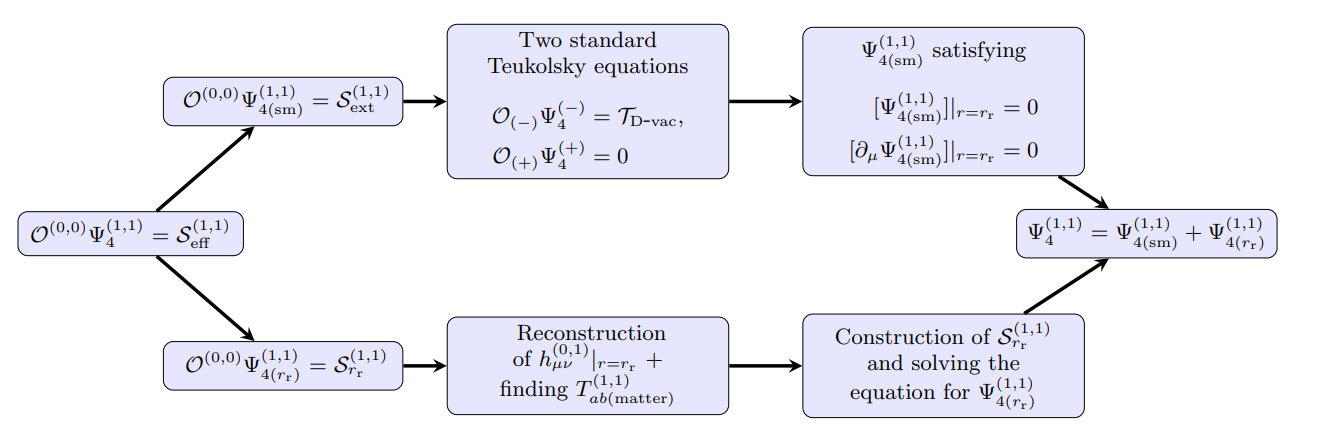
Motivated by recent developments in gravitational wave astronomy, researchers develop a fully relativistic framework for modelling inspirals under the gravitational influence of matter environments. Their approach employs a two-parameter perturbation expansion, utilising both the mass ratio and an environmental parameter, to capture leading cross-order effects. The team implements a simple pole-dipole approximation of an axisymmetric environment, modelling it through a thin matter shell and restricting the analysis to non-rotating black holes. Consequently, this yields a piecewise type D spacetime, which enables the use of Teukolsky-based methods while simultaneously accounting for junction physics, and the matter shell introduces effectively non-separable boundary conditions.
Black Hole Perturbations and Gravitational Waves
This research focuses on black hole perturbation theory, investigating how black holes respond to external influences like incoming gravitational waves or nearby matter, crucial for modelling gravitational waves emitted during black hole mergers or interactions. A significant portion of the research concentrates on extreme mass ratio inspirals (EMRIs), where a small compact object spirals into a supermassive black hole, prime targets for future gravitational wave detectors like LISA. EMRIs offer a unique opportunity to probe the strong-field regime of gravity and map the spacetime around supermassive black holes, but accurately modelling their gravitational wave signals requires a deep understanding of the surrounding environment. The research also emphasizes the importance of the environment surrounding black holes, considering how accretion disks, gas torques, and stochastic backgrounds affect gravitational wave signals. These environmental effects can significantly alter the waveform, introducing complexities that must be accounted for in data analysis. Advanced mathematical techniques, such as Arnold’s work on canonical transformations, Heun’s equations, a class of second-order linear ordinary differential equations, and spheroidal harmonics, are employed to solve the complex perturbation equations, alongside numerical relativity and codes like the Black Hole Perturbation Toolkit. This is a highly theoretical and mathematical project, focused on LISA and future gravitational wave detectors, aiming to model signals that will be observed by space-based detectors and incorporating realism by including environmental effects and accretion disk physics. The inclusion of these effects is vital for accurately extracting astrophysical parameters from observed waveforms.
Realistic Gravitational Waves from Black Hole Inspirals
Researchers have developed a new accurately predicting signals from extreme mass ratio inspirals when these events occur within regions containing surrounding matter. Current waveform models often assume vacuum spacetimes, neglecting the influence of matter, which can introduce errors in parameter estimation and potentially lead to false detections. The team’s approach builds upon the well-established Teukolsky equation, a relativistic wave equation describing perturbations of a Kerr black hole spacetime, but extends the formalism to account for the influence of surrounding matter, treating the environment as a perturbation of the black hole spacetime. This extension involves a complex mathematical expansion, considering both the small size of the inspiraling object (characterised by the mass ratio, μ/M, where μ is the small object’s mass and M is the large black hole’s mass) and the degree to which the surrounding matter deviates from a perfectly symmetrical environment. The two-parameter expansion allows for systematic inclusion of higher-order effects, improving the accuracy of the waveform model.
A key innovation lies in modelling the surrounding matter as a “thin shell” around the black hole, allowing for a mathematically tractable, yet physically plausible, representation of a complex environment. This simplification avoids the need to solve the full Einstein equations for a complex spacetime, significantly reducing the computational cost. The results demonstrate that the surrounding matter alters the frequency and amplitude of the waves, and introduces “mode mixing”, a coupling between different wave patterns. This mode mixing arises from the interaction between the inspiral, the emitted gravitational waves, and the surrounding matter, and can significantly affect the observed waveform. Furthermore, the framework accounts for the reciprocal interaction between the inspiral, the emitted waves, and the environment, providing a complete theoretical foundation for calculating waveforms from inspirals in these complex environments, paving the way for more accurate interpretation of future gravitational wave observations. This reciprocal interaction is crucial for self-consistency and ensures that the framework accurately captures the dynamics of the system.
Relativistic Framework for Extreme Mass Ratio Inspirals
This research presents a fully relativistic framework for modelling extreme mass ratio inspirals within realistic astrophysical environments containing surrounding matter. The team extended the standard Teukolsky equation to account for the influence of these surrounding environments through a two-parameter expansion, modelling the environment as a simple “pole-dipole ring”, a thin shell of matter. The pole-dipole approximation captures the leading-order effects of a non-spherically symmetric environment, such as an accretion disk or a warped disk. The resulting framework provides a foundational theoretical model for understanding how tidal environments affect extreme mass ratio inspirals and will be crucial for interpreting future observations from detectors like LISA. The framework allows researchers to systematically investigate the impact of environmental effects on the inspiral dynamics and the emitted gravitational waves, improving the accuracy of waveform models and enabling more precise parameter estimation. The authors acknowledge that their current model employs a simplified representation of the surrounding matter and future work will focus on implementing the formalism with more complex environmental models, with a second paper planned to present concrete examples of how these tidal environments influence the inspiral process and the emitted gravitational waves. This future work will involve incorporating more realistic accretion disk models and investigating the impact of different environmental configurations on the observed waveforms, ultimately leading to a more complete and accurate understanding of extreme mass ratio inspirals.
🗞 Towards relativistic inspirals into black holes surrounded by matter
🧠 DOI: https://doi.org/10.48550/arXiv.2507.15720
See today’s quantum computing news on Quantum Zeitgeist for the latest breakthroughs in qubits, hardware, algorithms, and industry deals.