Photonic lattices represent a promising platform for controlling the flow of light, but conventional designs often struggle with signal loss at their edges, limiting their potential for building advanced optical circuits, however, a new study led by Enrico Di Benedetto and Xuejian Sun, from the Universit`a degli Studi di Palermo and Zhoukou Normal University respectively, alongside Marcel A. Pinto and colleagues at École Polytechnique Fédérale de Lausanne, demonstrates a unique approach to overcome this challenge. The researchers investigate how light interacts with the edge of a specially designed photonic lattice, revealing that these interactions can be accurately described using principles from cavity quantum electrodynamics, a field typically used to study light-matter interactions within enclosed spaces. This discovery is significant because it predicts the emergence of a novel type of light confinement at the lattice edge, enabling efficient transfer of information between distant points and potentially paving the way for robust and scalable photonic technologies. The team predicts observable quantum effects, such as vacuum Rabi oscillations, and proposes a practical implementation using existing circuit technology.
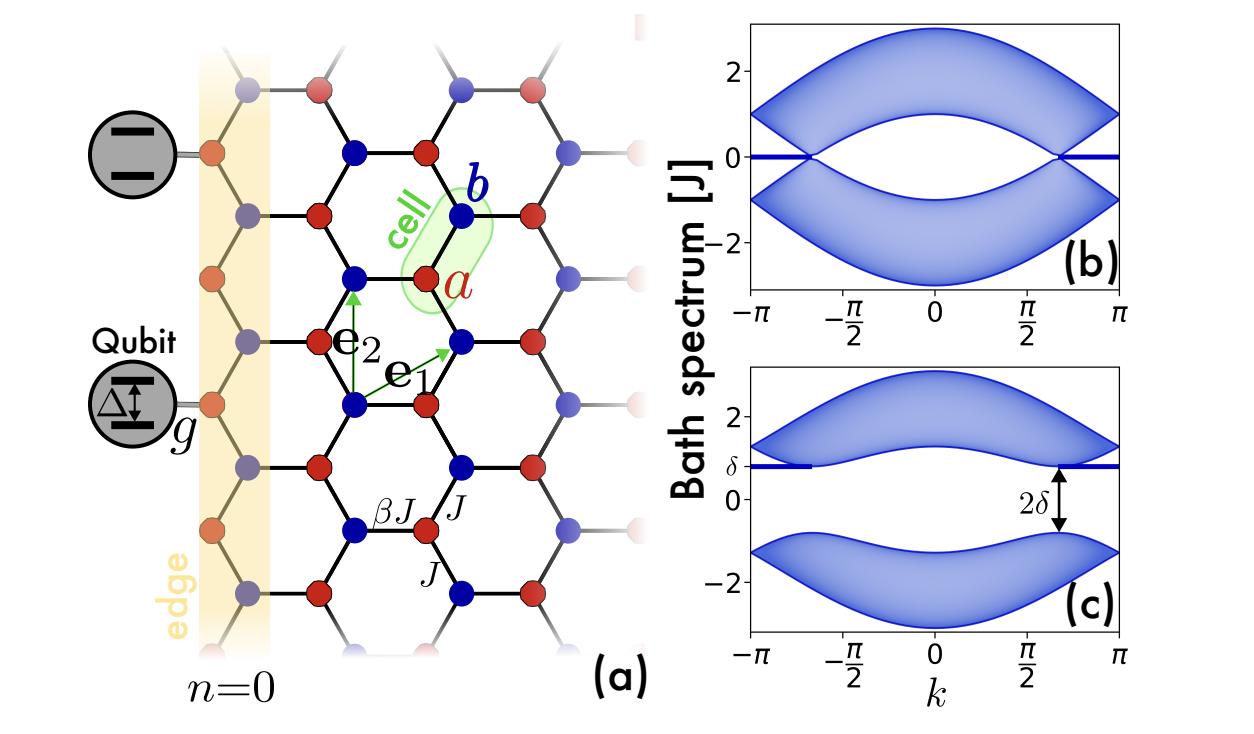
Researchers are investigating qubits coupled to the boundary of a two-dimensional photonic lattice, a unique structure that supports stable and localized qubit interactions unlike conventional systems. The team focuses on a honeycomb lattice, often termed “photonic graphene”, constructed from coupled resonators with a zigzag edge, to explore these properties. These lattices feature edge modes that form a flat band, meaning their characteristics depend solely on the lattice geometry and not the energy of photons travelling within it, offering potential advantages for building robust platforms for quantum computation and communication. This approach diverges from traditional quantum architectures that rely on direct qubit-qubit coupling, which often suffers from decoherence and scalability issues; the lattice provides a mediating structure that can enhance coherence and facilitate long-range interactions.
Honeycomb Lattices and Long-Range Qubit Interactions
The research centers on designing a system with topological flat band edge modes within a honeycomb lattice, predicting specific coherent dynamics crucial for quantum information processing. These edge modes appear only with specific edge shapes, such as zigzag or bearded edges, and are absent in others like armchair edges. The underlying principle stems from topology, a branch of mathematics concerned with properties preserved through continuous deformations; in this context, the flat band arises from the specific arrangement of resonators that constrains the possible states of photons within the lattice. A key finding is that interactions between qubits will be mediated by the lattice’s cavity modes and will decrease with distance following a predictable power-law scaling with an exponent of -2, meaning the interaction strength weakens as the inverse square of the distance between qubits. This power-law decay is particularly advantageous as it allows for controlled interactions over relatively long distances without requiring excessively strong, and therefore noisy, coupling between individual qubits. Importantly, this scaling remains stable even with imperfections in the system, offering a degree of resilience against fabrication errors and environmental noise.
The system’s chiral symmetry plays a vital role; disrupting this symmetry, for example through disorder in the lattice, broadens the flat band and alters the behavior of the edge modes. Chiral symmetry refers to the property of a system remaining unchanged under a mirror reflection; its preservation is crucial for maintaining the topological protection of the flat band. Researchers predict these flat band edge modes will enable controlled interactions between qubits, specifically through the exchange of virtual photons within the lattice. The system is to be implemented using superconducting lumped-element LC resonators arranged in a honeycomb lattice, with each lattice site containing an inductor and capacitor connected to ground. Neighboring sites are coupled via capacitors, creating the interactions between qubits, and the resonator frequency is determined by the properties of the inductor, capacitor, and the number of connections each site has. Superconducting circuits are favoured due to their low dissipation and potential for scalability, offering a pathway towards building larger and more complex quantum processors.
Precise control over the edge shape, specifically creating zigzag or armchair edges, is crucial for observing the presence or absence of the desired edge modes. The edge shape dictates the boundary conditions for the electromagnetic fields within the lattice, directly influencing the formation of the flat band. Several challenges must be addressed during implementation, including the emergence of long-range hopping between qubits due to the capacitance matrix, and the impact of fabrication variations introducing disorder in the system’s parameters. Long-range hopping refers to the unintended coupling between qubits that are not directly adjacent, which can introduce errors into quantum computations. There is a trade-off between increasing the coupling strength to improve robustness against disorder and minimizing unwanted higher-order hopping terms. Researchers suggest parameters of approximately 6 GHz for the resonator frequency, 100-200 MHz for the interaction strength, and 20 MHz for the qubit coupling as a reasonable compromise. These parameters represent a balance between maximizing coherence, minimizing errors, and achieving sufficient interaction strength for quantum operations.
Experimental verification will involve demonstrating the presence or absence of edge modes by controlling the edge shape, and strategically placing qubits along armchair edges as a control measurement. Ensuring the spectral width of the flat band remains small compared to the qubit coupling is also critical; a narrow bandwidth ensures that the qubits interact primarily through the desired edge modes, minimizing unwanted interactions. Furthermore, characterization of the system’s coherence times, which measure how long qubits retain their quantum information, is essential for assessing its suitability for quantum computation. In summary, this research describes a promising approach to realize a system with topological flat band edge modes using superconducting circuits, predicting a robust power-law interaction between qubits with an exponent of -2. Careful control of edge shape, parameter selection, and disorder are essential for successful experimental validation, potentially paving the way for more robust and scalable quantum technologies. The ability to engineer topological states within artificial materials represents a significant advancement in the field of quantum information science.
🗞 Emergent cavity-QED dynamics along the edge of a photonic lattice
🧠 DOI: https://doi.org/10.48550/arXiv.2507.13444



See today’s quantum computing news on Quantum Zeitgeist for the latest breakthroughs in qubits, hardware, algorithms, and industry deals.