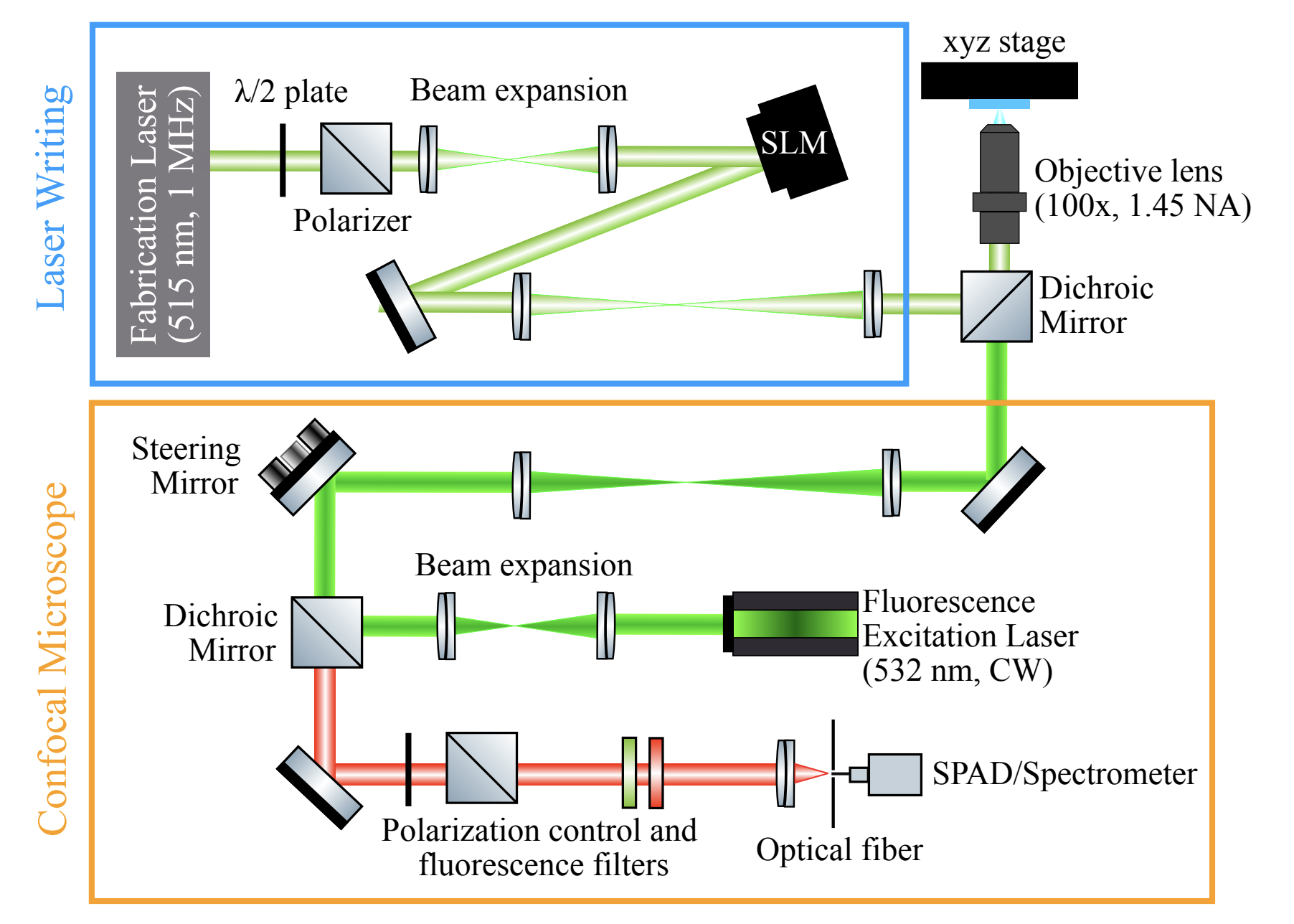
Nitrogen-vacancy centres within diamond represent a leading technology for nanoscale sensing, owing to their unique quantum properties and ability to operate at room temperature. Kai Klink, Andrew Raj Kirkpatrick, and colleagues at Michigan State University, alongside Yukihiro Tadokoro from the Toyota Research Institute of North America, now demonstrate a significant advance in controlling these defects. The team has developed a method to not only create, but also precisely orient, these NV centres using focused laser light, overcoming a key limitation of previous techniques where the defects appeared randomly. This all-optical approach allows for the creation of ordered arrays of NV centres aligned along specific crystallographic axes, promising substantial improvements in the sensitivity and contrast of devices used for magnetometry and other nanoscale applications.
Nitrogen-vacancy (NV) centers in diamond are highly promising solid-state quantum sensors, owing to their long room temperature coherence times and atomic-scale size. These characteristics enable exceptional sensitivity and nanoscale spatial resolution, even under ambient conditions, making them attractive for diverse applications including magnetic field sensing, electric field detection, and temperature mapping. The NV center itself is a point defect in the diamond lattice, created when a nitrogen atom replaces a carbon atom, adjacent to a vacancy , a missing carbon atom. This defect creates a spin-dependent fluorescence, allowing researchers to optically detect and manipulate the quantum state of the NV center. Ultrafast laser writing has demonstrated the deterministic spatial control of individual NV centers, allowing researchers to precisely position these sensors within the diamond lattice; however, the random orientation of the defect axis currently limits the full potential of these sensors for directional magnetic field measurements and other anisotropic sensing applications. Therefore, controlling the orientation of NV centers during their creation represents a significant challenge and a crucial step towards realizing advanced quantum sensing technologies.
Laser Writing Aligns NV Center Orientation
This research details a novel method for achieving precise control over the orientation of nitrogen-vacancy (NV) centers in diamond using laser writing techniques. The study addresses a key limitation in utilizing NV centers for advanced quantum technologies by demonstrating a method to actively orient NV centers after diamond fabrication using a focused laser beam. Traditionally, controlling NV center orientation has relied on complex diamond growth processes or applying significant strain to the material, both of which present substantial engineering challenges and limit scalability. This new approach circumvents these difficulties by leveraging the physics of defect formation during laser irradiation, offering a post-fabrication solution applicable to a wider range of diamond materials and geometries.
Many quantum sensing and information processing applications require precise control over NV center orientation, and traditional methods, such as growth-based techniques or strain engineering, are often complex or limited. The team’s approach centres on selectively exciting specific defects within the diamond lattice , specifically, carbon vacancies , using a femtosecond laser. By carefully controlling the laser polarization and scanning pattern, they induce the formation of NV centers with a preferential orientation along the polarization direction. This is achieved because the laser-induced excitation of vacancies is anisotropic; the probability of creating a vacancy is higher along the direction of the electric field component of the polarized laser beam. The resulting NV centers inherit this preferential orientation, aligning their defect axes with the laser polarization. This process relies on the principle of selective excitation, where the laser energy preferentially interacts with specific defects based on their orientation relative to the laser polarization.
Key findings include the demonstration that laser polarization dictates the preferential orientation of the created NV centers, achieving a degree of alignment significantly higher than previously reported. The researchers employed a series of experiments, including optical microscopy and electron paramagnetic resonance (EPR) spectroscopy, to characterize the orientation distribution of the created NV centers. EPR, a technique sensitive to the magnetic properties of defects, confirmed that the NV center axes were preferentially aligned along the laser polarization direction. This method allows for orientation control after the diamond substrate is already fabricated, offering significant flexibility and applicability to various diamond types without requiring specialized substrates or complex growth procedures. Furthermore, the researchers suggest the possibility of extending the technique to achieve three-dimensional control over NV center orientation by manipulating the laser focus and scanning trajectory, suggesting that laser-induced excitation of specific defects and the subsequent formation of NV centers are strongly influenced by the laser polarization and spatial beam profile.
This research represents a significant advancement in the field of NV center-based quantum technologies. The ability to precisely control the orientation of NV centers opens up new possibilities for enhanced quantum sensing, optimizing sensor sensitivity and performance, particularly for applications requiring directional measurements, such as biomagnetic field detection or materials characterization. The controlled orientation is crucial for building complex quantum circuits and architectures, advancing quantum information processing, and enabling the development of scalable quantum sensors and devices. The post-fabrication control offered by this method simplifies the manufacturing process, reduces costs, and enables the creation of scalable quantum devices, paving the way for wider adoption of NV center-based technologies. The technique also offers potential for creating novel quantum materials with tailored properties, where the orientation of NV centers can be engineered to achieve specific functionalities.
In essence, this study presents a powerful and versatile technique for programming the orientation of NV centers in diamond, paving the way for more advanced and sophisticated quantum technologies. Future research will focus on optimizing the laser parameters and scanning strategies to achieve even higher degrees of orientation control and exploring the potential for creating three-dimensional arrays of oriented NV centers, further expanding the capabilities of this promising quantum sensing platform.
🗞 Fabrication of oriented NV center arrays in diamond via femtosecond laser writing and reorientation
🧠 DOI: https://doi.org/10.48550/arXiv.2507.14047



See today’s quantum computing news on Quantum Zeitgeist for the latest breakthroughs in qubits, hardware, algorithms, and industry deals.