Modern GPUs increasingly offer the ability to partition themselves into multiple isolated instances, a technology known as Multi-Instance GPU or MIG, but realising its full potential requires innovative scheduling strategies. Jorge Villarrubia, Luis Costero, and Francisco D. Iguala, from Universidad Complutense de Madrid, alongside Katzalin Olcoza, address this challenge by proposing a new approach to task scheduling that dynamically reconfigures GPU resources. Their research demonstrates that traditional scheduling assumptions, commonly used in multicore processing, do not hold true for MIG environments, necessitating a more flexible algorithm. The team developed FAR, a three-phase scheduling method, which minimises task completion time and, through extensive experimentation, achieves results significantly better than existing techniques, showcasing the considerable benefits of leveraging dynamic reconfiguration within MIG technology and establishing a foundation for future research in this rapidly evolving field.
Parallel Task Scheduling Algorithms Explored
This overview synthesizes research areas and topics found within the provided bibliography, categorizing them for clarity and highlighting common themes. The research represents a broad and active field focused on efficient task allocation in modern computing systems. A significant portion of the research addresses fundamental challenges in allocating resources, particularly processing units, to tasks. Many studies investigate algorithms for scheduling parallel tasks, those divisible and executable across multiple processors, to minimize completion time, resource usage, or other key metrics. List scheduling, a greedy algorithm that prioritizes tasks based on a predefined heuristic, frequently serves as a baseline for more complex algorithms. Researchers also develop approximation algorithms, aiming to guarantee a certain performance level when finding the absolute best schedule proves computationally impractical due to the NP-hard nature of many scheduling problems. These algorithms often employ techniques like bin packing or knapsack problem solutions, adapted for task allocation. The core challenge lies in balancing the overhead of complex scheduling with the potential gains in efficiency and resource utilization.
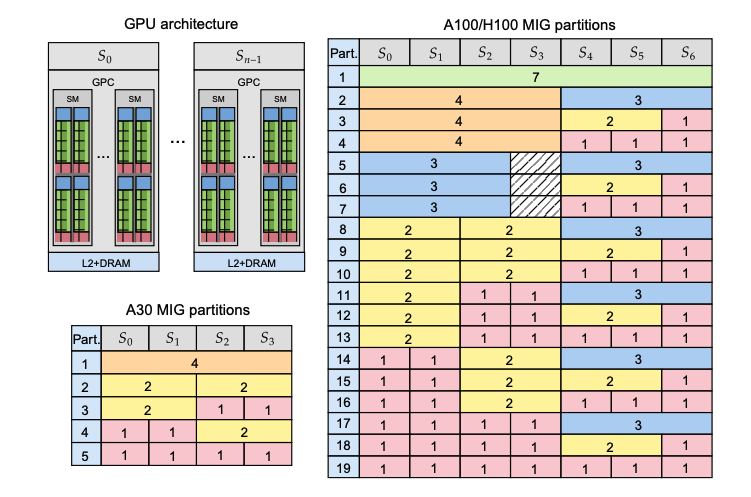
Online scheduling receives considerable attention, focusing on scenarios where tasks arrive dynamically and scheduling decisions must be made without complete future knowledge. This contrasts with offline scheduling, where the entire task set is known in advance. Makespan minimization, reducing the total time to complete all tasks, remains a primary objective, alongside efficient resource allocation, ensuring tasks receive the necessary processors, memory, and other resources. Research increasingly focuses on the unique challenges and opportunities presented by GPUs, driven by their growing importance in machine learning, data analytics, and other demanding fields. A major theme is Multi-Instance GPUs (MIG), a technology allowing a single GPU to be partitioned into multiple isolated instances, improving resource utilization and workload isolation. Each MIG instance behaves as a separate GPU, with its own dedicated resources, enabling better isolation and quality of service for different applications. This is particularly crucial in multi-tenant environments, such as cloud computing, where multiple users share the same physical infrastructure.
The Multi-Process Service (MPS) enables multiple processes to share a single GPU, further enhancing efficiency. While MIG partitions the GPU physically, MPS allows multiple processes to time-share a single GPU, switching between them rapidly. Optimizing GPU sharing among users and applications is also a key area of investigation. Researchers explore containerization, using technologies like Docker, to deploy and serve deep learning models on GPUs, and develop scheduling techniques to manage these containers effectively. Containerization provides a standardized and portable environment for applications, simplifying deployment and management. Elastic scheduling, which dynamically adjusts resource allocation based on workload demands, and performance prediction, which anticipates application performance on GPUs, are also prominent topics. Performance prediction often leverages machine learning models trained on historical data to estimate the execution time of tasks on different GPU configurations. This allows the scheduler to make informed decisions about resource allocation, maximizing throughput and minimizing latency.
Research addresses scheduling tasks in additive manufacturing (3D printing), optimizing workloads in data centers and cloud environments, and improving the deployment and execution of deep learning models. Workflow scheduling, which manages tasks within complex, interdependent workflows, also receives attention. These workflows often involve data dependencies, requiring tasks to be executed in a specific order. Theoretical research underpins many practical advancements. Studies develop Asymptotic Fully Polynomial-Time Approximation Schemes (FPTAS), algorithms capable of achieving arbitrarily good approximations in polynomial time. An FPTAS guarantees that for any desired level of accuracy, the algorithm will find a solution within that accuracy in polynomial time, making it a powerful tool for solving NP-hard optimization problems. Researchers also analyze algorithm performance, establishing bounds and guarantees on their accuracy and efficiency. Competitive analysis, a common technique, compares the performance of an algorithm to that of an optimal algorithm, providing a measure of its worst-case performance.
The research clearly demonstrates a growing focus on GPU-specific scheduling, reflecting the increasing importance of GPUs in modern computing. Technologies like MIG and MPS are becoming central to GPU resource management, and research explores how to best utilize these capabilities. Dynamic scheduling and elastic resource allocation address the need to handle changing workloads, while containerization provides a standard deployment method. Hybrid approaches, combining theoretical algorithms with practical heuristics and machine learning techniques, are increasingly common. For example, reinforcement learning is used to train scheduling policies that adapt to changing workload patterns. In summary, this bibliography represents a vibrant and active area of research at the intersection of scheduling theory, computer architecture, and machine learning. The focus is shifting towards optimizing resource utilization in modern computing environments, particularly those leveraging the power of GPUs. Future research will likely focus on developing more sophisticated scheduling algorithms that can handle increasingly complex workloads and heterogeneous computing environments.
🗞 Leveraging Multi-Instance GPUs through moldable task scheduling
🧠 DOI: https://doi.org/10.48550/arXiv.2507.13601
See today’s quantum computing news on Quantum Zeitgeist for the latest breakthroughs in qubits, hardware, algorithms, and industry deals.