The quest for efficient nonlinear optical materials drives ongoing research into nanoscale structures, and now, a team led by Kainan Chang, Ying Song, and Yuwei Shan at the Chinese Academy of Sciences investigates harmonic generation within graphene quantum dots. Their work explores how excitonic effects , the binding of electrons and holes , dramatically influence the way these tiny structures interact with light, significantly boosting their optical response. By employing a sophisticated theoretical framework, the researchers demonstrate that graphene quantum dots exhibit remarkably tunable harmonic generation, dependent on their size, shape, and even the arrangement of their edges. This high degree of control positions these nanostructures as potentially valuable building blocks for future nonlinear optical nanodevices, offering a pathway towards manipulating light at the nanoscale with unprecedented precision.
Excitonic Effects in Graphene Harmonic Generation
Graphene quantum dots (GQDs), nanoscale fragments of graphene, are attracting considerable attention for applications in diverse fields including photovoltaics, bioimaging, and advanced electronic devices. A key challenge in harnessing their potential lies in understanding and controlling their nonlinear optical properties, specifically how they generate harmonics of incident light. This research investigates these properties, focusing on the importance of ‘excitonic effects’ which arise from the strong interactions between electrons within these two-dimensional materials. The team’s work addresses a fundamental limitation in current models, which often simplify the complex interactions between electrons.
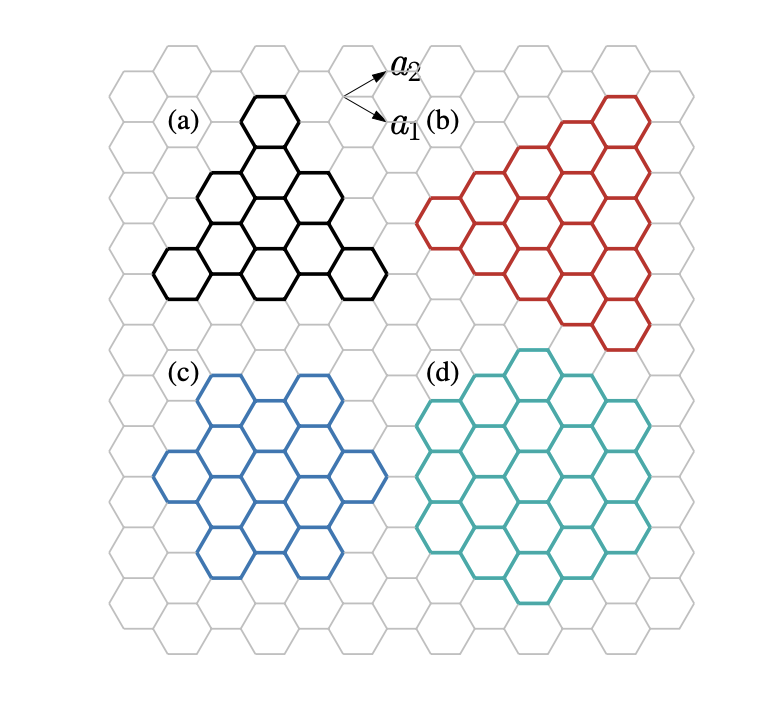
These models frequently fail to fully account for the way electrons bind together to form excitons, bound electron-hole pairs that significantly influence how GQDs absorb and emit light, and therefore their nonlinear optical response. To accurately model this behaviour, the researchers developed a sophisticated theoretical framework combining methods for calculating electronic structure with approximations describing electron-electron interactions. The researchers explored how the size, shape, and edge structure of GQDs, including triangular, hexagonal, armchair, and zigzag configurations, influence their optical properties. Their calculations reveal that excitonic effects profoundly alter the energy levels and intensity of optical responses within the quantum dots.
By accurately incorporating these effects into their model, the team demonstrated a significant enhancement in the predicted harmonic generation compared to simpler approximations. This tunability, achieved through geometric control, suggests GQDs are promising candidates for creating novel nonlinear optical nanodevices. The findings highlight the critical role of excitonic effects in determining the nonlinear optical behaviour of GQDs. By demonstrating the ability to control harmonic generation through precise manipulation of the quantum dot’s structure, this research paves the way for designing advanced photonic components with tailored optical properties. The team’s work provides a more complete and accurate understanding of GQD behaviour, moving the field closer to realizing the full potential of these versatile nanomaterials in a range of technological applications.
Excitonic Effects on Graphene Quantum Dot Harmonics
The researchers compared several methods for modelling electron behaviour, including those that treat electrons independently and those that consider their interactions. They thoroughly analysed how these methods affect the electronic energy levels, light absorption, and harmonic generation. Their findings show that excitonic effects significantly enhance the optical responses of graphene nanostructures, and that harmonic generation in GQDs exhibits high tunability via geometric configuration, making them promising candidates for nonlinear optical nanodevices. Graphene, the first fabricated two-dimensional material, possesses properties such as chemical stability, mechanical robustness, high carrier mobility, ultrafast carrier dynamics, wideband absorption, and strong optical nonlinearity.
These properties arise from its linear dispersion and can be well controlled by adjusting the number of electrons through electric gating or chemical doping techniques. Given the ease with which graphene can be integrated with photonic structures, it is ideal for realizing photonic devices with novel functionalities. Applications in nano-electronic and nano-photonic devices are often limited by graphene’s zero bandgap, which can be overcome by engineering the size, shape, or edge of graphene on the nanoscale to form various nanostructures, including nanoribbons, flakes and quantum dots. Graphene quantum dots (GQDs) are zero-dimensional fragments of graphene with a size smaller than 100 nm, and have been widely applied in photovoltaics, light-emitting diodes, batteries, fuel cells, bioimaging, and more.
Recent studies have focused on understanding the nonlinear optical properties of GQDs, revealing that they can exhibit stronger optical properties than noble metal nanoparticles, attributed to strong near-field enhancement. Theoretical investigations have explored the effect of vacancy defects on harmonic generation, demonstrating efficient harmonic generation even with low defect concentrations. Other studies have shown the dependence of harmonic generation on the size, edge, and shape of GQDs. However, these works typically consider electron interactions at a simplified level, while excitonic effects are often neglected.
It is well known that excitonic effects in two-dimensional materials with a bandgap are extremely important for both linear and nonlinear optical properties due to the insufficient screening of electron interactions, and it is of fundamental importance to understand how it affects nonlinear optical responses in GQDs. The electronic states of GQDs are calculated using a method for calculating electronic structure with nearest-neighbor coupling, and electron-electron interactions are modelled using an approximation that accounts for screening. The dynamics of applying a strong laser field are described using equations that govern the behaviour of semiconductors, and their numerical solutions are used to extract the nonlinear susceptibilities. Within this model, the Coulomb interaction contributes to the local field and screening, while the exchange interaction gives rise to excitonic effects.
External Fields Tune GQD Optical Response
Results reveal that excitonic effects have a profound impact on the resonance energy and intensity of the optical responses of GQDs. The research discusses the effects of GQD size, edge characteristics, and shape, as well as the amplitude and polarization of the electric field. These findings demonstrate a clear relationship between external factors and the optical behaviour of these quantum dots, offering potential for tailored applications. This precise control over optical properties is crucial for developing advanced technologies in areas such as bioimaging, sensing, and optoelectronics.
Graphene Quantum Dot Harmonic Generation Mechanisms
This work presents a comprehensive theoretical investigation of many-body effects on harmonic generation in graphene quantum dots, considering the influences of geometric parameters, shapes, sizes, and edges, and external electric fields. Many-body interactions are modelled through an approximation that accounts for screening and are incorporated into equations that govern the behaviour of semiconductors. For the ground states, the antiferromagnetic state has the lowest energy, and electron interactions greatly affect electronic energy levels, removing spin degeneracy. Optical responses are studied under different approximations, including the independent particle approximation, mean-field approximation, random phase approximation, and excitonic effects. Resonant transitions in the mean-field approximation exhibit larger transition energies than those in the independent particle approximation, indicating that the energy difference between the highest occupied and lowest unoccupied molecular orbitals is enlarged by electron interactions, similar to corrections from more advanced calculations. Results obtained in the random phase approximation show that the local field induces plasmonic resonance, enhancing the electric field.
🗞 Harmonic generation of graphene quantum dots in Hartree-Fock approximation
🧠 DOI: https://doi.org/10.48550/arXiv.2507.12982




See today’s quantum computing news on Quantum Zeitgeist for the latest breakthroughs in qubits, hardware, algorithms, and industry deals.