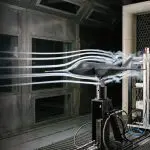
Turbulent flows at high speeds present a formidable challenge for conventional computer simulations, demanding increasingly powerful computational resources. Monica Lăcătuş from 1 and Matthias Möller from 1, along with their colleagues, address this problem by exploring quantum computing as a potential solution. Their research introduces a new framework for designing simplified quantum circuits that mimic the complex ‘collision’ step within the lattice Boltzmann method, a technique used to model fluid dynamics. This advance is significant because the team’s approach creates a circuit that accurately simulates fluid behaviour without requiring additional computational resources or complex programming tricks, offering a pathway to more efficient and scalable simulations of turbulent flows and potentially revolutionising fields from weather forecasting to aerodynamic design. The resulting circuit, tested on standard fluid dynamics problems, demonstrates accurate simulation of vortex behaviour and flow patterns.
Quantum Computing Tackles Turbulence Simulations
Turbulence presents a significant challenge in fluid mechanics, hindering accurate simulations of flows at high Reynolds numbers. Traditional computational methods struggle because the computational demands increase dramatically with increasing Reynolds number, restricting simulations to simplified scenarios. As the pace of conventional computing slows, researchers are exploring quantum computing to unlock the potential for high-resolution turbulence simulations. Quantum computing offers a fundamentally different approach to computation by leveraging superposition and entanglement. Researchers are developing quantum algorithms for computational fluid dynamics, with a promising avenue involving a quantum version of the lattice Boltzmann method (LBM).
Classical LBM simulates fluid flow by tracking particle distributions on a discrete lattice, offering inherent parallelism. A key obstacle has been accurately representing the ‘collision’ step within the constraints of quantum mechanics. The collision step, governing how particles interact and redistribute momentum, is inherently nonlinear and irreversible, characteristics incompatible with linear and reversible quantum operations. Researchers have now developed a framework for designing a ‘surrogate quantum circuit’ that closely approximates the collision operator, avoiding the need for additional qubits or complex calculations.
This newly designed circuit, tailored for a specific quantum processor, significantly reduces the complexity of the collision step, allowing for scalable simulations of turbulence. Validation using benchmark flow scenarios demonstrates that this surrogate circuit accurately captures key features of turbulent flow, such as vortex dissipation and recirculation, paving the way for more realistic and efficient simulations of complex fluid dynamics problems. This advancement establishes a foundation for future scalable quantum simulations of turbulence, potentially unlocking new insights into this long-standing scientific challenge.
Quantum Lattice Boltzmann Collision Simulation
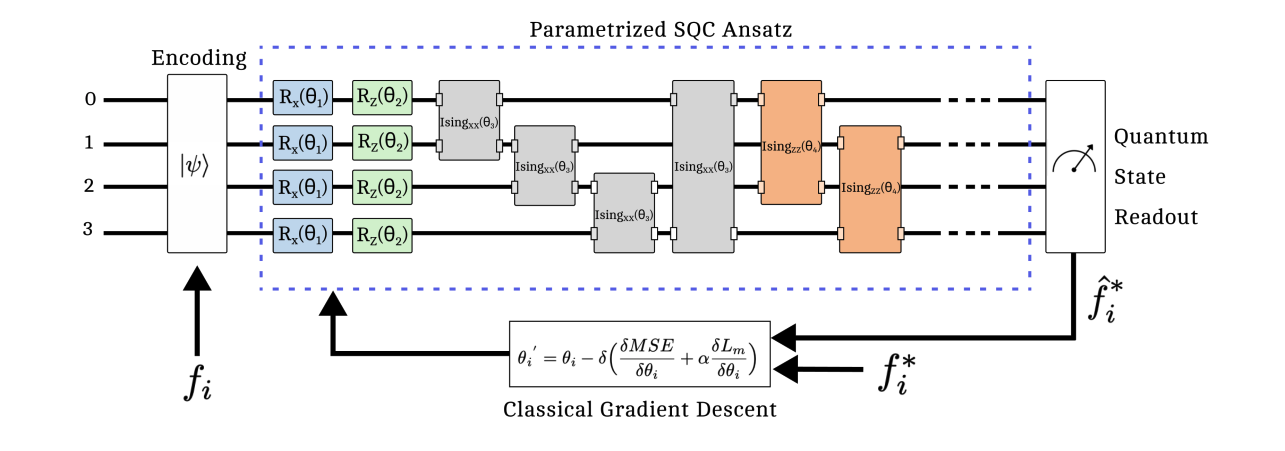
Researchers are tackling the challenge of simulating turbulent fluid flows by leveraging the potential of quantum computing. They have developed a novel approach based on the lattice Boltzmann method (LBM), adapted for quantum computers, to overcome the limitations of traditional methods. The core of their innovation lies in a new way to simulate the ‘collision’ step within the LBM framework, a process governing how particles interact. Instead of directly calculating these interactions, they employ a ‘surrogate quantum circuit’ (SQC) that acts as an approximation of the complex collision operator, effectively learning to mimic its behaviour.
Crucially, this SQC is designed to respect fundamental physical properties like conservation of mass and momentum, ensuring the simulation remains accurate and realistic. What sets this method apart is the efficiency of the SQC itself. The researchers have engineered a circuit that requires a remarkably small number of quantum operations, minimizing the demands on current quantum hardware. It avoids the need for additional qubits or complex post-processing steps, simplifying the implementation and reducing the potential for errors. Furthermore, the circuit’s complexity doesn’t increase with the resolution of the simulation grid, meaning it can handle increasingly detailed models without a corresponding increase in computational cost.
To validate their approach, the team tested the SQC on two standard fluid dynamics problems: the decay of a vortex and flow within a cavity. The results demonstrate that the quantum simulation accurately captures key features of these flows, such as the dissipation of energy in the vortex and the recirculation patterns within the cavity, confirming the viability of this quantum approach for tackling complex fluid dynamics problems. This work represents a significant step towards scalable quantum simulations of turbulence, potentially unlocking new insights into this fundamental phenomenon.
Quantum Simulation Accelerates Turbulent Fluid Dynamics
Researchers have developed a new method for simulating turbulent fluid flows using quantum computers, addressing a longstanding challenge in computational fluid dynamics. The team focused on the lattice Boltzmann method, a technique for modeling fluid behavior, and specifically tackled the complex “collision” step within the method, which governs how fluid particles interact. The breakthrough lies in a “surrogate quantum circuit” (SQC) that learns to approximate the behavior of the classical collision operator. Instead of directly implementing the complex collision process on a quantum computer, the team trained a quantum circuit to mimic its effects.
This training process ensures the circuit accurately reflects key physical properties like conservation of mass and momentum, and maintains consistency regardless of the scale of the simulation. The resulting circuit is remarkably compact, requiring far fewer operations than previous quantum implementations and eliminating the need for additional qubits or repeated calculations. Importantly, the SQC achieves this efficiency without sacrificing accuracy. When tested on benchmark fluid flow scenarios, including the decay of a vortex and flow within a cavity, the circuit accurately captured the expected behavior, demonstrating its ability to model complex fluid dynamics.
This new method offers a low-depth circuit that requires no additional resources, making it a promising building block for scalable quantum fluid simulations. The team achieved this by drawing inspiration from machine learning techniques, specifically training a quantum circuit in a way that minimizes its complexity while maintaining fidelity to the classical collision operator. This approach allows the SQC to learn the essential features of fluid interactions, effectively acting as a streamlined quantum approximation. The result is a significant step towards harnessing the power of quantum computing to solve complex problems in fluid dynamics, potentially enabling simulations of unprecedented scale and accuracy.
Simplified Quantum Circuit Simulates Fluid Dynamics
This study introduces a new framework for creating a simplified quantum circuit that mimics a key step in simulating fluid flows, the collision of particles within the lattice Boltzmann method. The researchers successfully trained this circuit to accurately represent the essential physics of the collision process, specifically conserving mass and momentum while respecting fundamental symmetries. Validation using benchmark fluid flow simulations, including decaying vortices and flow within a cavity, demonstrates that the simplified circuit accurately predicts fluid behaviour. While the current implementation performs well at lower flow regimes, the authors acknowledge that it is an approximation of the full complexity of fluid dynamics. Future work will focus on extending this framework to more complex three-dimensional simulations, reducing the resources needed for implementation, and developing circuits capable of accurately modelling higher velocity flows. This research represents a significant step towards performing full fluid flow simulations on quantum computers, potentially offering speed advantages over traditional methods.
🗞 Surrogate Quantum Circuit Design for the Lattice Boltzmann Collision Operator
🧠 DOI: https://doi.org/10.48550/arXiv.2507.12256


See today’s quantum computing news on Quantum Zeitgeist for the latest breakthroughs in qubits, hardware, algorithms, and industry deals.