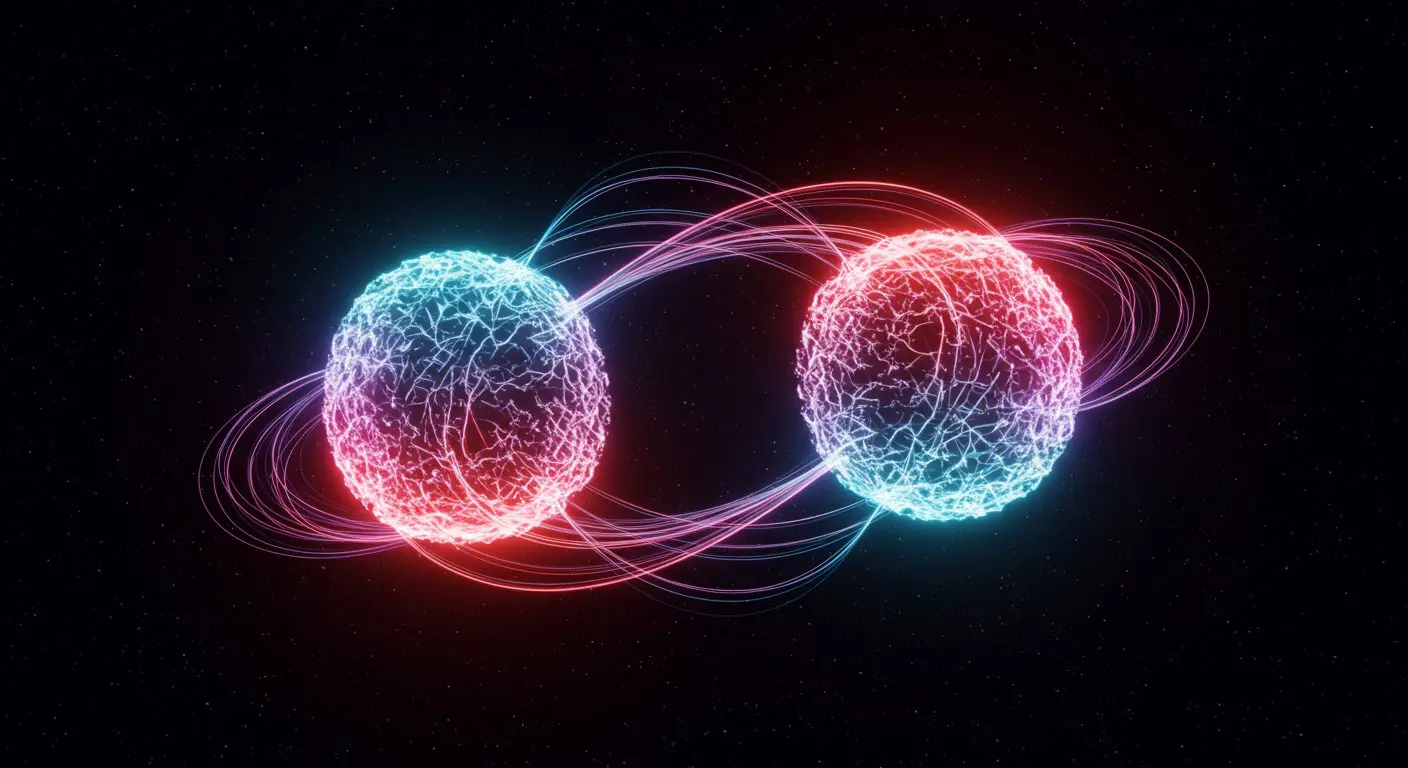
Precise measurement, or metrology, stands to benefit greatly from harnessing the unusual properties of quantum mechanics, and researchers are continually seeking ways to push the boundaries of sensitivity. Danish Ali Hamza and Jan Chwedeńczuk, both from the Faculty of Physics at the University of Warsaw, investigate a novel approach to achieving this, utilising atoms trapped within an array of microscopic double wells. Their work demonstrates how entanglement, a uniquely quantum phenomenon, can be generated and scaled up within this system, surpassing the limitations of traditional measurement techniques. By carefully manipulating these atoms and exploiting a quantum effect similar to the well-known Hong-Ou-Mandel effect, the team shows it is possible to significantly improve the precision of measurements, and they identify the optimal strategy for achieving the highest possible sensitivity.
Precision of measurement is crucial in physics, and a sensor’s accuracy depends on its sensitivity to small changes in the observed system. Classical measurements are limited by the Standard Quantum Limit (SQL); increasing the number of detecting particles improves sensitivity, but practical limitations always exist. For subtle measurements of gravitational acceleration or magnetic field fluctuations, sensitive atomic, photonic, molecular, or solid-state sensors are required. Quantum effects offer a pathway to overcome these limitations. By utilising quantum resources such as entanglement, it is, in principle, possible to achieve sensitivity approaching the Heisenberg limit.
Reaching this limit requires highly correlated quantum states, which is challenging due to decoherence. Therefore, any demonstration of improved sensitivity beyond the SQL represents a significant achievement. Entanglement in multi-particle systems is often generated through spin squeezing or by utilising collisions of atoms to create entangled pairs. Sensitivity can also be improved by increasing the signal dependent on the measured parameter. In gravitational-wave detection, this is achieved using long interferometer arms.
For measurements of local gravitational acceleration, atomic beam
For measurements of local gravitational acceleration, atomic beam trajectories are separated as far as possible, limited only by the coherence of the matter waves. Recent experiments have involved a one-dimensional array of double-well potentials trapping ultra-cold atoms, offering the potential for high precision and long-range coherence through the observation of long-lived oscillations. This work explains how the sensitivity of this multi-well interferometer increases due to the interplay between its large size and quantum correlations. The model is introduced, followed by a discussion of the Quantum Fisher Information, the primary tool for determining sensitivity, and the derivation of ultimate bounds for the system, namely the SQL and the Heisenberg limit.
The method generates scalable, many-body entangled states and demonstrates their usability for quantum-enhanced metrology. The experimental setup consists of a one-dimensional array of double-well potentials, each holding independent Bose-Einstein condensates. A beam-splitting transformation mixes the signal between adjacent wells, yielding a strongly entangled state through a many-body equivalent of a quantum interference effect. Researchers demonstrate that this entanglement improves the sensitivity of quantum sensors, and the analysis accounts for the effects of atomic fluctuations, identifying the optimal measurement strategy that maximises precision.
The results extend to the case in which
The results extend to the case in which the interferometer receives a collection of entangled states generated through a specific procedure. This method produces highly entangled and even strongly correlated states, valuable for quantum metrology. Further analysis illustrates the impact of atom number fluctuations on the overall sensitivity of the system.
🗞 Metrology using atoms in an array of double-well potentials
🧠 DOI: https://doi.org/10.48550/arXiv.2507.11395

See today’s quantum computing news on Quantum Zeitgeist for the latest breakthroughs in qubits, hardware, algorithms, and industry deals.