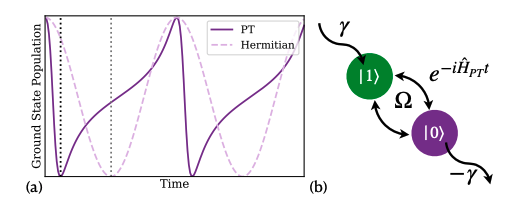
The quest to harness the unusual properties of parity-time-symmetric systems takes a significant step forward with a new method for simulating their behaviour on conventional quantum computers. Maryam Abbasi, Koray Aydoğan, and Anthony W. Schlimgen, alongside colleagues at the University of Minnesota, demonstrate a technique that overcomes a key challenge: representing non-unitary dynamics – the way these systems evolve over time – using the standard, unitary operations of existing quantum hardware. Their approach cleverly exploits mathematical relationships to map the dynamics of symmetric systems onto equivalent, Hermitian systems that can be directly implemented on quantum computers. This breakthrough not only enables the simulation of these intriguing systems, with potential applications in entanglement generation, but also paves the way for exploring the broader realm of pseudo-Hermitian operators in quantum computation, and the team validates their algorithms using both real quantum hardware and simulations.
The realm of quantum mechanics governs the behaviour of matter at the atomic and subatomic levels, promising revolutionary technologies in computing, sensing, and materials science. Simulating these quantum systems is incredibly challenging, particularly when dealing with ‘open’ systems – those that interact with their environment. Many real-world quantum systems don’t fit traditional models, exhibiting behaviours that require new approaches to simulation.
A particularly intriguing class of these non-standard systems are those governed by ‘Parity-Time’ (PT) symmetry. PT-symmetric systems, while not conserving energy in the usual sense, can still exhibit stable behaviour and possess unique properties not found in conventional quantum mechanics. These systems offer potential advantages in areas like enhanced sensing and faster entanglement generation – a key resource for quantum technologies.
However, their non-standard behaviour presents a significant hurdle
However, their non-standard behaviour presents a significant hurdle for simulation using existing quantum computers, which are built on principles of energy conservation. Researchers have now developed a novel method to overcome this challenge by cleverly transforming the problem. The team demonstrates that PT-symmetric systems can be mathematically rewritten in a form that appears to follow the standard rules of quantum mechanics.
This transformation involves finding an equivalent, ‘Hermitian’ Hamiltonian – a mathematical description of the system that conserves energy, which can then be simulated using existing quantum algorithms. This effectively ‘hides’ the non-standard behaviour of the PT-symmetric system within a standard framework. The researchers explored two ways to achieve this, one relying on classical computation and the other utilising additional quantum resources.
Significantly, they extended this method to consider not just a single PT-symmetric system, but two interacting systems, demonstrating the potential to simulate more complex scenarios and generate entanglement more efficiently. By successfully simulating these systems on both a real quantum device and a simulator, the researchers have paved the way for scalable simulations of these intriguing quantum systems, opening up new avenues for exploring their potential in future technologies. This work demonstrates a mapping of weakly-coupled PT-symmetric qubits to a unitary gate-based quantum algorithm, suggesting a scalable approach for simulating these dynamics on both near-term and fault-tolerant quantum computers.
👉 More information🗞Quantum Simulation of Two-Level -Symmetric Systems
🗞 Quantum Simulation of Two-Level -Symmetric Systems Using Hermitian Hamiltonians
🧠 DOI: https://doi.org/10.48550/arXiv.2507.08129
See today’s quantum computing news on Quantum Zeitgeist for the latest breakthroughs in qubits, hardware, algorithms, and industry deals.