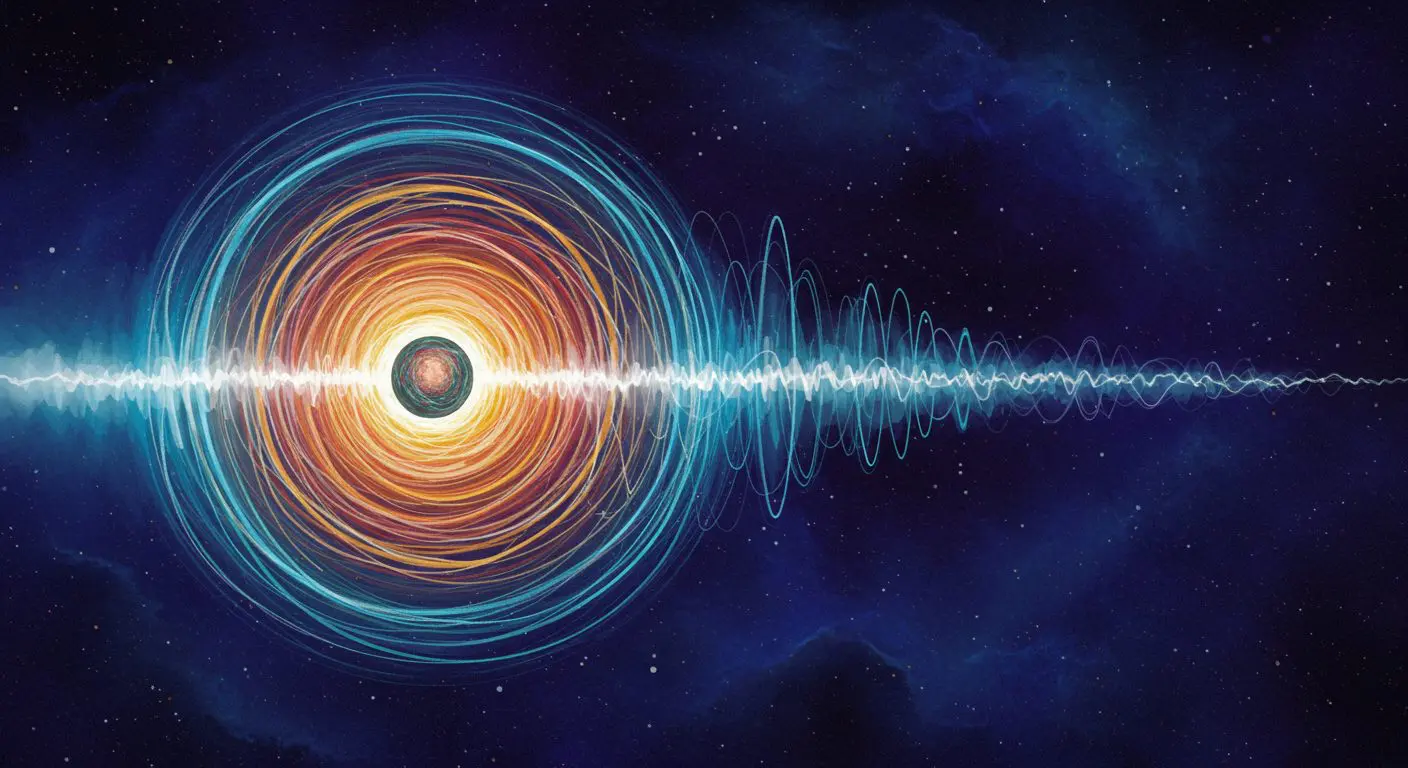
Researchers at the Stevens Institute of Technology have, as of July 8th, 2025, established a definitive mathematical relationship between the wave-like and particle-like behaviours of quantum objects, resolving a century-old ambiguity in quantum mechanics. Their formula, published in Physical Review Research, demonstrates that these behaviours sum precisely to one when accounting for quantum coherence – a measure of potential wave interference – enabling more accurate calculations than previous models which allowed for simultaneous increases in both behaviours. This advancement, potentially impacting quantum computing and imaging, was demonstrated through quantum imaging with undetected photons, maintaining image clarity even with system disturbances and opening avenues for technologies requiring precise quantum state control.
A Century of Quantum Duality
The established principle of wave-particle duality posits that quantum objects do not exhibit exclusively wave-like or particle-like behaviour, but rather a combination of both. Recent work at the Stevens Institute of Technology has refined the mathematical description of this duality, moving beyond previous inequalities to establish a precise relationship between a quantum object’s wave-ness and particle-ness. This refinement introduces ‘coherence’ – a measure of potential for wave-like interference – as a crucial variable alongside conventional metrics of wave and particle behaviour.
Quantification of coherence allows for a summation of wave-ness and particle-ness that precisely equals one, enabling more accurate calculations than previously possible. This relationship is visually represented as an elegant curve – a perfect quarter-circle for fully coherent systems, transitioning to a flatter ellipse as coherence diminishes. The ability to accurately determine both wave-ness and particle-ness has significant implications for applications in quantum information and computation.
The researchers demonstrated this advancement using quantum imaging with undetected photons (QIUP), a technique reliant on entangled photon pairs. By scanning an aperture with one photon and measuring the coherence of its entangled partner, they successfully mapped the aperture’s shape. This confirms the potential for utilising wave-ness and particle-ness as a resource in quantum imaging, and suggests broader applicability to other quantum tasks.
Notably, the imaging process remained functional even with degradation of overall system coherence due to external factors like temperature fluctuations or vibrations. These factors affect both high and low coherence scenarios equally, allowing for the detection of subtle differences in coherence and continued information extraction. Despite a reduction in the ellipse’s dimensions, the object’s information remains discernible.
Further investigation is required to explore the implications of this refined understanding of wave-particle duality in more complex quantum scenarios, particularly those involving multiple interacting pathways. While the underlying mathematics are conceptually straightforward, the full extent of this phenomenon within quantum mechanics remains an open area of research.
Refining the Wave-Particle Relationship
The introduction of coherence as a quantifiable variable represents a significant refinement of existing models. Prior research established that the sum of wave-like and particle-like behaviours could not exceed one, failing to account for scenarios where both behaviours might simultaneously increase. By incorporating coherence – essentially a measure of the potential for wave interference – researchers have established a precise, reciprocal relationship: wave-ness plus particle-ness equals one. This allows for a deterministic calculation of both properties, moving beyond probabilistic estimations.
The practical implications of this advancement are particularly evident in the field of quantum imaging. Utilizing quantum imaging with undetected photons (QIUP), the team demonstrated how wave-ness and particle-ness can be leveraged as a resource for image reconstruction. The technique relies on the correlation between entangled photons; measuring the coherence of one photon allows for the deduction of information about the other, enabling the mapping of an object’s aperture. This suggests that precise control and measurement of these quantum properties can be harnessed for advanced imaging applications, and potentially for other quantum information processing tasks.
Importantly, the robustness of this imaging technique to environmental disturbances highlights its potential for real-world applications. While external factors such as temperature fluctuations or vibrations inevitably degrade overall system coherence, the imaging process remains viable. The resulting graphical representation of wave-particle duality – the ellipse – may be compressed, but the underlying information remains discernible, demonstrating a degree of resilience not previously achievable. This suggests that practical quantum devices may be less susceptible to environmental noise than previously anticipated.
The Role of Quantum Coherence
The significance of coherence extends beyond merely refining the mathematical description of wave-particle duality; it establishes a quantifiable link between potential and realised wave-like behaviour. While conventional visibility measures the amount of wave-ness extracted in an experiment, coherence represents the inherent potential for wave-like interference within the quantum system. This distinction is crucial, as it allows for a more nuanced understanding of how quantum objects transition between wave and particle characteristics, and how this transition can be controlled and exploited.
The demonstrated application of this refined understanding to quantum imaging with undetected photons (QIUP) underscores the practical utility of quantifying coherence. By meticulously measuring the coherence of entangled partner photons, the researchers were able to reconstruct images despite the absence of direct detection of the illuminating photon. This technique effectively transforms coherence into an information-carrying resource, opening avenues for imaging in scenarios where traditional methods are impractical or impossible. The ability to maintain image fidelity even with diminished overall system coherence is particularly noteworthy, suggesting a degree of robustness that could facilitate the development of more resilient quantum imaging devices.
The observed resilience to external disturbances, such as temperature fluctuations and vibrations, further enhances the potential of this approach. These factors equally impact both high and low coherence scenarios, allowing for the detection of subtle differences in coherence levels and continued information extraction. This suggests that practical quantum devices may be less susceptible to environmental noise than previously anticipated, potentially easing the stringent requirements for isolation and control that often plague quantum technologies. The compression of the wave-particle duality ellipse – representing a decrease in coherence – does not necessarily equate to a loss of information, but rather a change in the signal-to-noise ratio, which can be compensated for through appropriate signal processing techniques.
Quantum Imaging and Practical Application
The practical implications of accurately quantifying quantum imaging coherence extend beyond improved theoretical models. The demonstrated resilience of the QIUP technique to environmental disturbances – temperature fluctuations and vibrations – suggests a pathway toward more robust quantum imaging systems. While these factors inevitably degrade overall system coherence, the ability to discern differences in coherence levels – and thus extract meaningful information – remains. This robustness is not simply a matter of maintaining signal strength; it implies a degree of inherent noise tolerance within the system, potentially simplifying the engineering requirements for practical device implementation. The compression of the wave-particle duality ellipse, representing a decrease in coherence, does not necessarily equate to a loss of information, but rather a change in the signal-to-noise ratio, which can be addressed through optimized data acquisition and processing techniques.
Further research will likely focus on exploiting the relationship between quantum imaging coherence and image resolution. A precise understanding of how coherence limits, or potentially enhances, the achievable resolution in QIUP – and other quantum imaging modalities – is crucial for developing advanced imaging systems. Exploring the interplay between coherence, entanglement quality, and photon detection efficiency will be paramount. Furthermore, investigations into the scalability of this approach – extending it to more complex imaging scenarios and larger apertures – will be necessary to assess its potential for real-world applications beyond laboratory demonstrations. The ability to actively manipulate and control coherence within a quantum imaging system could unlock entirely new imaging modalities and functionalities, offering capabilities beyond the reach of classical imaging techniques.
Future Research and Complex Systems
Beyond the immediate advancements in understanding wave-particle duality, a crucial avenue for future research lies in exploring these principles within more complex multipath quantum scenarios. The current mathematical framework, while elegant and demonstrably accurate in controlled experiments, requires extension to accommodate systems where quantum objects traverse multiple interacting pathways simultaneously. Such complexity is inherent in many real-world applications and represents a significant challenge for theoretical modelling and experimental verification. Understanding how coherence is maintained or degraded in these scenarios will be critical for developing practical quantum technologies.
A particularly promising area of investigation concerns the potential for actively manipulating coherence to enhance quantum imaging performance. While the demonstrated resilience to environmental disturbances is encouraging, the ability to proactively control coherence levels – perhaps through the application of tailored electromagnetic fields or engineered quantum materials – could unlock entirely new imaging modalities and functionalities. This could involve maximizing coherence for high-resolution imaging, or intentionally reducing it to achieve specific contrast mechanisms or to mitigate the effects of noise.
Furthermore, research should focus on quantifying the relationship between quantum imaging coherence and achievable resolution. While the current work establishes a framework for understanding the interplay between wave-ness, particle-ness, and image reconstruction, a precise understanding of how coherence limits, or potentially enhances, resolution in QIUP – and other quantum imaging modalities – is crucial for developing advanced imaging systems. Investigations into the scalability of this approach – extending it to more complex imaging scenarios and larger apertures – will be necessary to assess its potential for real-world applications beyond laboratory demonstrations. Exploring the interplay between coherence, entanglement quality, and photon detection efficiency will be paramount.
More information
External Link: Click Here For More
See today’s quantum computing news on Quantum Zeitgeist for the latest breakthroughs in qubits, hardware, algorithms, and industry deals.