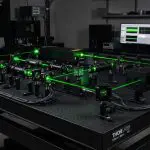
A silicon photonic integrated circuit implements a single-qubit classifier achieving nearly 90% accuracy with an average of two photons per input, provided a sufficiently large training dataset. Data reuploading with sequential minimal optimisation optimises layer performance, demonstrating resource-efficient machine learning potential on integrated photonic platforms.
Quantum machine learning, a field seeking to leverage the principles of quantum mechanics to enhance computational tasks, demands innovative approaches to minimise resource requirements. Researchers are particularly focused on reducing the number of photons needed for effective computation, a critical step towards practical, scalable quantum devices. Shunsuke Abe, Shota Tateishi, and colleagues reporting on this issue, detail an experimental investigation into a single-qubit classifier implemented on a silicon photonic integrated circuit. Their work, titled ‘Experimental investigation of single qubit quantum classifier with small number of samples’, demonstrates that such a classifier can achieve nearly 90% accuracy even with an average of only two photons per input, provided a sufficiently large training dataset is employed.
Implementing Advanced Quantum Classification Techniques
Implementing Advanced Classification Techniques
The team, spanning Kagawa University and Keio University, utilised a technique called Data Reuploading, combined with layer-wise optimisation via Sequential Minimal Optimization (SMO), to encode and classify data using heralded single photons generated within a silicon waveguide. This research offers valuable insight into the potential for resource-efficient machine learning on integrated photonic platforms, and suggests that complex computations may be achievable with surprisingly limited photonic resources.
Quantum classifiers explore enhanced data analysis through quantum computation, offering potential advantages over classical methods. Classification algorithms underpin modern data analysis, enabling automated categorisation across diverse fields, including healthcare and predictive modelling. Recent advances investigate leveraging quantum mechanics to enhance these algorithms, promising computational benefits and potentially higher accuracy in complex datasets.
Understanding the Theoretical Classification Pipeline
Understanding the Quantum Classification Pipeline
Quantum classifiers typically operate through a three-stage process: quantum state preparation, data encoding, and quantum measurement. Training these classifiers requires embedding classical data into a quantum circuit and optimising its parameters to align outputs with desired labels, a process heavily influenced by the chosen quantum model and circuit architecture. This optimisation commonly involves minimising a cost function based on measurement outcomes, allowing the classifier to learn from data and improve its predictive capabilities.
The Data Reuploading method, a relatively new approach, constructs a universal quantum classifier using photons and shares structural similarities with classical neural networks. This allows adaptation of established machine learning techniques to the quantum realm, offering a pathway to harness quantum capabilities within familiar frameworks. Unlike traditional quantum machine learning algorithms requiring complex quantum state preparation, data reuploading allows information to be repeatedly impressed onto the quantum system through a series of controlled operations.
Theoretical studies suggest that even with limited photon
Theoretical studies suggest that even with limited photon resources, accurate training remains possible with sufficiently large datasets, demonstrating the potential for resource-efficient quantum machine learning. This hinges on the ability to mitigate the impact of quantum fluctuations and extract meaningful signals from noisy measurements, requiring sophisticated data processing techniques. Experimental validation is therefore crucial to assess the practical viability of these models and confirm their potential for resource-efficient machine learning applications.
Addressing Resource Constraints in Quantum Algorithms
Leveraging Silicon Photonics for Quantum Hardware
Scalability using Silicon Photonics Hardware Platforms
Silicon photonics offers a promising platform for implementing quantum classifiers due to its compatibility with existing integrated circuit manufacturing techniques, enabling scalable and compact devices. Researchers are actively exploring how to optimise these photonic circuits and develop effective training strategies to overcome the challenges posed by photon-limited conditions, paving the way for practical quantum machine learning systems.
Recent experiments demonstrate a single-qubit classifier’s performance under conditions mimicking the limitations of real-world photon sources. The team implemented a classifier on a silicon photonic integrated circuit, a device where optical components are fabricated on a chip, and tested its ability to distinguish between different input states when provided with a limited number of photons. This addresses a significant challenge in photonic machine learning: the inherent scarcity of single photons, which are ideal carriers of quantum information but difficult to generate and detect efficiently.
The core of the experiment relies on data reuploading, allowing for efficient use of quantum resources. The classifier’s parameters are then optimised using Sequential Minimal Optimization (SMO), a classical algorithm commonly used in support vector machines, but adapted for the quantum realm, iteratively adjusting parameters to minimise classification error.
A crucial aspect of the experiment is the generation of heralded single photons, created through spontaneous four-wave mixing within a silicon waveguide, a tiny channel that guides light. The ‘heralded’ aspect refers to the fact that the creation of a single photon is confirmed by detecting another photon, ensuring a higher degree of certainty in the quantum signal. This is vital because photon loss and detection errors are common in photonic systems, and the ability to reliably generate and detect single photons is paramount for accurate computation. The team deliberately reduced the average number of photons used per input to approximately two, simulating the limitations of practical photon sources, yet the classifier still achieved nearly 90% accuracy with a sufficiently large training dataset.
Numerical simulations corroborated the experimental findings, demonstrating the
Numerical simulations corroborated the experimental findings, demonstrating the consistency between theoretical predictions and observed performance, validating the experimental setup and data analysis. These simulations also revealed that increasing the size of the training dataset further improves the classifier’s accuracy, even at low photon counts, highlighting the importance of data-driven approaches. The results demonstrate the potential for resource-efficient machine learning on integrated photonic platforms, paving the way for practical applications where quantum computation can be deployed with minimal hardware requirements, particularly in edge computing applications.
Quantum machine learning (QML) actively explores the potential of quantum computation to enhance or accelerate machine learning tasks, seeking to overcome the limitations of classical algorithms. The system generates heralded single photons through spontaneous four-wave mixing within a silicon waveguide, serving as the input states for the classifier, ensuring a reliable source of quantum information. Importantly, the classifier maintains nearly 90% accuracy even when the average number of photon samples per input falls to approximately two, provided a sufficiently large training dataset exists, demonstrating its robustness.
This result is significant because it demonstrates the potential for resource-efficient machine learning on integrated photonic platforms, enabling practical applications with limited quantum resources. The ability to operate effectively with a limited number of photons addresses a key practical hurdle in scaling photonic quantum machine learning systems, paving the way for more complex and powerful quantum algorithms.
The study highlights the viability of photonic classifiers for applications where photon resources are constrained, opening up new possibilities for quantum machine learning in various fields. This research contributes to the growing body of work exploring hybrid quantum-classical algorithms and integrated photonic quantum computing, advancing the field of quantum information science. The successful implementation of a single-qubit classifier with high accuracy under photon-limited conditions represents a step towards practical, resource-efficient quantum machine learning solutions, bringing quantum computation closer to real-world applications.
Experimental results reveal that a classifier, implemented on a silicon photonic integrated circuit and utilising the Data Reuploading method with layer-wise optimisation via Sequential Minimal Optimization (SMO), maintains nearly 90% accuracy with an average of only two photons per input, contingent upon a sufficiently large training dataset. This performance aligns closely with numerical simulations, validating the experimental findings and reinforcing the potential for resource-efficient machine learning.
The Data Reuploading technique, coupled with layer-wise optimisation,
The Data Reuploading technique, coupled with layer-wise optimisation, proves effective in mitigating the challenges posed by low photon counts, enabling accurate classification with limited quantum resources. This approach allows the classifier to extract meaningful information from limited input data, achieving high accuracy despite the inherent noise and limitations of photonic systems. The use of heralded single photons, generated through spontaneous four-wave mixing in a silicon waveguide, further enhances the reliability and performance of the classifier, ensuring a consistent and reliable source of quantum information.
Importantly, the study highlights a clear correlation between training dataset size and classifier accuracy at low photon sample sizes, demonstrating the importance of data-driven approaches in quantum machine learning. Increasing the amount of training data demonstrably improves performance, suggesting a pathway for further optimisation and enhancement of photonic machine learning systems.
Future work should focus on scaling these single-qubit classifiers to multi-qubit systems, exploring more complex quantum circuits and algorithms, paving the way for more powerful and versatile quantum machine learning applications. Investigating alternative data encoding strategies and optimisation techniques could further enhance performance and reduce resource requirements. Additionally, research into error mitigation and fault tolerance is essential for building robust and scalable photonic machine learning platforms.
Expanding the scope of applications beyond the current classification task represents another promising avenue for future research, unlocking new opportunities and driving further innovation in various fields. Exploring the potential of photonic quantum machine learning in areas such as image recognition, natural language processing, and materials science could unlock new opportunities and drive further innovation. The demonstrated feasibility of resource-efficient photonic classifiers provides a strong foundation for these future endeavours.
🗞 Experimental investigation of single qubit quantum classifier with small number of samples
🧠 DOI: https://doi.org/10.48550/arXiv.2507.04764


See today’s quantum computing news on Quantum Zeitgeist for the latest breakthroughs in qubits, hardware, algorithms, and industry deals.