The pursuit of stable quantum computation necessitates a detailed understanding of decoherence, the process by which quantum systems lose their coherence and become susceptible to errors. Material imperfections at the interfaces of superconducting circuits represent a significant source of this decoherence, yet the precise origins and mechanisms remain incompletely characterised. Lamia Ateshian, Max Hays, and colleagues from the Research Laboratory of Electronics and Lincoln Laboratory at the Massachusetts Institute of Technology investigate these limitations in a new study focusing on the temperature and magnetic-field dependence of energy relaxation in a fluxonium qubit. Their research, detailed in the article ‘Temperature and Magnetic-Field Dependence of Energy Relaxation in a Fluxonium Qubit’, reveals a linear relationship between flux noise and temperature, alongside a power-law dependence of dielectric loss down to 100 milliKelvin, offering valuable insight into the behaviour of charge-coupled defects and informing improved coherence modelling for these promising quantum systems.
Material imperfections fundamentally constrain the coherence of qubits, the fundamental units of quantum information. Recent research meticulously characterises the temperature and magnetic field dependence of two primary noise sources in low-temperature superconducting circuits: flux noise and dielectric loss. This detailed analysis provides crucial data for refining models of qubit behaviour and, consequently, designing more resilient quantum systems.
Researchers observe a linear correlation between flux noise, fluctuations in magnetic flux that disrupt qubit states, and temperature. Simultaneously, they demonstrate a power-law dependence for dielectric loss, a mechanism where energy is dissipated through the material’s insulating components, up to 100 milliKelvin, a temperature just above absolute zero. This predictability in noise characteristics is significant, allowing for more accurate simulations and projections of qubit performance.
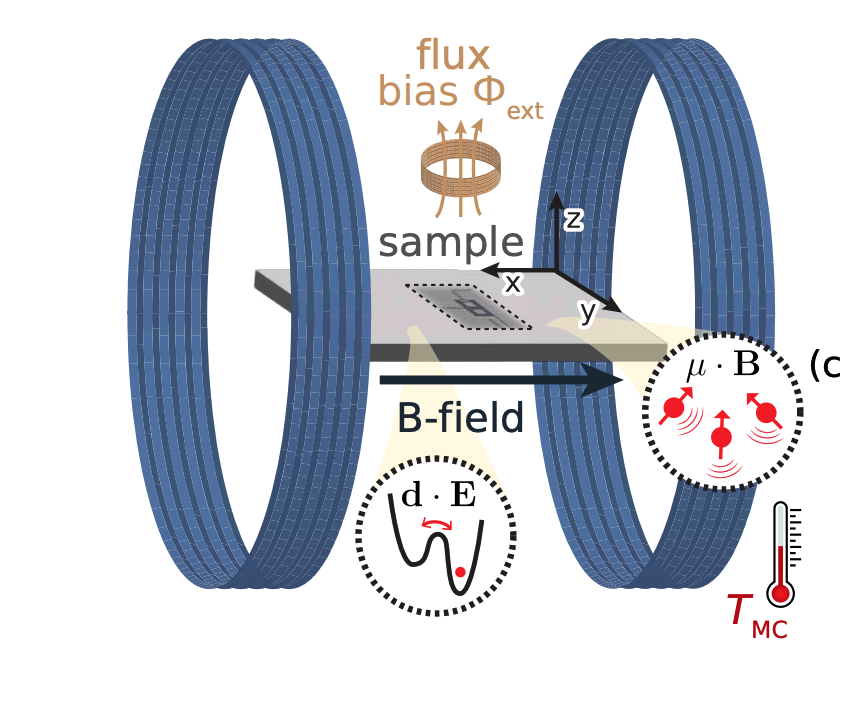
Crucially, the study reveals that decoherence, the loss of quantum information, limited by dielectric loss diminishes when a weak, in-plane magnetic field is applied. This suggests that the charge-coupled defects responsible for dielectric loss exhibit a response to magnetic fields. This opens a potential pathway for mitigating noise through external control, effectively ‘tuning’ the material to reduce imperfections. Defects are imperfections in the crystal structure of the superconducting material, and charge-coupled defects involve the movement of electrical charge within these imperfections.
To analyse the experimental data, researchers implement a
To analyse the experimental data, researchers implement a multi-level decoherence model. This model is motivated by the tunable nature of ‘matrix elements’ and ‘transition energies’ within the fluxonium system, a specific type of superconducting qubit. Matrix elements describe the strength of interactions between different quantum states, while transition energies represent the energy required to move between these states. By incorporating these tunable parameters, the model provides a more accurate representation of observed behaviour and enables more precise predictions of qubit performance.
This work validates the importance of both flux noise and dielectric loss as significant contributors to qubit decoherence. It further suggests that complex interactions within material defects contribute to the overall noise spectrum, highlighting the need for continued materials science research to improve the quality and stability of superconducting qubits.
🗞 Temperature and Magnetic-Field Dependence of Energy Relaxation in a Fluxonium Qubit
🧠 DOI: https://doi.org/10.48550/arXiv.2507.01175




See today’s quantum computing news on Quantum Zeitgeist for the latest breakthroughs in qubits, hardware, algorithms, and industry deals.