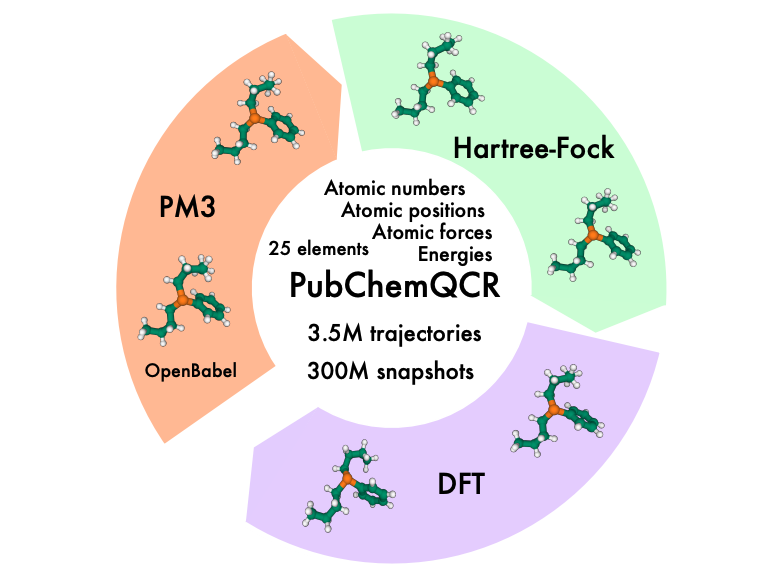
Accurate modelling of molecular interactions remains central to advances in diverse fields including pharmaceutical development, materials discovery and fundamental chemical understanding. Computational cost, however, frequently limits the scale and duration of these simulations. Researchers are increasingly turning to machine learning interatomic potentials (MLIPs), algorithms trained to predict molecular energies and forces, as a means of accelerating these calculations while maintaining acceptable accuracy. A team led by Cong Fu, Yuchao Lin, and colleagues from Texas A&M University, alongside collaborators at Chiba Institute of Technology and RIKEN, present a substantial new resource for the development and validation of these models. Their work, detailed in the article ‘A Benchmark for Quantum Chemistry Relaxations via Machine Learning Interatomic Potentials’, introduces PubChemQCR, a publicly available dataset comprising 3.5 million molecular relaxation trajectories and over 300 million molecular conformations calculated using density functional theory (DFT), a quantum mechanical method used to investigate the electronic structure of atoms and molecules. This dataset, hosted on Hugging Face, provides a valuable benchmark for assessing the performance of MLIPs and facilitating the creation of more efficient and reliable computational tools.
The pursuit of accurate and efficient molecular simulations underpins innovation in computational chemistry and materials science, and researchers continually seek methods to overcome the limitations of traditional density functional theory (DFT) calculations. Machine learning interatomic potentials (MLIPs) represent a promising solution, offering the potential to replicate DFT accuracy with significantly reduced computational cost; these surrogate models learn the complex relationships between atomic structure and energy. To facilitate the development and validation of these MLIPs, scientists have introduced PubChemQCR, a substantial dataset comprising 3.5 million molecular relaxation trajectories, designed to provide a robust benchmark for assessing their performance. This publicly available resource, hosted on Hugging Face, contains over 300 million molecular conformations, each meticulously labelled with both total energy and atomic forces, and empowers researchers to train and evaluate MLIPs effectively.
Evaluating MLIP performance demands rigorous metrics that assess both accuracy and reliability during geometry optimisation. Researchers employ several key indicators to quantify this performance, comparing MLIP results directly to DFT calculations. Average Energy Minimisation Percentage measures the extent to which an MLIP reduces a molecule’s energy from a starting conformation, effectively gauging its ability to locate lower-energy structures. Chemical Accuracy Success Rate determines the proportion of MLIP-optimised structures falling within a chemically relevant energy threshold of 1 kcal/mol from the DFT-calculated structure; divergence from this threshold indicates potential inaccuracies in the MLIP. The dataset also facilitates the assessment of the model’s ability to accurately predict forces, crucial for molecular dynamics simulations, which model the time evolution of atomic positions.
The dataset’s focus on relaxation trajectories, capturing the
The dataset’s focus on relaxation trajectories, capturing the process of molecules reaching stable geometries, proves particularly valuable for ensuring the reliability of simulations involving dynamic processes. Researchers continually refine their models and algorithms, and the dataset facilitates this process by providing a consistent and reliable benchmark for evaluating performance. Future work should concentrate on expanding the dataset to encompass a wider range of chemical species and larger molecular systems, broadening its applicability to a wider range of chemical problems. Incorporating data from more advanced levels of theory, beyond those currently included in PubChemQC, would further enhance the dataset’s utility for developing highly accurate MLIPs.
Investigating the impact of different training strategies and model architectures on MLIP performance, using PubChemQCR as a benchmark, promises to accelerate the development of more robust and transferable potentials. Furthermore, research should explore the application of these validated MLIPs to real-world problems in areas such as drug discovery, materials science, and chemical synthesis. Evaluating the computational speedup achieved by using MLIPs compared to traditional DFT calculations, while maintaining acceptable accuracy, will be crucial for demonstrating their practical value.
The publicly available resources empower researchers to access and utilise the dataset, fostering collaboration and accelerating the development of new MLIPs. The ability to accurately simulate molecular behaviour has significant implications for a wide range of applications, including drug discovery, materials design, and chemical engineering. Researchers leverage MLIPs to accelerate these processes, and the dataset enables them to develop more efficient and reliable simulations. The development of MLIPs represents a significant advancement in computational chemistry, and the dataset contributes to this advancement by providing a valuable resource for the community. The ongoing development of MLIPs promises to revolutionise the field of computational chemistry, and the dataset will continue to play a crucial role in this revolution.
👉 More information🗞A Benchmark for Quantum Chemistry Relaxations
🗞 A Benchmark for Quantum Chemistry Relaxations via Machine Learning Interatomic Potentials
🧠 DOI: https://doi.org/10.48550/arXiv.2506.23008