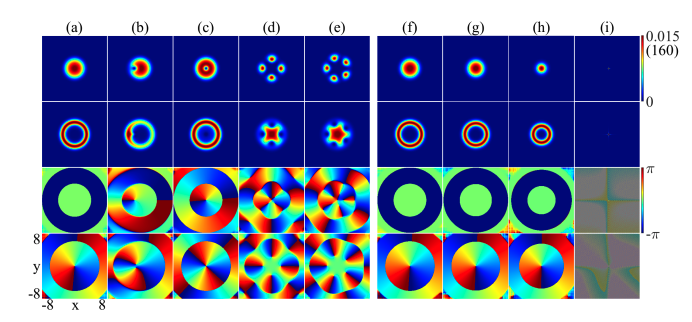
Research demonstrates that dipole-dipole interactions, combined with spin-orbit coupling and rotation in Bose-Einstein condensates, generate diverse defect and droplet formations, including lattice, wheel and ring distributions. These interactions produce exotic spin textures, notably quarter and fractional skyrmions, enabling manipulation of density topology and spin structure.
The behaviour of matter at extremely low temperatures continues to reveal unexpected complexity, particularly within Bose-Einstein condensates (BECs), states of matter formed when bosons are cooled to near absolute zero. Recent research explores the intricate interplay of several physical phenomena within these condensates, specifically the effects of dipole-dipole interactions – differing from the more common isotropic interactions – alongside spin-orbit coupling, rotation, and the shape of the confining potential. Yun Liu and Zu-Jian Ying, both from Lanzhou University, detail these investigations in their article, ‘A Kaleidoscope of Topological Structures in Dipolar Bose-Einstein Condensates with Weyl-Like Spin-Orbit Coupling in Anharmonic Trap’. Their work systematically analyses how these combined factors induce a diverse range of topological states, including defects and droplet formations exhibiting critical behaviour and revealing exotic spin structures such as fractional skyrmions, potentially offering resources for future applications.
Recent advances demonstrate enhanced capabilities in quantum sensing and simulation, representing a dynamic and rapidly developing field at the convergence of cold atom physics, quantum technologies, and condensed matter simulation. Researchers actively pursue the creation and manipulation of quantum states, notably Bose-Einstein condensates, with a clear emphasis on exploiting quantum phenomena to improve sensing and metrology. A Bose-Einstein condensate is a state of matter formed when bosons are cooled to temperatures very close to absolute zero, at which point a large fraction of the bosons occupy the lowest quantum state, exhibiting quantum mechanical phenomena on a macroscopic scale.
A central theme involves the generation of artificial gauge fields, pioneered by researchers including Anderson, Spielman, and Juzeliunas, who have established foundational techniques for manipulating neutral atoms. These fields, implemented using sophisticated laser techniques, effectively mimic magnetic forces, enabling the simulation of complex condensed matter systems and the exploration of novel quantum behaviours. Simultaneously, significant effort focuses on squeezing and the reduction of quantum noise, crucial for improving measurement precision and enhancing the sensitivity of quantum sensors. Quantum squeezing reduces the uncertainty in one variable at the expense of increased uncertainty in another, allowing for measurements beyond the standard quantum limit.
The prolific output of Z
The prolific output of Z.-J. Ying and collaborators, alongside the consistent co-authorship of Braak and Felicetti, highlights a strong collaborative environment and a focused research program. This program spans a broad range of topics within quantum technologies, from fundamental investigations of quantum metrology to the development of potential quantum computation architectures. Detailed exploration of dipole-dipole interactions within rotating Bose-Einstein condensates further illustrates this trend, revealing a sophisticated understanding of topological defects and spin structures, potentially offering resources for future applications in quantum information processing. Topological defects are imperfections in the structure of a material that are stable and cannot be removed by continuous deformations.
Furthermore, research actively investigates the interplay between various physical parameters, such as spin-orbit coupling, rotation, and trap anharmonicity, to induce and control novel quantum states, demonstrating a sophisticated understanding of quantum system dynamics. Spin-orbit coupling describes the interaction between a particle’s spin and its motion, while trap anharmonicity refers to deviations from a perfectly harmonic potential. The discovery of fractional skyrmions and complex topological structures within these condensates demonstrates a sophisticated level of control over matter, enabling the creation of bespoke quantum systems tailored for specific applications. Skyrmions are topologically stable, particle-like disturbances in a field, and their fractional counterparts represent novel quantum states. This ability to manipulate both density topology and spin structure via tunable parameters suggests a pathway towards the creation of advanced quantum devices with unprecedented capabilities.
Future work will likely concentrate on translating these fundamental discoveries into practical quantum technologies, requiring a concerted effort to overcome the challenges of scalability and coherence. This includes refining sensor designs, improving the coherence of quantum states, and exploring the scalability of quantum systems, demanding innovative approaches to quantum engineering. A continued emphasis on interdisciplinary collaboration, combining expertise from atomic physics, condensed matter physics, and quantum information theory, will be essential for driving innovation in this rapidly evolving field, fostering a holistic approach to quantum technology development. The demonstrated ability to engineer complex quantum states provides a fertile ground for exploring new quantum phenomena and developing transformative technologies, promising a revolution in sensing, computation, and materials science.
Researchers are actively developing new techniques for controlling
Researchers are actively developing new techniques for controlling and manipulating quantum states, pushing the boundaries of quantum control and enabling the creation of increasingly complex quantum systems. They are exploring the use of advanced laser techniques, magnetic fields, and optical lattices to create and manipulate Bose-Einstein condensates, enabling the study of novel quantum phenomena and the development of new quantum technologies. The pursuit of squeezed states and the reduction of quantum noise remains a central focus, as these techniques are crucial for improving the precision of measurements and enhancing the sensitivity of quantum sensors, paving the way for more accurate and reliable quantum devices. Scientists are also investigating the use of topological structures, such as skyrmions and vortices, as potential building blocks for quantum information storage and processing, exploring their unique properties and potential advantages. A vortex is a region within a fluid or field where the flow or field rotates around an axis line.
🗞 A Kaleidoscope of Topological Structures in Dipolar Bose-Einstein Condensates with Weyl-Like Spin-Orbit Coupling in Anharmonic Trap
🧠 DOI: https://doi.org/10.48550/arXiv.2506.16734
See today’s quantum computing news on Quantum Zeitgeist for the latest breakthroughs in qubits, hardware, algorithms, and industry deals.