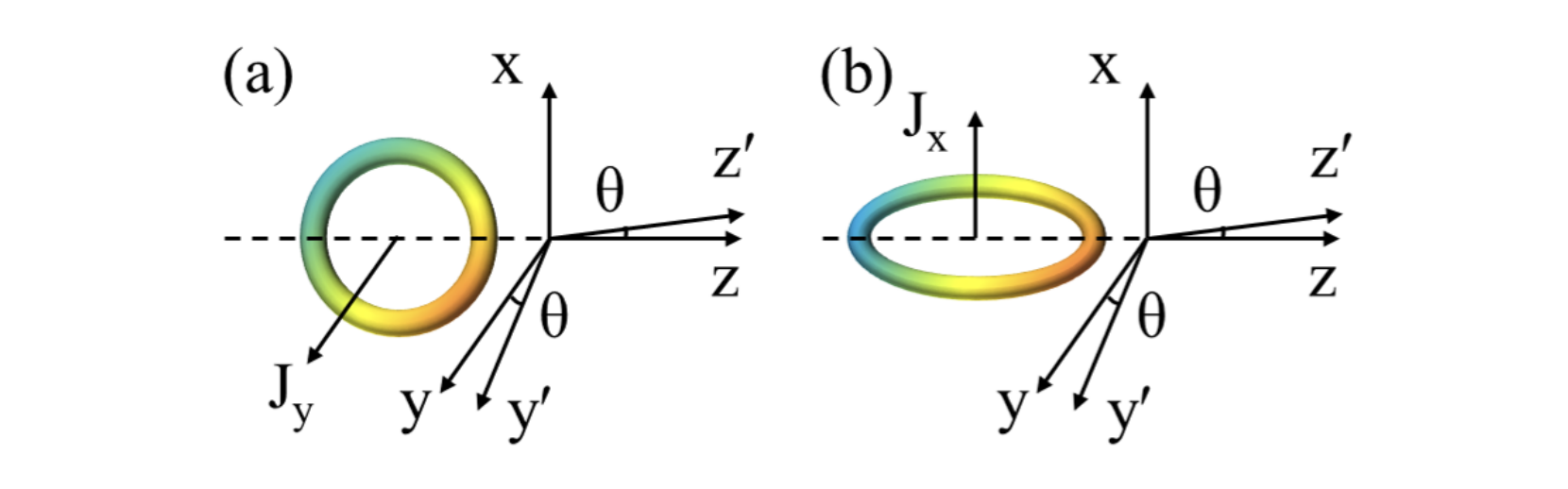
Research demonstrates a direct correlation between the transverse shift of spatiotemporal optical vortices and their topological charge, occurring within a tilted reference frame. This geometric spin Hall effect of light relies on the spatial distribution of angular momentum, with shift magnitude inversely proportional to the cosine of the tilt angle.
The behaviour of light, particularly its intrinsic angular momentum, continues to reveal subtle yet significant physical effects. Recent investigations demonstrate a geometric spin Hall effect, a transverse displacement of light beams arising from their angular momentum, even without material interaction. This phenomenon is now being explored in the context of spatiotemporal optical vortices (STOV), complex light structures carrying pure transverse angular momentum, where the distribution of this momentum dictates the magnitude and direction of the observed shift. Researchers at Zhejiang University, Chaokai Yang, Weifeng Ding, and Zhaoying Wang, detail these findings in their article, “Geometric spin Hall effect of spatiotemporal optical vortices”, establishing a clear relationship between the topological charge of STOV and the resulting transverse displacement, with implications for precision optical manipulation and measurement at reduced scales.
The behaviour of spatiotemporal optical vortices (STOV) is governed by their polarization and spatial distribution, resulting in predictable shifts and delays at interfaces and establishing a clear connection to the geometric spin Hall effect of light (GSHEL). Researchers investigate the transverse displacements and time delays experienced by STOV when reflecting from or refracting through a planar interface, building upon established principles of GSHEL and orbital angular momentum (OAM). OAM describes the angular momentum carried by light due to the helical phase front of a beam, and is a key property of STOV. This study confirms STOV undergo transverse shifts following both reflection and refraction, with the magnitude and direction critically dependent on the vortex order, angle of incidence, and light’s polarization, and higher-order vortices exhibiting larger shifts.
The investigation also confirms the presence of time
The investigation also confirms the presence of time delays in STOV following reflection and refraction, correlating with the vortex order, angle of incidence, and polarization, and aligning with the conservation of OAM and the principles of GSHEL. Researchers developed an analytical model accurately predicting both the magnitude and direction of these effects, offering a valuable tool for designing and controlling STOV-based applications, and providing a fundamental advancement in understanding how STOV interact with interfaces. These findings have implications for diverse fields, including optical manipulation of microscopic objects, enhancement of optical imaging resolution, and development of secure optical communication systems, and enable the precise design and optimisation of devices utilising STOV.
Through both theoretical modelling and numerical simulations, a linear relationship between the transverse shift and topological charge consistently emerges. Topological charge, often referred to as vortex order, defines the number of 2π phase changes around the vortex axis. The findings reveal that the GSHE-induced shift is not universal to all STOV; this distinction arises from the spatial distribution of angular momentum density within the vortex, highlighting the importance of considering its structure when predicting behaviour. The direction of the observed shift consistently aligns perpendicularly to the angular momentum vector, providing a predictable means of control.
The magnitude of the transverse shift exhibits an inverse proportionality to the cosine of the tilt angle, offering a means to tune the displacement through geometric configuration. A maximum shift value, proportional to the wavelength of the light, is identified, providing a quantifiable parameter for experimental verification and optimisation. These results extend the understanding of GSHE beyond traditional spin-dependent phenomena, demonstrating its applicability to complex optical fields carrying transverse angular momentum, and have implications for ultrafast optics and nanophotonics, offering new possibilities for manipulating and measuring light at the micro and nanoscale. The ability to predictably control the transverse displacement of STOV opens avenues for developing novel optical devices and techniques, and further research should investigate the influence of material interfaces and complex media on the observed shifts, potentially leading to enhanced control and functionality.
👉 More information🗞Geometric spin Hall effect of spatiotemporal
🗞 Geometric spin Hall effect of spatiotemporal optical vortices
🧠 DOI: https://doi.org/10.48550/arXiv.2506.15053



See today’s quantum computing news on Quantum Zeitgeist for the latest breakthroughs in qubits, hardware, algorithms, and industry deals.